Kirjojen hintavertailu. Mukana 11 342 296 kirjaa ja 12 kauppaa.

Kirjahaku

Etsi kirjoja tekijän nimen, kirjan nimen tai ISBN:n perusteella.

4 kirjaa tekijältä Frank B. Farrell

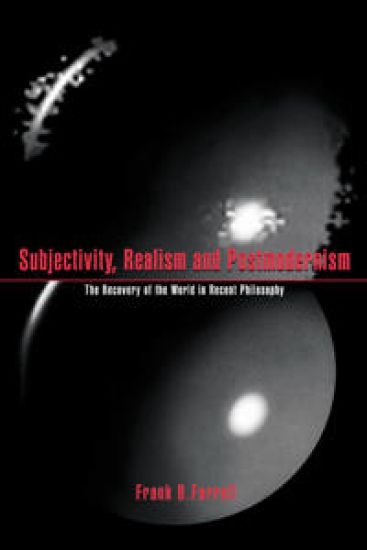
Subjectivity, Realism, and Postmodernism

Subjectivity, Realism, and Postmodernism

Frank B. Farrell

Cambridge University Press
1996
pokkari
This unusually accessible account of recent Anglo-American philosophy focuses on how that philosophy has challenged deeply held notions of subjectivity, mind, and language. The book is designed on a broad canvas in which recent arguments are placed in a historical context (in particular they are related to medieval philosophy and German idealism). The author then explores such topics as mental content, moral realism, realism and antirealism, and the character of subjectivity. Much of the book is devoted to an investigation of Donald Davidson's philosophy, and there is also a sustained critique of the position of Richard Rorty. A final chapter defends the realist position against objections from postmodern thought. As a rigorous and historically sensitive account of recent philosophy, this book should enjoy a wide readership among philosophers of many different persuasions, literary theorists, and social scientists who have been influenced by postmodern thought.
Why Does Literature Matter?

Why Does Literature Matter?

Frank B. Farrell

Cornell University Press
2004
sidottu
"Literature matters because... it allows for experiences important to the living out of a sophisticated and satisfying human life; because other arenas of culture cannot provide them to the same degree; and because a relatively small number of texts carry out these functions in so exceptional a manner that we owe it to past and future members of the species to keep such texts alive in our cultural traditions."—from Chapter One Frank B. Farrell defends a rich conception of the space of literature that retains its links to issues of self-formation and metaphysics and does not let that space collapse into just another reflection of social space. He maintains that recent literary theory has badly misread findings in the philosophy of language and the theory of subjectivity. That misreading, Farrell says, has tended to endorse ways of understanding literature that make one question why it matters at all. Farrell here opposes some recent theoretical trends and, through a mix of philosophical and literary studies, tells us why in his view literature does truly matter.Among the writers Farrell discusses are John Ashbery, Samuel Beckett, Amit Chaudhuri, Cormac McCarthy, James Merrill, Marcel Proust, Thomas Pynchon, Salman Rushdie, W. G. Sebald, and John Updike. The philosophers important to his arguments include Donald Davidson, Daniel Dennett, and Bernard Williams; G. W. F. Hegel, Martin Heidegger, Friedrich Nietzsche, and Ludwig Wittgenstein play roles as well. Among the literary theorists addressed are Stephen Greenblatt, Paul de Man, and Marjorie Perloff. In addition to his close readings of literary, philosophical, and critical texts, Farrell considers cultural studies and postcolonial studies more generally and speculates on the possible contributions of object-relations theory in psychology to the study of literature.
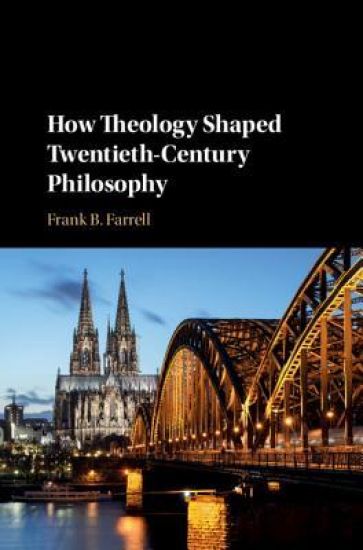
How Theology Shaped Twentieth-Century Philosophy

How Theology Shaped Twentieth-Century Philosophy

Frank B. Farrell

Cambridge University Press
2019
sidottu
Medieval theology had an important influence on later philosophy which is visible in the empiricisms of Russell, Carnap, and Quine. Other thinkers, including McDowell, Kripke, and Dennett, show how we can overcome the distorting effects of that theological ecosystem on our accounts of the nature of reality and our relationship to it. In a different philosophical tradition, Hegel uses a secularized version of Christianity to argue for a kind of human knowledge that overcomes the influences of late-medieval voluntarism, and some twentieth-century thinkers, including Benjamin and Derrida, instead defend a Jewish-influenced notion of the religious sublime. Frank B. Farrell analyzes and connects philosophers of different eras and traditions to show that modern philosophy has developed its practices on a terrain marked out by earlier theological and religious ideas, and considers how different philosophers have both embraced, and tried to escape from, those deep-seated patterns of thought.
How Theology Shaped Twentieth-Century Philosophy

How Theology Shaped Twentieth-Century Philosophy

Frank B. Farrell

Cambridge University Press
2021
pokkari
Medieval theology had an important influence on later philosophy which is visible in the empiricisms of Russell, Carnap, and Quine. Other thinkers, including McDowell, Kripke, and Dennett, show how we can overcome the distorting effects of that theological ecosystem on our accounts of the nature of reality and our relationship to it. In a different philosophical tradition, Hegel uses a secularized version of Christianity to argue for a kind of human knowledge that overcomes the influences of late-medieval voluntarism, and some twentieth-century thinkers, including Benjamin and Derrida, instead defend a Jewish-influenced notion of the religious sublime. Frank B. Farrell analyzes and connects philosophers of different eras and traditions to show that modern philosophy has developed its practices on a terrain marked out by earlier theological and religious ideas, and considers how different philosophers have both embraced, and tried to escape from, those deep-seated patterns of thought.