Kirjojen hintavertailu. Mukana 11 244 527 kirjaa ja 12 kauppaa.

Kirjahaku

Etsi kirjoja tekijän nimen, kirjan nimen tai ISBN:n perusteella.

8 kirjaa tekijältä Frank Lambert

Battle of Ole Miss: Civil Rights v. States' Rights

Battle of Ole Miss: Civil Rights v. States' Rights

Frank Lambert

Oxford University Press
2010
nidottu
James Meredith broke the color barrier in 1962 as the first African American student at Ole Miss. The violent riot that followed would be one of the most deadly clashes of the civil rights era, seriously wounding scores of U.S. Marshals and killing two civilians, and forcing the federal government to send thousands of soldiers to restore the peace.
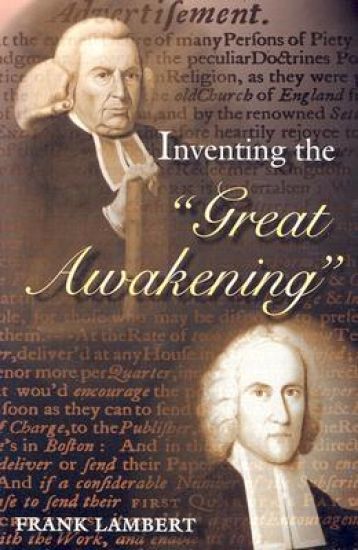
Inventing the "Great Awakening"

Inventing the "Great Awakening"

Frank Lambert

Princeton University Press
2001
pokkari
This book is a history of an astounding transatlantic phenomenon, a popular evangelical revival known in America as the first Great Awakening (1735-1745). Beginning in the mid-1730s, supporters and opponents of the revival commented on the extraordinary nature of what one observer called the "great ado," with its extemporaneous outdoor preaching, newspaper publicity, and rallies of up to 20,000 participants. Frank Lambert, biographer of Great Awakening leader George Whitefield, offers an overview of this important episode and proposes a new explanation of its origins. The Great Awakening, however dramatic, was nevertheless unnamed until after its occurrence, and its leaders created no doctrine nor organizational structure that would result in a historical record. That lack of documentation has allowed recent scholars to suggest that the movement was "invented" by nineteenth-century historians. Some specialists even think that it was wholly constructed by succeeding generations, who retroactively linked sporadic happenings to fabricate an alleged historic development. Challenging these interpretations, Lambert nevertheless demonstrates that the Great Awakening was invented--not by historians but by eighteenth-century evangelicals who were skillful and enthusiastic religious promoters. Reporting a dramatic meeting in one location in order to encourage gatherings in other places, these men used commercial strategies and newly popular print media to build a revival--one that they also believed to be an "extraordinary work of God." They saw a special meaning in contemporary events, looking for a transatlantic pattern of revival and finding a motive for spiritual rebirth in what they viewed as a moral decline in colonial America and abroad. By examining the texts that these preachers skillfully put together, Lambert shows how they told and retold their revival account to themselves, their followers, and their opponents. His inquiries depict revivals as cultural productions and yield fresh understandings of how believers "spread the word" with whatever technical and social methods seem the most effective.
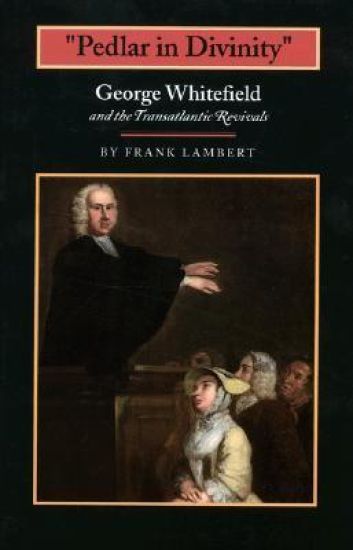
"Pedlar in Divinity"

"Pedlar in Divinity"

Frank Lambert

Princeton University Press
2002
pokkari
A pioneer in the commercialization of religion, George Whitefield (1714-1770) is seen by many as the most powerful leader of the Great Awakening in America: through his passionate ministry he united local religious revivals into a national movement before there was a nation. An itinerant British preacher who spent much of his adult life in the American colonies, Whitefield was an immensely popular speaker. Crossing national boundaries and ignoring ecclesiastical controls, he preached outdoors or in public houses and guild halls. In London, crowds of more than thirty thousand gathered to hear him, and his audiences exceeded twenty thousand in Philadelphia and Boston. In this fresh interpretation of Whitefield and his age, Frank Lambert focuses not so much on the evangelist's oratorical skills as on the marketing techniques that he borrowed from his contemporaries in the commercial world. What emerges is a fascinating account of the birth of consumer culture in the eighteenth century, especially the new advertising methods available to those selling goods and services--or salvation. Whitefield faced a problem similar to that of the new Atlantic merchants: how to reach an ever-expanding audience of anonymous strangers, most of whom he would never see face-to-face. To contact this mass "congregation," Whitefield exploited popular print, especially newspapers. In addition, he turned to a technique later imitated by other evangelists such as Dwight L. Moody, Billy Sunday, and Billy Graham: the deployment of advance publicity teams to advertise his coming presentations. Immersed in commerce themselves, Whitefield's auditors appropriated him as a well-publicized English import. He preached against the excesses and luxuries of the spreading consumer society, but he drew heavily on the new commercialism to explain his mission to himself and to his transatlantic audience.
The Founding Fathers and the Place of Religion in America

The Founding Fathers and the Place of Religion in America

Frank Lambert

Princeton University Press
2006
pokkari
How did the United States, founded as colonies with explicitly religious aspirations, come to be the first modern state whose commitment to the separation of church and state was reflected in its constitution? Frank Lambert explains why this happened, offering in the process a synthesis of American history from the first British arrivals through Thomas Jefferson's controversial presidency. Lambert recognizes that two sets of spiritual fathers defined the place of religion in early America: what Lambert calls the Planting Fathers, who brought Old World ideas and dreams of building a "City upon a Hill," and the Founding Fathers, who determined the constitutional arrangement of religion in the new republic. While the former proselytized the "one true faith," the latter emphasized religious freedom over religious purity. Lambert locates this shift in the mid-eighteenth century. In the wake of evangelical revival, immigration by new dissenters, and population expansion, there emerged a marketplace of religion characterized by sectarian competition, pluralism, and widened choice. During the American Revolution, dissenters found sympathetic lawmakers who favored separating church and state, and the free marketplace of religion gained legal status as the Founders began the daunting task of uniting thirteen disparate colonies. To avoid discord in an increasingly pluralistic and contentious society, the Founders left the religious arena free of government intervention save for the guarantee of free exercise for all. Religious people and groups were also free to seek political influence, ensuring that religion's place in America would always be a contested one, but never a state-regulated one. An engaging and highly readable account of early American history, this book shows how religious freedom came to be recognized not merely as toleration of dissent but as a natural right to be enjoyed by all Americans.
Religion in American Politics

Religion in American Politics

Frank Lambert

Princeton University Press
2010
pokkari
The delegates to the 1787 Constitutional Convention blocked the establishment of Christianity as a national religion. But they could not keep religion out of American politics. From the election of 1800, when Federalist clergymen charged that deist Thomas Jefferson was unfit to lead a "Christian nation," to today, when some Democrats want to embrace the so-called Religious Left in order to compete with the Republicans and the Religious Right, religion has always been part of American politics. In Religion in American Politics, Frank Lambert tells the fascinating story of the uneasy relations between religion and politics from the founding to the twenty-first century. Lambert examines how antebellum Protestant unity was challenged by sectionalism as both North and South invoked religious justification; how Andrew Carnegie's "Gospel of Wealth" competed with the anticapitalist "Social Gospel" during postwar industrialization; how the civil rights movement was perhaps the most effective religious intervention in politics in American history; and how the alliance between the Republican Party and the Religious Right has, in many ways, realized the founders' fears of religious-political electoral coalitions. In these and other cases, Lambert shows that religion became sectarian and partisan whenever it entered the political fray, and that religious agendas have always mixed with nonreligious ones. Religion in American Politics brings rare historical perspective and insight to a subject that was just as important--and controversial--in 1776 as it is today.
The Barbary Wars

The Barbary Wars

Frank Lambert

HILL WANG INC.,U.S.
2007
pokkari
Traces the history of America's conflict with the piratical states of the Mediterranean and North Africa, the construction of a full-time professional Navy during the early Republic, the nation's gradual move toward commercial independence, and the Barbary Wars, arguing that America's earliest conflict with the Arab world represented a struggle for economic advantage. Reprint.
James Habersham

James Habersham

Frank Lambert

University of Georgia Press
2012
pokkari
James Habersham was an early American success story. After arriving in Savannah in 1738, he failed in his efforts to wrest a living from the Georgia wilderness and lived his first year at public expense. Then, by dint of his own efforts and through the connections he forged, Habersham emerged as one of the colony's most influential and prosperous citizens, making his name as a planter, merchant, evangelist, and political leader. The third wealthiest person in the colony at the time of his death in 1775, Habersham had a public career that included service as the secretary of Georgia, president of the King's council, and acting Governor.But Habersham's story is more than biography. It also provides a window into colonial Georgia and its transformation from a struggling colony on the brink of collapse in the 1740s to a prosperous province in the 1770s, confident enough to defy the Crown. Ranging over such topics as the rise of Methodist missionary fervor, the development of transatlantic trade, the introduction of slavery, and the escalating debate over American independence, Frank Lambert tells how Habersham's success is inextricably tied to Georgia's fortunes and how he played a major role in helping the colony exploit its abundant resources. Habersham's economic development plan provided a blueprint for attracting new settlers, supplying an abundance of cheap labor, and opening new markets.Habersham's achievements, however, are obscured by his unpopular stance on American independence. While his three sons distinguished themselves as Patriots, Habersham remained loyal to the Crown, though he had opposed Britain's new imperial policies in the 1760's. Nevertheless, it was Habersham's loyal service to colonial Georgia that enabled the colony to separate successfully from the mother country and assume its place in the new republic as a prosperous, vigorous state.
Pittas, Broadbills and Asities

Pittas, Broadbills and Asities

Frank Lambert

BLOOMSBURY PUBLISHING PLC
2025
sidottu
The complete guide to these jewels of the tropical Old World undergrowthInhabiting tropical and subtropical forests of the Old World, pittas, broadbills and asities include some of the most beautiful, elusive and sought-after birds on the planet. Pittas are medium-sized, insectivorous terrestrial birds that are rather thrushlike in their behaviour. Most are brilliantly coloured, generally solitary, and have a well-deserved reputation for secretive, skulking habits, adding to the challenge of seeing them in their often dark environment. The 52 species of pitta largely occur from Asia through Wallacea to New Guinea and Australia, with two (perhaps three) species in Africa.Broadbills are very different to pittas, being typically chunky birds with large heads, broad flattened beaks and short legs. The majority are colourful and sociable, but none are terrestrial. Three are highly frugivorous, but the others are largely insectivorous. They form a diverse group of 18 species in nine genera, of which four species are confined to Africa, with the rest in Asia. The four species of asities form an endemic Madagascan family. Two species are similar to broadbills, but the other two resemble sunbirds, even in their feeding habits. Breeding males have facial wattles (as do two broadbill species). The first monograph of these three groups was published in 1996; this book, by the same author, is its follow-up. Completely revised and updated, it draws together a wealth of material from the literature and from online and unpublished sources to provide the ultimate reference to these fascinating birds, from taxonomy and identification to habitat requirements, biology and ecology, accompanied by a stunning photographic selection, and the art of Martin Woodcock.