
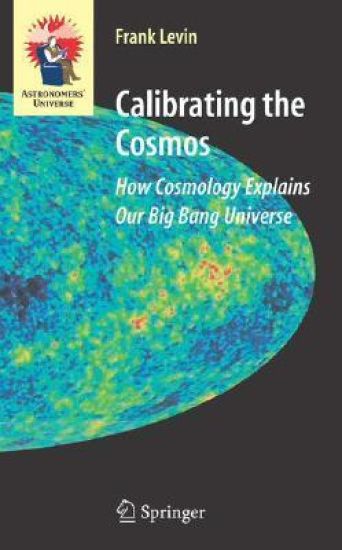
Calibrating the Cosmos describes hard science, but is gently written. It explains in clear, non-mathematical language the measurements and the interpretation of the resulting data that have led to the current understanding of the origin, evolution and properties of our expanding Big Bang universe. Many people have a sketchy idea of the work of cosmologists, but Professor Levin’s experience in teaching both scientific and liberal arts students has enabled him to impart much of our current thinking without resorting to difficult mathematics. Theoretical concepts are emphasized, in particular the symmetries of homogeneity and isotropy enjoyed by our universe on the largest scales, how these symmetries lead to only one quantity being needed to describe the growth of the universe from its infancy to the present time, and how the so-called parameters of the universe are the ingredients used to construct the model universes to which ours – the real thing – is compared. Levin includes the 2003 results from the Wilkinson Microwave Anisotropy Probe (WMAP) and the 2003 and 2004 results of the Sloan Digital Sky Survey to ensure that the book is up to date. He explains the relevance of the discoveries done by the new physics Nobel laureates Smoot and Mather! Background material is provided in the first four chapters; the current picture and how it was attained are discussed in the next four chapters; and some unsolved problems and conjectured solutions are explored in the final chapter.
