Kirjojen hintavertailu. Mukana 11 699 587 kirjaa ja 12 kauppaa.

Kirjahaku

Etsi kirjoja tekijän nimen, kirjan nimen tai ISBN:n perusteella.

3 kirjaa tekijältä Frank Markham Brown

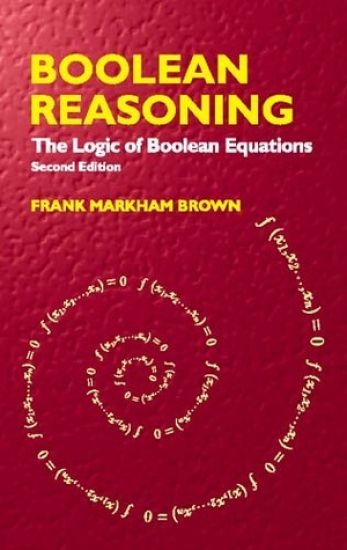
Boolean Reasoning

Boolean Reasoning

Frank Markham Brown

Dover Publications Inc.
2003
nidottu
A systematic treatment of Boolean reasoning, this concise, newly revised edition combines the works of early logicians with recent investigations, including previously unpublished research results. Brown begins with an overview of elementary mathematical concepts and outlines the theory of Boolean algebras. Two concluding chapters deal with applications. 1990 edition.
Boolean Reasoning

Boolean Reasoning

Frank Markham Brown

Springer
1990
sidottu
This book is about the logic of Boolean equations. Such equations were central in the "algebra of logic" created in 1847 by Boole [12, 13] and devel­ oped by others, notably Schroder [178], in the remainder of the nineteenth century. Boolean equations are also the language by which digital circuits are described today. Logicians in the twentieth century have abandoned Boole's equation­ based logic in favor of the more powerful predicate calculus. As a result, digital engineers-and others who use Boole's language routinely-remain largely unaware of its utility as a medium for reasoning. The aim of this book, accordingly, is to is to present a systematic outline of the logic of Boolean equations, in the hope that Boole's methods may prove useful in solving present-day problems. Two Logical Languages Logic seeks to reduce reasoning to calculation. Two main languages have been developed to achieve that object: Boole's "algebra of logic" and the predicate calculus. Boole's approach was to represent classes (e. g. , happy creatures, things productive of pleasure) by symbols and to represent logical statements as equations to be solved. His formulation proved inadequate, however, to represent ordinary discourse. A number of nineteenth-century logicians, including Jevons [94], Poretsky [159], Schroder [178], Venn [210], and Whitehead [212, 213], sought an improved formulation based on ex­ tensions or modifications of Boole's algebra. These efforts met with only limited success.
Boolean Reasoning

Boolean Reasoning

Frank Markham Brown

Springer-Verlag New York Inc.
2012
nidottu
This book is about the logic of Boolean equations. Such equations were central in the "algebra of logic" created in 1847 by Boole [12, 13] and devel­ oped by others, notably Schroder [178], in the remainder of the nineteenth century. Boolean equations are also the language by which digital circuits are described today. Logicians in the twentieth century have abandoned Boole's equation­ based logic in favor of the more powerful predicate calculus. As a result, digital engineers-and others who use Boole's language routinely-remain largely unaware of its utility as a medium for reasoning. The aim of this book, accordingly, is to is to present a systematic outline of the logic of Boolean equations, in the hope that Boole's methods may prove useful in solving present-day problems. Two Logical Languages Logic seeks to reduce reasoning to calculation. Two main languages have been developed to achieve that object: Boole's "algebra of logic" and the predicate calculus. Boole's approach was to represent classes (e. g. , happy creatures, things productive of pleasure) by symbols and to represent logical statements as equations to be solved. His formulation proved inadequate, however, to represent ordinary discourse. A number of nineteenth-century logicians, including Jevons [94], Poretsky [159], Schroder [178], Venn [210], and Whitehead [212, 213], sought an improved formulation based on ex­ tensions or modifications of Boole's algebra. These efforts met with only limited success.