Kirjojen hintavertailu. Mukana 11 627 373 kirjaa ja 12 kauppaa.

Kirjahaku

Etsi kirjoja tekijän nimen, kirjan nimen tai ISBN:n perusteella.

12 kirjaa tekijältä Frank O'Hara

The Collected Poems of Frank O'Hara

The Collected Poems of Frank O'Hara

Frank O'Hara

University of California Press
2026
nidottu
Winner of the National Book Award for Poetry "During the halcyon days of the Abstract Expressionist and Imaginative Realism movements, Frank O'Hara was the laureate of the New York art scene."--New York Times The Collected Poems of Frank O'Hara, edited by Donald Allen and with an introduction by John Ashbery, captures the full range of one of postwar America's most original and influential poets. Born in Massachusetts in 1926, O'Hara became the quintessential voice of mid-century Manhattan, evolving a witty, mercurial, and glamorous urban poetry that captured the artistic scene of 1950s to '60s New York. Including poems from his dazzling early experimental verses of the late 1940s to his more reflective work before his untimely death at the age of forty, the collection reveals O'Hara's inventive voice, blending French post-symbolism, surrealist, and Dada techniques and the everyday American experience into a uniquely postmodern poetics. First published posthumously in 1972, this landmark collection affirms Frank O'Hara's central place in American poetry: witty, fantastical, vital.
Selected Poems: Frank O'Hara

Selected Poems: Frank O'Hara

Frank O'Hara

Carcanet Press Ltd
2005
nidottu
Frank O'Hara (1926-66) is among the most delightful and radical poets of the twentieth century. He is celebrated for his apparently unpremeditated poems, autobiographical and immediate ('any time, any place'). This is not the whole O'Hara: he may have scribbled poems on serviettes, but others he worked on with intense concentration, creating sequences that are inexhaustibly nuanced, full of surprise, heartbreak and laughter. There are analogies between his work and that of the painters he championed, Pollock, Kline and de Kooning among them. He is resolutely metropolitan, and his metropolis is New York City. He brilliantly captured the pace and rhythms, quandaries and exhilarations, of its mid-twentieth-century life.
Lunch Poems

Lunch Poems

Frank O'Hara

City Lights Books
2001
pokkari
Important poems by the late New York poet published in The New American Poetry, Evergreen Review, Floating Bear and stranger places. Often this poet, strolling through the noisy splintered glare of a Manhattan noon, has paused at a sample Olivetti to type up thirty or forty lines of ruminations, or pondering more deeply has withdrawn to a darkened ware- or firehouse to limn his computed misunderstandings of the eternal questions of life, coexistence, and depth, while never forgetting to eat lunch, his favorite meal. "O'Hara speaks directly across the decades to our hopes and fears and especially our delights; his lines are as intimate as a telephone call. Few books of his era show less age." --Dwight Garner, New York Times "As collections go, none brings...quality to the fore more than the thirty-seven Lunch Poems, published in 1964 by City Lights." --Nicole Rudick, The Paris Review "What O'Hara is getting at is a sense of the evanescence, and the power, of great art, that inextricable contradiction -- that what makes it moving and transcendent is precisely our knowledge that it will pass away. This is the ethos at the center of "Lunch Poems": not the informal or the conversational for their own sake but rather in the service of something more intentional, more connective, more engaged." --David L. Ulin, Los Angeles TImes "The collection broadcasts snark, exuberance, lonely earnestness, and minute-by-minute autobiography to a wide, vague audience--much like today's Twitter and Facebook feeds." --Micah Mattix, The Atlantic Among the most significant post-war American poets, Frank O'Hara grew up in Grafton, MA, graduating from Harvard in 1950. After earning an MA at Michigan in 1951, O'Hara moved to New York, where he began working for the Museum of Modern Art and writing for Art News. By 1960, he was named Assistant Curator of Painting and Sculpture Exhibitions at MOMA. Along with John Ashbery, Kenneth Koch, James Schuyler, and Barbara Guest, he is considered an original member of the New York School. Though he died in a tragic accident in 1966, recent references to O'Hara on TV shows like Mad Men or Thurston Moore's new single evidence our culture's continuing fascination with this innovative poet.
Poems Retrieved

Poems Retrieved

Frank O'Hara

City Lights Books
2013
pokkari
Originally published under Donald Allen's classic Grey Fox Press imprint, Poems Retrieved is a substantial part of Frank O'Hara's oeuvre, containing over two hundred pages of previously unpublished poetry discovered after the publication of his posthumous Collected Poems in 1971. Featuring a new introduction by O'Hara expert and friend, poet and art critic Bill Berkson, Retrieved has been completely reformatted and is essential for any reader of twentieth century poetry. As Berkson writes, "The breadth of what Frank O'Hara took to be poetry is reflected in the many kinds of poems he wrote...Turning the pages of any of his collections, you wonder what he didn't turn his hand to, what variety of poem he left untried or didn't, in some cases, as if in passing, anticipate." Among the most significant post-war American poets, Frank O'Hara grew up in Grafton, Massachusetts, graduating from Harvard in 1950. After earning an MA at the University of Michigan in 1951, O'Hara moved to New York, where he began working for the Museum of Modern Art and writing for Art News. By 1960, he was named the assistant curator of painting and sculpture exhibitions at MOMA. Along with John Ashbery, Kenneth Koch, James Schuyler, and Barbara Guest, he is considered an original member of the New York School. Though he died in a tragic accident in 1966, recent references to O'Hara on TV shows like Mad Men or Thurston Moore's new record evidence our culture's continuing fascination with this innovative poet.
Second Avenue

Second Avenue

Frank O'Hara

Literary Licensing, LLC
2012
sidottu
""Second Avenue"" is a novel by Frank O'Hara that follows the lives of a group of young artists and writers living in New York City in the 1950s. The story centers around a young man named Kenneth Koch, who is struggling to find his place in the world and make a name for himself as a poet. Along the way, he falls in love with a beautiful dancer named Jane and becomes friends with a group of eccentric characters, including a painter, a musician, and a playwright. As they navigate the ups and downs of life in the city, they must confront their own insecurities, desires, and fears. With its vivid descriptions of New York's bohemian scene and its exploration of the creative process, ""Second Avenue"" is a compelling and insightful portrait of a generation of artists trying to find their way in the world.""This scarce antiquarian book is a facsimile reprint of the old original and may contain some imperfections such as library marks and notations. Because we believe this work is culturally important, we have made it available as part of our commitment for protecting, preserving, and promoting the world's literature in affordable, high quality, modern editions, that are true to their original work.
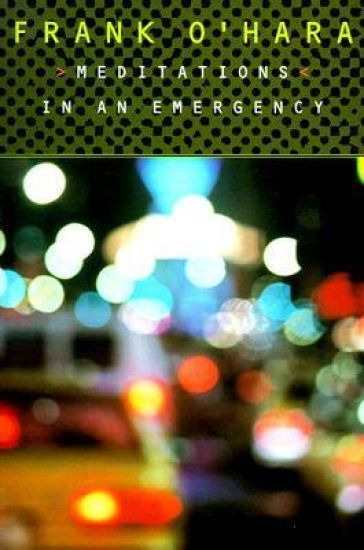
Meditations in an Emergency

Meditations in an Emergency

Frank O'Hara

GROVE PRESS / ATLANTIC MONTHLY PRESS
2022
sidottu
Frank O'Hara was one of the great poets of the twentieth century and, along with such widely acclaimed writers as Denise Levertov, Allen Ginsberg, Robert Creeley and Gary Snyder, a crucial contributor to what Donald Allen termed the New American Poetry, 'which, by its vitality alone, became the dominant force in the American poetic tradition.'Frank O'Hara was born in Baltimore in 1926 and grew up in New England; from 1951 he lived and worked in New York, both for Art News and for the Museum of Modern Art, where he was an associate curator. O'Hara's untimely death in 1966 at the age of forty was, in the words of fellow poet John Ashbery, 'the biggest secret loss to American poetry since John Wheelwright was killed.'This collection is a reissue of a volume first published by Grove Press in 1957, and it demonstrates beautifully the flawless rhythm underlying O'Hara's conviction that to write poetry, indeed to live, 'you just go on your nerve.'
Why I am Not a Painter and Other Poems

Why I am Not a Painter and Other Poems

Frank O'Hara

Carcanet Press Ltd
2003
nidottu
Frank O'Hara (1926-66) composed poems 'any time, any place', collaborating with and inspired by a circle of artists, musicians and poets, immersed in the creative life of New York. For O'Hara, the city was a place of possibility, both disorientating and exciting, and his poems have an immediacy that draws its energies from the pace and rhythms of city life, and from the contemporary artforms of jazz, film and painting. It is this openness to experience that makes O'Hara an indispensable poet of the imaginative experience of the modern city. Reviewing this new selection in the Guardian, Charles Bainbridge wrote: 'Frank O'Hara is a wonderful poet - funny, moving, chatty, engaging, enthusiastic, risk-taking, elegiac, supremely urban - and anything that encourages people to read him is a good thing. His poems have a disarming intimacy, a kind spontaneous enthusiasm and his work proves, with tremendous elan and energy, that you don't have to adopt a solemn tone in order to write poetry of seriousness and purpose. As O'Hara himself says of the nature of writing in the brilliantly comic "Personism: A Manifesto": "You just go on your nerve. If someone's chasing you down the street with a knife you just run, you don't turn around and shout, 'Give it up! I was a track star for Mineola Prep'." '
Lunchdikter

Lunchdikter

Frank O'Hara

Rámus Förlag
2015
nidottu
1964 sammanställde Frank O'Hara de dikter han under ett decennium nedtecknat, ofta i hast och på språng. Lunchdikter var färdigställd och därmed en av den moderna amerikanska lyrikens allra viktigaste och mest inflytelserika diktsamlingar. Frank O'Hara föddes 1926 och dog allt för tidigt efter en trafikolycka 1966. Han räknas som nyckelmedlem i New York-skolans första generation. O'Hara arbetade på MoMa i New York och skrev många av dessa dikter på sina lunchraster. I Jonas Bruns översättning utkommer nu Lunchdikter för första gången på svenska, lika aktuell idag som när den först gavs ut, med förord av John Ashbery och efterord av översättaren.