Kirjojen hintavertailu. Mukana 12 390 941 kirjaa ja 12 kauppaa.

Kirjahaku

Etsi kirjoja tekijän nimen, kirjan nimen tai ISBN:n perusteella.

4 kirjaa tekijältä Frank Rosengarten

The Writings of the Young Marcel Proust (1885-1900)

The Writings of the Young Marcel Proust (1885-1900)

Frank Rosengarten

Peter Lang Publishing Inc
2001
sidottu
This book offers a comprehensive analysis of young Proust's evolving conception of the world, from his early friendships and educational experiences in the 1880s to the turn of the twentieth century. It looks in detail at his early fictional and critical writings, his associations with various literary periodicals, and the social milieus in which he moved. Its primary purpose is to understand Proust as a worldly figure with concrete attitudes and ideas about such issues as social class, the relationship between art and society, the responsibilities of the writer, and the debate between materialism and idealism as seen in the context of mid- to late-nineteenth-century thought.
Urbane Revolutionary

Urbane Revolutionary

Frank Rosengarten

University Press of Mississippi
2010
nidottu
In Urbane Revolutionary: C.L.R. James and the Struggle for a New Society, Frank Rosengarten traces the intellectual and political development of C.L.R. James (1901-1989), one of the most significant Caribbean intellectuals of the twentieth century. In his political and philosophical commentary, his histories, drama, letters, memoir, and ficion, James broke new ground dealing with the fundamental issues of his age-colonialism and post-colonialism, Soviet socialism and western neo-liberal capitalism, and the uses of race, class, and gender as tools for analysis. The author examines the in depth three facets of James's work: his interpretation and use of Marxist, Trotskyist, and Leninist concepts; his approach to Caribbean and African struggles for independence in the 1950s and 1960s; and his branching into prose fiction, drama, and literary criticism. Rosengarten analyzes James's previously underexplored relationships with women and with the women's liberation movement. The study also scrutinizes James's methods of research and writing. Rosengarten explores James's provocative and influential concepts regarding black liberation in the Caribbean, Africa, the United States, and Great Britain and James's varying responses to revolutionary movements. With its extensive use of unpublished letters, private correspondence, papers, books, and other documents, Urbane Revolutionary provides fresh insights into the work of one of the twentieth century's most important intellectuals and activists. Frank Rosengarten is professor emeritus of Italian and comparative literature at the City University of New York. He is the author of The Writings of the Young Marcel Proust (1885-1900): An Ideological Critique and The Italian Anti-Fascist Press, 1919-1945.
Revolutionary Marxism Of Antonio Gramsci

Revolutionary Marxism Of Antonio Gramsci

Frank Rosengarten

Haymarket Books
2015
nidottu
In The Revolutionary Marxism of Antonio Gramsci, Frank Rosengarten explores Gramsci's writings in areas as diverse as Marxist theory, the responsibilities of political leadership and the theory and practice of literary criticism. He also discusses Gramsci's influence on the post-colonial world. Through close readings of texts ranging from Gramsci's socialist journalism in the Turin years to his prison letters and famous Notebooks (1948), Rosengarten captures the full vitality of Antonio Gramsci's thought and outlook on life.
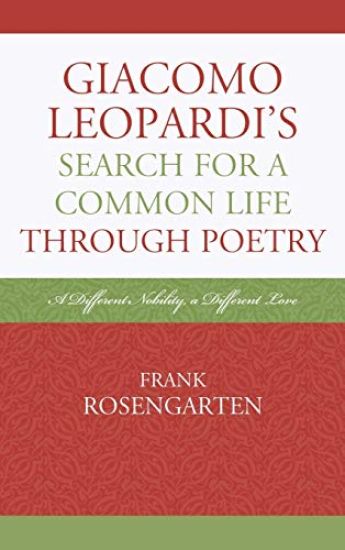
Giacomo Leopardi’s Search For a Common Life Through Poetry

Giacomo Leopardi’s Search For a Common Life Through Poetry

Frank Rosengarten

Fairleigh Dickinson University Press
2012
sidottu
This book traces the life of Giacomo Leopardi by examining four different yet interrelated aspects: his social origins and class in relation to his evolving conception of nobility; the mixture of idealism and misogynism in his attitude toward women and in his conception of love; his poems and prose on the theme of Italian independence; and his philosophical materialism as expressed in his poetry, intellectual diary, and essays. Frank Rosengarten pays particular attention to the ways in which the thought of Arthur Schopenhauer and Friedrich Nietzsche illuminates Leopardi’s world view. He also devotes a section of the book to the different personal, moral, and philological components of Leopardi’s humanism. Throughout, he maintains a sharp focus on the connections between Leopardi’s life and the historical period in which he lived. The major themes and human concerns expressed in Leopardi’s writings relate to his life experiences and to the historical period in which he lived. Of central interest are nobility and love, since Leopardi’s perception of these two themes evolved and changed as he acquired a more general and universal conception of life. This fascinating combination of classical and modern perspectives on life and literature is highlighted throughout the book.