Kirjojen hintavertailu. Mukana 11 244 527 kirjaa ja 12 kauppaa.

Kirjahaku

Etsi kirjoja tekijän nimen, kirjan nimen tai ISBN:n perusteella.

13 kirjaa tekijältä Franz Wright

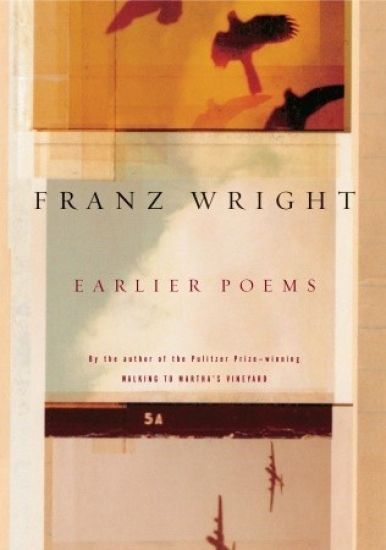
Earlier Poems of Franz Wright

Earlier Poems of Franz Wright

Franz Wright

Alfred A. Knopf
2009
pokkari
The haunting collection of poems that gathers the first four books of Pulitzer winner Franz Wright under one cover, where "fans old and new will find a feast amid famine" (Publishers Weekly), and discover how large this poet's gift was from the start.
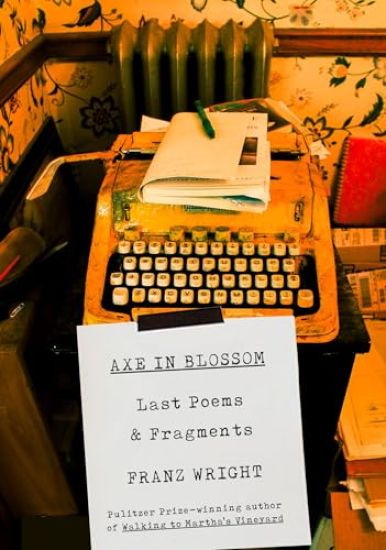
Axe in Blossom: Last Poems & Fragments

Axe in Blossom: Last Poems & Fragments

Franz Wright

Knopf Publishing Group
2026
sidottu
The Pulitzer Prize winner's final written work: poems of penetrating acceptance and humor, whose soul-sweeping gaze encompasses his own autobiography and the broken world he nonetheless gives thanks for "His hands strip poetry to its nub." --Los Angeles Times "Reading Wright] is like walking through a plate-glass window on purpose. . . . The shattering sound you heard was your own heart breaking." --Chicago Tribune "My death is in the second drawer," writes Franz Wright. "While you're standing there, would you mind getting me one?" It is a thrill to be back in these cadences, in his world of exquisite solitude, as he ponders becoming a ghost and returning to a childhood room where, he says, "I won't have written any of it. / I will have back the rights / of anonymity," and there is nothing left that anyone can take from him. Wright's significant themes shine forth: radical acceptance of his own pain, mental illness, and loss; his belief in the poem's ability to rhyme with the mysteries of our worldly suffering; his nearly surreal vision of Christian grace. But most powerful for readers will be the tender force of his imagery--the "green vesperal rain at the screen," the "long Jeffersonian / $2-bill- / tinted twilight"--and, as he invites us to join him in his nicatorium, the smoking-porch of recovering addicts, the joy of finding this black-humorous voice still alive on the page to meet us.
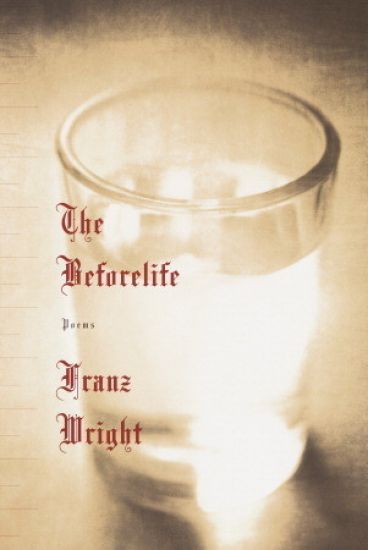
The Beforelife

The Beforelife

Franz Wright

Random House USA Inc
2002
pokkari
In this stunning collection, Franz Wright chronicles the journey back from a place of isolation and wordlessness. After a period when it seemed certain he would never write poetry again, he speaks with bracing clarity about the twilit world that lies between madness and sanity, addiction and recovery. Wright negotiates the precarious transition from illness to health in a state of skeptical rapture, discovering along the way the exhilaration of love--both divine and human--and finding that even the most battered consciousness can be good company. Whether he is writing about his regret for the abortion of a child, describing the mechanics of slander ("I can just hear them on the telephone and keening all their kissy little knives"), or composing an ironic ode to himself ("To a Blossoming Nut Case"), Wright's poems are exquisitely precise. Charles Simic has characterized him as a poetic miniaturist, whose "secret ambition is to write an epic on the inside of a matchbook cover." Time and again, Wright turns on a dime in a few brief lines, exposing the dark comedy and poignancy of his heightened perception. Here is one of the poems from the collection: Description of Her Eyes Two teaspoonfuls, and my mind goeseveryone can kiss my ass now-- then it's changed, I change my mind. Eyes so sad, and infinitely kind.
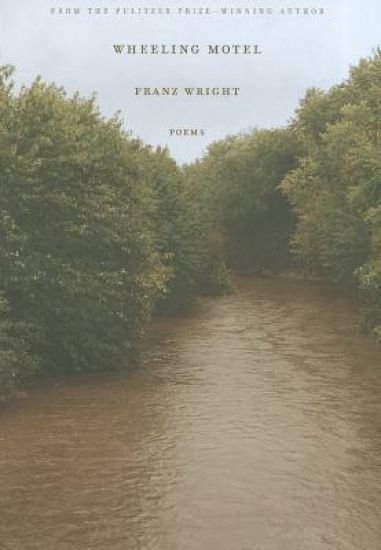
Wheeling Motel

Wheeling Motel

Franz Wright

Random House Inc
2011
pokkari
In his tenth collection of poetry, Franz Wright gives us an exquisite book of reconciliation with the past and acceptance of what may come in the future. From his earliest years, he writes in "Will," he had "the gift of impermanence / so I would be ready, / accompanied / by a rage to prove them wrong / . . . and that I too was worthy of love." This rage comes coupled with the poet's own brand of love, what he calls "one / strange alone / heart's wish / to help all / hearts." Poetry is indeed Wright's help, and he delivers it to us with a wry sense of the daily in America: in his wonderfully local relationship to God (whom he encounters along with a catfish in the emerald shallows of Walden Pond); in the little West Virginia motel of the title poem, on the banks of the great Ohio River, where "Tammy Wynette's on the marquee" and he is visited by the figure of Walt Whitman, "examining the tear on a dead face." Here, in Wheeling Motel, Wright's poetry continues to surprise us with its frank appraisal of our soul, and with his own combustible loneliness and unstoppable joy.
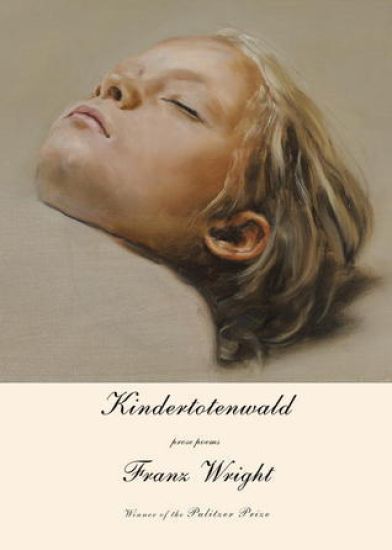
Kindertotenwald

Kindertotenwald

Franz Wright

Random House Inc
2013
pokkari
A genre-bending collection of prose poems from Pulitzer Prize-winner Franz Wright brings us surreal tales of childhood, adolescence, and adult awareness, moving from the gorgeous to the shocking to a sense of peace. Wright's most intimate thoughts and images appear before us in dramatic and spectral short narratives: mesmerizing poems whose colloquial sound and rhythms announce a new path for this luminous and masterful poet. In these journeys, we hear the constant murmured "yes" of creation--"it will be packing its small suitcase soon; it will leave the keys dangling from the lock and set out at last," Wright tells us. He introduces us to the powerful presences in his world (the haiku master Basho, Nietzsche, St. Teresa of Avila, and especially his father, James Wright) as he explores the continually unfolding loss of childhood and the mixed blessings that follow it. Taken together, the pieces deliver the diary of a poet--"a fairly good egg in hot water," as he describes himself--who seeks to narrate his way through the dark wood of his title, following the crumbs of language. "Take everything," Wright suggests, "you can have it all back, but leave for a little the words, of all you gave the most mysteriously lasting." With a strong presence of the dramatic in every line, Kindertotenwald pulls us deep into this journey, where we too are lost and then found again with him.
F

F

Franz Wright

Random House Inc
2016
pokkari
In these riveting poems, Wright declares, "I've said all that / I had to say. / In writing. / I signed my name. / It's death's move." As he considers his mortality, the poet finds a new elation and clarity on the page, handing over for our examination the flawed yet kneeling-in-gratitude self he has become. F stands both for Franz, the poet-speaker who represents all of us on our baffling lifelong journeys, and for the alphabet, the utility and sometimes brutality of our symbols. (It may be, he jokes grimly, his "grade in life.") From "Entries of the Cell," the long central poem that details the loneliness of the single soul, to short narrative prose poems and traditional lyrics, Wright revels in the compensatory power of language, observing the daytime headlights following a hearse, or the wind, "blessing one by one the unlighted buds of the backbent peach tree's unnoted return." He is at his best in this beautiful and startling collection.
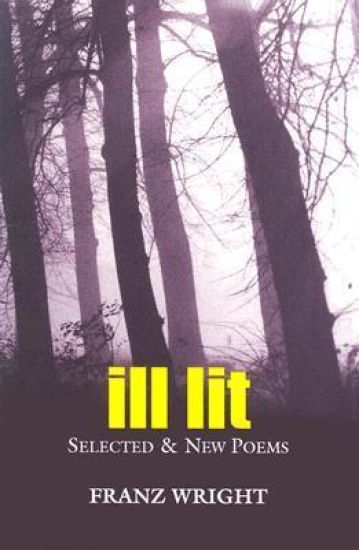
Ill Lit

Ill Lit

Franz Wright

Oberlin College Press
1998
nidottu
Franz Wright was recognized as one of the leading poets of his generation even before he won the 2004 Pulitzer Prize. His voice and sensibility are distinctive, and the places he goes are ones where not many writers are able or willing to venture. The dark world of his poems, which face many of the hardest truths we must learn to live with, is lit by humor, tenderness, compassion, and honesty. For this edition, the poet has selected from the best of his previous collections, in some cases making substantial revisions, and has added his newest poems. The resulting collection is exciting in its breadth, consistency, depth, and distinction.
Leave Me Hidden

Leave Me Hidden

Franz Wright

Marick Press
2010
nidottu
Poetry. Poets speak metaphorically of poets of previous generations as their spiritual and artistic parents or grandparents. For Franz Wright, this is literally true: his father, James Wright, was one of the most influential American poets of the latter half of the twentieth century. In this book Franz Wright is more intimate than ever before. His collection is a description of the struggle with the demons associated with following in the lineage of a great poet. We can find more of Wright himself in this collection, more of his identity, a grown up man who finally conquers the stigma of living in the shadow of his father. The memories of James Wright are clear and vivid but not a torment. In poems like "Recurring Dream," "Admonitions To Self," "The Future," "Untitled Poem in Three Parts," Franz Wright steps into a new phase of his own writing, he is more accessible to the reader and lets us pick and choose among his hopes and reflections. He alternates between memories of his family and present experiences in a rental apartment. He reveals the splendor and grandiosity of a friendship in the short poem "The Future" where we find a generous man taking care of a fallen friend.
7Prose

7Prose

Franz Wright

Marick Press
2010
nidottu
Literary Nonfiction. Marick Press is happy to be publisher of Franz Wright's very first book of prose, some of it narrative, some of it dramatic, some of it highly lyrical, and much of it verging on the unclassifiable. This chapbook of seven of his prose pieces presages the publication by Knopf of Kindertotenwald, his collection of sixty-five prose pieces, in October of 2011. Those familiar with Wright's work will find many of the preoccupations and obsessions of his lyric poems present in his prose, but presented in a looser, more improvisatory and experimental form.
Entries of the Cell

Entries of the Cell

Franz Wright

Marick Press
2010
nidottu
Poetry. ENTRIES OF THE CELL is some of Franz Wright's best writing in years. "The cell will teach you all things" is a saying of some early Christians who, in the third century, bewildered to find that no matter what they did and no matter how powerful their faith, the new world they dreamed of far too closely resembled the irreparably corrupt old world. Their remedy to this dilemma was to withdraw from the cities of their time into the desolate solitude in which they found God's presence perpetually closer and more available to them. The saying has been adopted by the Society of the Brotherhood of St. John the Evangelist where, at their Cambridge branch, T. S. Eliot attended services while teaching at Harvard in the thirties. Dedicated to Franz Wright's friend Palestinian poet Fady Joudah good husband, dad, emergency room MD in Houston and American translator of Mahmoud Darwish the book is a single poem. Its title is meant to suggest all kinds of cells body, jail, but primarily the cell in the sense of the small functional bare room in which a monk prays, studies and sleeps."