Kirjojen hintavertailu. Mukana 12 083 983 kirjaa ja 12 kauppaa.

Kirjahaku

Etsi kirjoja tekijän nimen, kirjan nimen tai ISBN:n perusteella.

3 kirjaa tekijältä Frauke Berndt

Poema / Gedicht

Poema / Gedicht

Frauke Berndt

de Gruyter
2011
sidottu
An den unbegrifflichen Stellen literarischer Texte werden Alexander Gottlieb Baumgarten und Friedrich Gottlieb Klopstock auf das ganz eigene, durch nichts anderes zu ersetzende Vermogen sinnlicher Zeichen und Bilder bei der menschlichen Selbst- und Welterschlieung aufmerksam. Zwischen 1730 und 1770 entsteht dabei eine Position in der Wissensordnung, an der das Denken, Konnen, Handeln, Sollen und Wollen der Literatur epistemisch begrundet wird. Indem sowohl Philosoph als auch Dichter die kognitive wie mediale Komplexitat des so genannten Gedichts (poema) ausloten, rucken sie die Literatur von den unscharfen Randern der Wissensordnung in deren zentrales Sichtfeld. Baumgarten halt das Gedicht fur die Protoform der sinnlichen Erkenntnis, deren Systematik er medientheoretisch, metaphysisch und ethisch ausarbeitet. Fur Klopstock wird das Gedicht zum exklusiven Medium immanenter Transzendenz. Dass Gott und Liebe - die beiden sinnstiftenden Systeme der Moderne - nur noch im Gedicht erfahren werden konnen, zeigen die exemplarischen Lekturen des religiosen Versepos Der Messias und der anakreontischen Ode Das Rosenband. Am Schluss der Studie steht ein Ausblick auf die Symboltheorien des 18. und 19. Jahrhunderts, die das Erbe der epistemischen Konfiguration 'Poema/Gedicht' antreten.
Facing Poetry

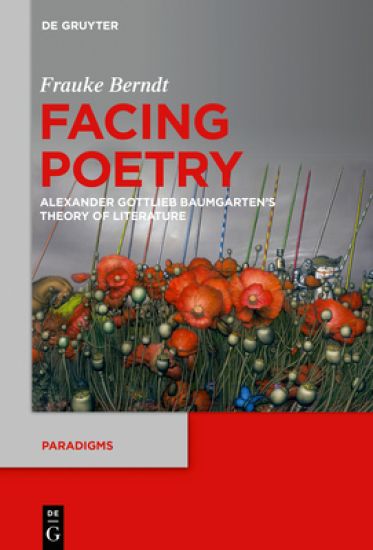
Facing Poetry

Frauke Berndt

De Gruyter
2020
sidottu
Alexander Gottlieb Baumgarten (1714–1762) is known in intellectual history for having established the discourse of philosophical aesthetics with his "Meditationes philosophicae de nonnullis ad poema pertinentibus" (Reflections on Poetry) and "Aesthetica" (Aesthetics), which consists of two books and is considered Baumgarten’s most important work. But this book amends that history. It shows that Baumgarten's aesthetics is a science of literature that demonstrates the value of literature to philosophy. Baumgarten did not intend to pursue such a task, but in working on his philosophical texts and lectures, he ends up analyzing, synthesizing, and contextualizing literature. He thereby treats it not as belles lettres or as a moral institution but rather as an epistemic object. His aesthetics is thus the first modern literary theory, and his articulation of this theory would never again be matched in its complexity and systematicity. Baumgarten’s theory of literature has never been discovered. It waits latently to take its place in intellectual history.
Anamnesis

Anamnesis

Frauke Berndt

de Gruyter
1999
sidottu
The life-stories of problematic central figures as recounted in Moritz' -Anton Reiser-, Keller's -Der grune Heinrich- and Raabe's -Akten des Vogelsangs- serve as a basis for mapping out ambitiously extensive topologies of memory. Behind the narrative -I remember- ploy, topologically structured models of the cultural organization and imaging of knowledge are discernible. Literary com-memoration makes one thing clear: prior to any kind of individual materialization, memory requires an archive of images to draw on, an archive containing the rhetorical formulas of both mythological and christological initiation narratives as well as of iconography. The literary figuration of -modern- memory thus calls for reexamination and reevaluation."