Kirjojen hintavertailu. Mukana 12 016 292 kirjaa ja 12 kauppaa.

Kirjahaku

Etsi kirjoja tekijän nimen, kirjan nimen tai ISBN:n perusteella.

6 kirjaa tekijältä Fred Goodman

Allen Klein: The Man Who Bailed Out the Beatles, Made the Stones, and Transformed Rock & Roll
"Fred Goodman makes this world come alive, and any fan of rock or insider tales of the music industry will be in heaven reading about this fascinating, troubling character." -- Judd Apatow, Omnivoracious "Writing about contracts, percentages, and deals can be tedious, but Goodman makes it as exciting as reading about an artist's sex life. The book explodes with inside dope." --New York Daily News Allen Klein was like no one the music industry had seen before. Though he became infamous for allegedly causing the Beatles' breakup and robbing the Rolling Stones, the truth is both more complex and more fascinating. As the manager of the Stones and then the Beatles--not to mention Sam Cooke, Pete Townshend, Donovan, the Kinks, and numerous others--he taught young soon-to-be legends how to be businessmen as well as rock stars. While Klein made millions for his clients, he was as merciless with them as he was with anyone, earning himself an outsize reputation for villainy that has gone unchallenged until now. Through unique, unprecedented access to Klein's archives, veteran music journalist Fred Goodman tells the full story of how the Beatles broke up, how the Stones achieved the greatest commercial success in rock history, and how the music business became what it is today. "Fred Goodman is a superb writer . . . and his account here of one of rock 'n' roll's most polarizing figures could not be more readable. The even-handed tone, the supposition that readers are moderately intelligent and sophisticated, and the rather astounding involvement Allen Klein had with pop music's largest legends--put all that together, and you've got one highly engrossing read." --Yahoo Music "Succeed s] both as a compelling work of rock 'n' roll history and as a cautionary business primer." --Wall Street Journal
The Mansion on the Hill: Dylan, Young, Geffen, Springsteen, and the Head-on Collision of Rock and Commerce
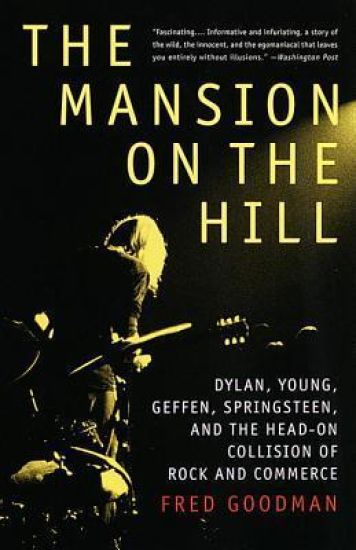
In 1964, on the brink of the British Invasion, the music business in America shunned rock and roll. There was no rock press, no such thing as artist management -- literally no rock-and-roll business. Today the industry will gross over $20 billion. How did this change happen? From the moment Pete Seeger tried to cut the power at the 1965 Newport Folk Festival debut of Bob Dylan's electric band, rock's cultural influence and business potential have been grasped by a rare assortment of ambitious and farsighted musicians and businessmen. Jon Landau took calls from legendary producer Jerry Wexler in his Brandeis dorm room and went on to orchestrate Bruce Springsteen's career. Albert Grossman's cold-eyed assessment of the financial power at his clients' fingertips made him the first rock manager to blaze the trail that David Geffen transformed into a superhighway. Dylan's uncanny ability to keep his manipulation of the business separate from his art and reputation prefigured the savvy -- and increasingly cynical -- professionalism of groups like the Eagles. Fred Goodman, a longtime rock critic and journalist, digs into the contradictions and ambiguities of a generation that spurned and sought success with equal fervor. The Mansion on the Hill, named after a song title used by Hank Williams, Neil Young, and Bruce Springsteen, breaks new ground in our understanding of the people and forces that have shaped the music.
Fortune's Fool

Fortune's Fool

Fred Goodman

Simon Schuster
2014
pokkari
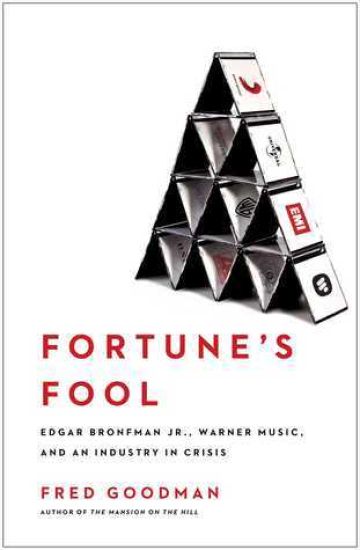
In 1999, when Napster made music available free online, the music industry found itself in a fight for its life. A decade later, the most important and misunderstood story—and the one with the greatest implications for both music lovers and media companies—is how the music industry has failed to remake itself. In Fortune’s Fool, Fred Goodman, the author of The Mansion on the Hill, shows how this happened by presenting the singular history of Edgar M. Bronfman Jr., the controversial heir to Seagram’s, who, after dismantling his family’s empire and fortune, made a high-stakes gamble to remake both the music industry and his own reputation. Napster had successfully blown the industry off its commercial foundations because all that the old school label heads knew how to do was record and market hits. So when Bronfman took over the Warner Music Group in 2004, his challenge was to create a new kind of record executive. Goodman finds the source of the crisis in the dissolution of the old Warner Music Group, the brilliant conglomerate of Atlantic, Elektra, and Warner Bros. Records. He shows how Doug Morris, the head of Atlantic Records, rose through the ranks and rode the CD bonanza of the 1990s to enormous corporate and personal profit before becoming embroiled in an ego-driven corporate turf war, and how all of Warner’s record executives were blindsided when AOL/Time-Warner announced in 2003 that it wanted nothing more to do with the record industry. When the music group was finally sold to Bronfman, it was a ghost of itself. Bronfman built an aggressive, streamlined team headed by Lyor Cohen, whose relentless ambition and discipline had helped build Def Jam Records. They instituted a series of daring initiatives intended to give customers legitimate online music choices and took market share from Warner’s competitors. But despite these efforts, illegal downloads still outnumber legitimate ones 19–1. Most of the talk of a new world of music and media has proven empty; despite the success of iTunes, even wildly popular sites like YouTube and MySpace have not found a way to make money with music. Instead, Warner and the other labels are diversifying and forcing young artists to give them a cut of their income from touring, publishing, and merchandising. Meanwhile, the average downloader isn’t even meeting forward-thinking musicians halfway. Each time a young band finds a following through music websites, it’s a unique story; no formula has emerged. If one does, Warner is probably in a better position than anyone to exploit it. But at the end of the day, If is the one-word verdict on Bronfman’s big bet.
Why Lhasa de Sela Matters

Why Lhasa de Sela Matters

Fred Goodman

University of Texas Press
2019
nidottu
An artist in every sense of the word, Lhasa de Sela wowed audiences around the globe with her multilingual songs and spellbinding performances, mixing together everything from Gypsy music to Mexican rancheras, Americana and jazz, chanson française, and South American folk melodies. In Canada, her album La Llorona won the Juno Award and went gold, and its follow-up, The Living Road, won a BBC World Music Award. Tragically, de Sela succumbed to breast cancer in 2010 at the age of thirty-seven after recording her final album, Lhasa.Tracing de Sela’s unconventional life and introducing her to a new generation, Why Lhasa de Sela Matters is the first biography of this sophisticated creative icon. Raised in a hippie family traveling between the United States and Mexico in a converted school bus, de Sela developed an unquenchable curiosity, with equal affinities for the romantic, mystic, and cerebral. Becoming a sensation in Montreal and Europe, the trilingual singer rejected a conventional path to fame, joining her sisters’ circus troupe in France. Revealing the details of these and other experiences that inspired de Sela to write such vibrant, otherworldly music, Why Lhasa de Sela Matters sings with the spirit of this gifted firebrand.