Kirjojen hintavertailu. Mukana 11 244 527 kirjaa ja 12 kauppaa.

Kirjahaku

Etsi kirjoja tekijän nimen, kirjan nimen tai ISBN:n perusteella.

6 kirjaa tekijältä Frederic Faust

Instructions for Armourers: Rifles No. 1, No.2 and No. 3 (Pattern 14)

Instructions for Armourers: Rifles No. 1, No.2 and No. 3 (Pattern 14)

Frederic Faust

Middle Coast Publishing, Incorporated
2015
nidottu
KNOW YOUR RIFLE Reference Notes On Troubleshooting and Repairing: Lee-Enfield No. 1 Mark III (SMLE)andRifle No. 3 (Pattern 14) Rifles This compilation of British War Office notes (circa 1931) provides detailed information on: How to strip and reassemble the rifleStrip and reassemble a boltStrip and reassemble a magazineClean a rusty barrelClear an obstructed boreClean the chamberCheck for correct headspaceReplace a bolt headAdjust trigger pullFit a new strikerFit a new searBlacken sightsFit a new fore-endTroubleshoot misfires This dedicated armourer's text details maintaining and caring for your rifle, from assembly through disassembly, how to make simple fixes to the bolt, magazine, and trigger assembly. It includes critical drawings, such as skeletonized parts breakdowns for each rifle, showing the barreled action replete with the bolt as well as furniture and fittings. Moreover, a chart details each fastener and its thread sizes.This valuable find is a must-have resource for anyone who owns a Lee-Enfield No. 1 Mark III (SMLE) or No. 3 (Pattern 14). Click on the Buy Now button at the top of this page and learn from the primary source, the early 20th-century British Armourers who maintained the British Army's weapons of war.

The Lineage of the Arisaka

The Lineage of the Arisaka

Frederic Faust

Middle Coast Publishing, Incorporated
2016
pokkari
Know your Rifle We recommend this book to anyone who owns one of the Arisaka rifles or is interested in its history and development.The Arisaka family of Japanese military bolt-action service rifles was first issued in 1897, when it replaced the Murata series of rifles, until the end of the Second World War II in 1945. The most common specimens include the Type 38 chambered for the 6.5 50mmSR Type 38 cartridge and the Type 99 chambered for the 7.7 58mm Type 99 cartridge, which was comparable to a modern .308 round. Soldiers brought thousands of Type 99s and other Arisaka variants to the United States as war trophies during and after World War II. Find out about the part played by the rifle's namesake Colonel Arisaka and learn about this esteemed battle rifle's fascinating history and evolution. This book covers the following Arisaka rifles and carbines built at several factories in Japan and China: Type 38 Rifle, adapted in 1905, also known as San-Hachi-Shiki Hoheiju, was produced to supplement the Type 99 standard infantry rifle adopted by the Imperial Japanese Army in 1905 until the end of the Second World War.Murata M-13 was created in 1880, a single-shot rifle that fired a black powder, brass cartridge.Murata M-18, almost identical to M-13 with simplified parts, was used in the Japan-China War of 1889.Murata M-22 features a seven-shot tubular magazine.Type 30 This bolt action uses five round clip developed by General Arisaka.Type 35. Kijiro Nambu's first rifle was produced for the Japanese Navy, based on the M-30 and M-38 rifles.Type 38. Designed by Kijiro Nambu, a classic among original Japanese small arms.Type 38 Carbine. Issued to the cavalry, engineers, quartermasters, and other troops introduced concurrently with the Type 38.Chinese Six/Five Infantry. Chinese copies of the Japanese Type 38 were used from the 1920s into the 1930s.Type 38 Cavalry. Type 38s converted to cavalry rifles at Nagoya arsenal.Type 44 Carbine. When viewed from the middle and back resembles the Type 38 Carbine.Type 97. The scoped sniper rifle was introduced in 1937 and founded on Type 38.Type 99. An upgraded version of the M-38 with the same length as the M-38.Type 99 sniper rifle.Type 918, manufactured at the South Manchuria Army Arsenal, are based on Type 38.North China Type 19 Carbines, said to have been manufactured for puppet troops.Generously illustrated with pictures of the rifles. You will find a table of maker's marks (Nagoya, Kokura, Koishikawa et Cetera) in the back of the book.Click the Buy Now button at the top of this page to add this title to your Arisaka library.
Mosin-Nagant M1891

Mosin-Nagant M1891

Frederic Faust

Middle Coast Publishing
2022
pokkari
KNOW YOUR RIFLE This essential book is perfect for someone who has always wanted to own a Mosin-Nagan, or, for that matter, a shooter who already does.Copiously illustrated, its words and pictures tell the lineage of this great infantryman's rifle.Learn the history that brought Imperial Russian's Czar Nicholas II to understand his army needed a new infantry rifle.Learn details of its design and the designer's petty squabbles.Learn the differences between the numerous variants.Learn how to read a Soviet bloc military spam can to find out what's insideLearn how U.S. troops carried the U.S. Rifle, 7.62 mm Model of 1916 in battle against the Bolsheviks.Find out how building this rifle/carbine nearly bankrupt the Remington Arms company.If you own a Mosin-Nagant or are interested in what makes it tick, this essential guide will suit you well. Its words and pictures guide the reader through every procedure required to properly disassemble and then reassemble the weapons. Photographs and illustrations support the detailed textual information.This great book on Mosin-Nagants boasts a wealth of knowledge. Printed in large format (8.5 X 11) for better image clarity, it is a must-have for military firearms collection.
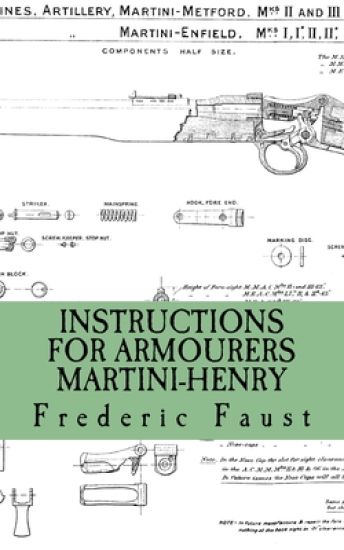
Instructions for Armourers - Martini-Henry

Instructions for Armourers - Martini-Henry

Frederic Faust

Middle Coast Publishing, Incorporated
2016
pokkari
Know your rifleLearn from the primary source how 19th century British Armourers cared for and repaired the British Army's Martini-Henrys and Martini-Enfields.Critical coverage includes: Disassembly and reassembly of the action.How to adjust breech block height for smoother operation.How to tune trigger pull-off.Details for stripping the stock, barrel and action.Illustrated
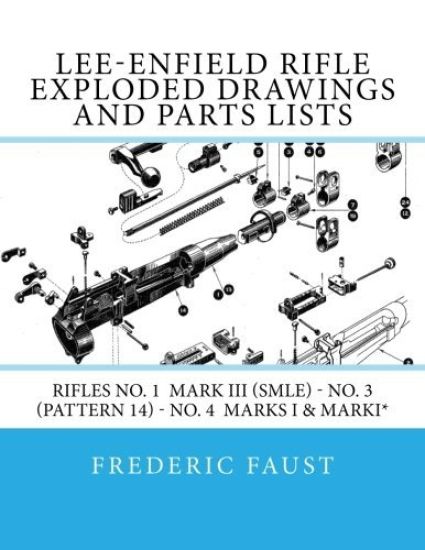
Lee-Enfield Rifle Exploded Drawings and Parts Lists

Lee-Enfield Rifle Exploded Drawings and Parts Lists

Frederic Faust

Middle Coast Publishing, Incorporated
2017
pokkari
Know your Rifle We recommend this book for anyone who has a Lee-Enfield rifle for the way it shows phantom parts drawings, lists each part and gives its Ministry of Defence part number. It is copiously illustrated. More particularly, this book covers the following rifles: Lee-Enfield Rifles No. 1 Mark III (the venerable SMLE)The Enfield No. 3 (Pattern 14)Rifle No. 4 Mark I and Mark I*Use this book to aid in disassembly and re-assembly and learn the proper nomenclature for a particular part.The No. 1 MARK III, affectionately known as the SMLE, was built at Royal Enfield in England and Lithgow in Australia.The Lee-Enfield Rifle Number 4 Mark I was built in England at a number of factories: Namely, the Royal Ordnance Factory, Fazakerley, the Royal Ordnance Factory, Maltby, and finally the Birmingham Small Arms Company an expedient wartime variation, the Lee-Enfield Rifle Number 4 Mark I* was built in Canada at the Long Branch Arsenal and in the United States of America, by Savage at Chicopee Falls, Massachusetts.Many military firearms aficionados consider Rifle No. 4s (all makes and marks) to be the best bolt action rifles fielded during World War II.This guide's diagrams are clear and informative. Copiously illustrated, phantom drawings of the various models of Lee-Enfield SMLE and the Pattern 14 Enfield show in great detail all assemblies and parts. Each part is identified by name and number.Besides the rifles proper, also illustrated are all of the necessary accessories: Bayonets, sling, and issue cleaning components, including the oil bottle, bore pull-through, and wire gauze.This collection of drawings and parts lists is highly recommended for anyone wanting a breakdown of the internal workings of their venerable rifle. It is beneficial for identifying missing parts when rebuilding a sporterized rifle.This book is printed in large format (8 X 10) for easier viewing of the schematic drawings.Click the Buy Now button at the top of this page to add this title to your Lee-Enfield library.Nota bene: This book does not cover the Lee-Enfield 2A rifle (7.62 mm NATO caliber), built at Ishapore, India.
Lee-Enfield Rifle No. 4: Phantom Parts Diagrams and Parts Listing

Lee-Enfield Rifle No. 4: Phantom Parts Diagrams and Parts Listing

Frederic Faust

Middle Coast Publishing, Incorporated
2017
nidottu
Know Your Rifle We recommend this book for anyone who has a Lee-Enfield rifle for the way it shows phantom parts drawings, lists each individual part and gives its Ministry of Defence part number. Copiously illustrated, it is especially helpful for identifying missing parts when rebuilding a sporterized rifle. The Lee-Enfield Rifle Number 4 Mark I* was built in Canada at the Long Branch Arsenal Many military firearms aficionados consider this old warhorse to be the best of all the Lee-Enfield variants fielded during the Second World War. Besides parts identification lists, detailing by illustration, descriptive part name and part number, for all parts of the Rifle, .303 Calibre, Lee -Enfield, No 4, Mark 1 *, this book also lists associated equipment including the bayonet, frog, action cover, wire gauze and pull-through and clearly shows the parts breakdown for each item of kit. Furthermore, parts are listed in top-down breakdown sequence showing major assemblies, sub-assemblies, and component parts. The relationship of each part to the next higher assembly is shown by indentation of the part name in the description column. Restated for emphasis: This book only covers the Canadian and Savage No. 4 Mark I* and not the British manufactured No. 4 Mark I and 2.