Kirjojen hintavertailu. Mukana 11 244 527 kirjaa ja 12 kauppaa.

Kirjahaku

Etsi kirjoja tekijän nimen, kirjan nimen tai ISBN:n perusteella.

22 kirjaa tekijältä Frederick Taylor

The Principles of Scientific Management, by Frederick Taylor
Read the American classic that inspired Shigeo Shingo! Frederick W. Taylor's The Principles of Scientific Managementwas a mental revolution that spawned the very ideas of process improvement, equity and efficiency between workers and management, and the attainability of high production with low labor costs. Taylor discusses eliminating waste by using the system he developed over the course of his career and how it applies to individual, as well as collective, improvement initiatives. As the basis of modern organizational efficiency, this instrumental book has motivated managers and engineers for almost 100 years.
Shop Management, by Frederick Taylor
With the growth of Lean into all sectors of manufacturing and service industries around the globe, a survey into the origins of Lean becomes vital. As English economist Maynard Keynes once said, "ideas shape the course of history," and Frederick Taylor's ideas still shape the course of history well after a century of use. Shop Management is a living lesson that shows how an innovative idea will adapt in order to survive. The purpose of Enna's Lean Origin Series is to facilitate that adaptation by publishing classic texts that are relevant to today's business needs.
Dresden: Tuesday, February 13, 1945

Dresden: Tuesday, February 13, 1945

Frederick Taylor

HARPER PERENNIAL
2005
nidottu
"A picture markedly different from conventional accounts." --New York Times Book ReviewThe dramatic and controversial account that completely re-examines the Allied attack on Dresden For decades it has been assumed that the Allied bombing of Dresden was militarily unjustifiable, an act of rage and retribution for Germany's ceaseless bombing of London and other parts of England.In Dresden, Frederick Taylor's groundbreaking research offers a completely new examination of the facts, and reveals that Dresden was a highly-militarized city actively involved in the production of military armaments and communications concealed beneath the cultural elegance for which the city was famous. Incorporating first-hand accounts, contemporaneous press material and memoirs, and never-before-seen government records, Taylor documents unequivocally the very real military threat Dresden posed, and thus altering forever our view of that attack.
1939: A People's History of the Coming of the Second World War
In the autumn of 1938, Europe believed in the promise of peace. But only a year later, the fateful decisions of just a few men had again led Europe to a massive world war. Drawing on contemporary diaries, memoirs, and newspapers, as well as recorded interviews, 1939 is a narrative account of what the coming of the Second World War felt like to those who lived through it.Frederick Taylor, author of renowned histories of the Berlin Wall and the bombing of Dresden, highlights the day-to-day experiences of ordinary citizens as well as those who were at the height of power in Germany and Britain. Their voices lend an intimate flavor to this often-surprising account of the period and reveal a marked disconnect between government and people, for few people in either country wanted war. 1939 is a vivid and richly peopled narrative of Europe's slide into the horrors of war and a powerful warning for our own time.
Dresden

Dresden

Frederick Taylor

Bloomsbury Publishing PLC
2005
nidottu
At 9.51 p.m. on Tuesday 13 February 1945, Dresden's air-raid sirens sounded as they had done many times during the Second World War. But this time was different. By the next morning, more than 4,500 tons of high explosives and incendiary devices had been dropped on the unprotected city. At least 25,000 inhabitants died in the terrifying firestorm and thirteen square miles of the city's historic centre, including incalculable quantities of treasure and works of art, lay in ruins. In this portrait of the city, its people, and its still-controversial destruction, Frederick Taylor has drawn on archives and sources only accessible since the fall of the East German regime, and talked to Allied aircrew and survivors, from members of the German armed services and refugees fleeing the Russian advance to ordinary citizens of Dresden.
The Berlin Wall Lib/E: A World Divided: 1961-1989
"This vivid account of the Wall and all that it meant reminds us that symbolism can be double-edged, as a potent emblem of isolation and repression became, in its destruction, an even more powerful totem of freedom." -- The Atlantic MonthlyNOW WITH AN UPDATED EPILOGUE 30 YEARS AFTER THE FALL OF THE WALLOn the morning of August 13, 1961, the residents of East Berlin found themselves cut off from family, friends, and jobs in the West by a tangle of barbed wire that ruthlessly split a city of four million in two. Within days the barbed-wire entanglement would undergo an extraordinary metamorphosis: it became an imposing 103-mile-long wall guarded by three hundred watchtowers. A physical manifestation of the struggle between Soviet Communism and American capitalism that stood for nearly thirty years, the Berlin Wall was the high-risk fault line between East and West on which rested the fate of all humanity.In the definitive history on the subject, Frederick Taylor weaves together official history, archival materials, and personal accounts to tell the complete story of the Wall's rise and fall.
1939: A People's History of the Coming of the Second World War
In the autumn of 1938, Europe believed in the promise of peace. But only a year later, the fateful decisions of just a few men had again led Europe to a massive world war. Drawing on contemporary diaries, memoirs, and newspapers, as well as recorded interviews, 1939 is a narrative account of what the coming of the Second World War felt like to those who lived through it.Frederick Taylor, author of renowned histories of the Berlin Wall and the bombing of Dresden, highlights the day-to-day experiences of ordinary citizens as well as those who were at the height of power in Germany and Britain. Their voices lend an intimate flavor to this often-surprising account of the period and reveal a marked disconnect between government and people, for few people in either country wanted war. 1939 is a vivid and richly peopled narrative of Europe's slide into the horrors of war and a powerful warning for our own time.
The Berlin Wall

The Berlin Wall

Frederick Taylor

Bloomsbury Publishing PLC
2009
nidottu
The appearance of a hastily-constructed barbed wire entanglement through the heart of Berlin during the night of 12-13 August 1961 was both dramatic and unexpected. Within days, it had started to metamorphose into a structure that would come to symbolise the brutal insanity of the Cold War: the Berlin Wall. A city of almost four million was cut ruthlessly in two, unleashing a potentially catastrophic East-West crisis and plunging the entire world for the first time into the fear of imminent missile-borne apocalypse. This threat would vanish only when the very people the Wall had been built to imprison, breached it on the historic night of 9 November 1989. The Berlin Wall reveals the strange and chilling story of how the initial barrier system was conceived, then systematically extended, adapted and strengthened over almost thirty years. Patrolled by vicious dogs and by guards on shoot-to-kill orders, the Wall, with its more than 300 towers, became a wired and lethally booby-trapped monument to a world torn apart by fiercely antagonistic ideologies. The Wall had tragic consequences in personal and political terms, affecting the lives of Germans and non-Germans alike in a myriad of cruel, inhuman and occasionally absurd ways. The Berlin Wall is the definitive account of a divided city and its people.
Exorcising Hitler

Exorcising Hitler

Frederick Taylor

Bloomsbury Publishing PLC
2012
nidottu
The first major history of what happened in Germany immediately after the Second World War‘Frederick Taylor is one of the brightest historians writing today.' Newsweek'Taylor's book is popular history at its best, essential reading for anyone who is interested in the Nazis and wants to know what happened next.' New Statesman Germany had entered the twentieth century united, prosperous, and strong, admired by almost all humanity for its remarkable achievements. By 1945 it was a broken shell: its great cities lay in ruins and its shattered industries and cultural heritage seemed utterly beyond saving. The Germans themselves had come to be regarded as evil monsters. After six years of warfare how were the exhausted victors to handle the end of a horror that to most people seemed without precedent?In Exorcising Hitler, Frederick Taylor tells the story of Germany's year zero and what came after. As he describes the final Allied campaign, the hunting down of the Nazi resistance, the vast displacement of peoples in central and eastern Europe, the attitudes of the conquerors, the competition between Soviet Russia and the West, the hunger and near starvation of a once proud people, the initially naive attempt at expunging Nazism from all aspects of German life and the later more pragmatic approach, we begin to understand that despite almost total destruction, a combination of conservatism, enterprise and pragmatism in relation to former Nazis enabled the economic miracle of the 1950s. And we see how it was only when the '60s generation (the children of the Nazi era) began to question their parents with increasing violence that Germany began to awake from its 'sleep cure'.
The Downfall of Money

The Downfall of Money

Frederick Taylor

Bloomsbury Publishing PLC
2014
nidottu
A timely narrative account of the biggest financial crisis in modern history and its human consequences by the author of Dresden and The Berlin Wall.'Excellent … This is a dramatic story, well told' Wall Street JournalMany theorists believed a hundred years ago, just as they did at the beginning of our twenty-first century, that the world had reached a state of economic perfection, a never before seen condition of beneficial human interdependence that would lead to universal growth and prosperity. And yet the early years of the Weimar Republic in Germany witnessed the most complete and terrifying unravelling of a major country's financial system to have occurred in modern times. The story of the Weimar Republic's financial crisis has a clear resonance in the second decade of the twenty-first century, when the world is anxious once more about what money is, what it means and how we can judge if its value is true. The Downfall of Money will tell anew the dramatic story of the hyperinflation that saw the once-solid German mark, worth 4.2 to the dollar in 1914, trading at over four trillion by the autumn of 1923. It is a trajectory of events uncomfortably relevant for today's uncertain world. The Downfall of Money will reveal the real causes of the crisis, what this collapse meant to ordinary people, and also trace its connection to Germany's subsequent catastrophic political history. By drawing on a wide range of sources and making sense for the general reader of the vast amount of specialist research that has become available in recent decades, it will provide a timely, fresh and surprising look at this chilling period in history.
Coventry

Coventry

Frederick Taylor

Bloomsbury Publishing PLC
2016
nidottu
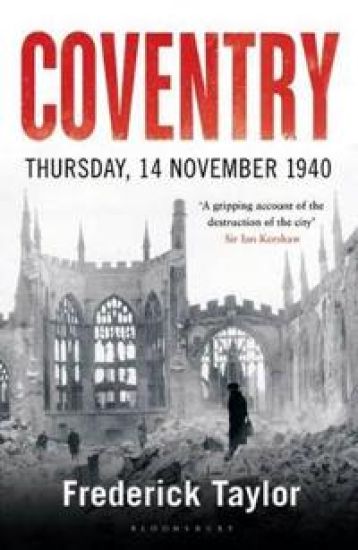
Serving as a companion volume to Frederick Taylor's acclaimed Dresden, this is the definitive account of the bombing of Coventry, England on November 14 1940.At a few minutes past seven on the evening of Thursday, November 14 1940, the historic industrial city of Coventry was subjected to the longest, most devastating air raid England had yet experienced. Only after eleven hours of continual bombardment by the German Luftwaffe could its people emerge from their half-sunk Anderson shelters and their cellars, from under their stairs or kitchen tables, to venture up into their wounded city. That long night of destruction marked a critical moment in the Second World War. It heralded a new kind of air warfare, one which abandoned the pursuit of immediate military goals and instead focused on obliterating all aspects of city life. It also provided the push America needed to join Britain in the war. But while the Coventry raid was furiously condemned publicly, such effective enemy tactics provided Britain's politicians and military establishment with a 'blueprint for obliteration', to be adapted and turned against Germany. A merciless four-year war of attrition had begun.In this important work of history, Frederick Taylor draws upon numerous sources, including eye witness interviews from the archives of the BBC which are published here for the first time, to reveal the true repercussions of the bombing of Coventry in 1940. He teases out the truth behind the persistent rumors and conspiracy theories that Winston Churchill knew the raid was coming, assesses this significant turning point in modern warfare, looks at how it affected England's status in the war, and considers finally whether this attack really could provide justification for the horror of Dresden, 1945.
Pomp

Pomp

Frederick Taylor

AuthorHouse
2004
pokkari
Whatever happened to Sacagawea's son? His mother became a legend. But the infant boy who also made the hazardous 1,900-mile journey to Oregon with the Lewis and Clark Expedition nearly disappeared from sight after their return. Yet he
1939

1939

Frederick Taylor

Picador
2020
pokkari
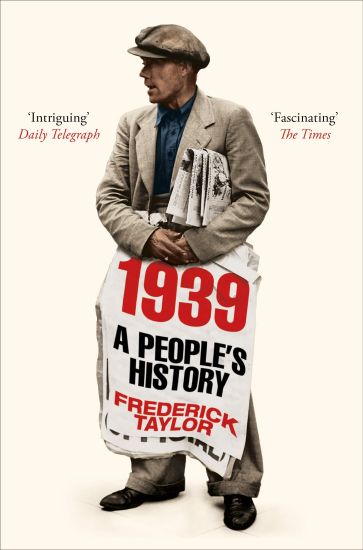
‘Taylor has done us a great service in making the personal stories of what it was actually like to live through the most crucial year of the twentieth century vivid, compelling and salutary.’ - Roland Philipps, author of A Spy Named Orphan: The Enigma of Donald MacleanIn the autumn of 1938, Europe believed in the promise of peace. Still reeling from the ravages of the Great War, its people were desperate to rebuild their lives in a newly safe and stable era. But only a year later, the fateful decisions of just a few men had again led Europe to war, a war that would have a profound and lasting impact on millions.Bestselling historian Frederick Taylor focuses on the day-to-day experiences of British and German people trapped in this disastrous chain of events and not, as is so often the case, the elite. Drawn from original sources, their voices, concerns and experiences reveal a marked disconnect between government and people; few ordinary citizens in either country wanted war.1939: A People’s History is not only a vivid account of that turbulent year but also an interrogation of our capacity to go to war again. In many ways it serves as a warning; an opportunity for us to learn from our history and a reminder that we must never take peace for granted.
The Berlin Wall

The Berlin Wall

Frederick Taylor

Bloomsbury Publishing PLC
2019
nidottu
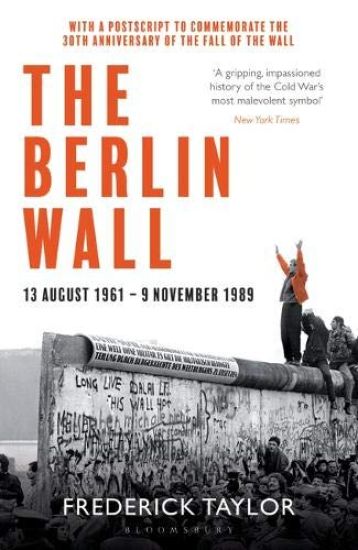
The astonishing drama of Cold War nuclear poker that divided humanity - reissued with a new Postscript to commemorate the thirtieth anniversary of the fall of the wall.During the night of 12–13 August 1961, a barbed-wire entanglement was hastily constructed through the heart of Berlin. It metamorphosed into a structure that would come to symbolise the insanity of the Cold War: the Berlin Wall. Frederick Taylor tells the story of the post-war political conflict that led to a divided Berlin and unleashed an East–West crisis, which lasted until the very people the Wall had been built to imprison breached it on 9 November 1989.Weaving together history, original archive research and personal stories, The Berlin Wall, now published in fifteen languages, is the definitive account of a divided city and its people in a time when humanity seemed to stand permanently on the edge of destruction.