Kirjojen hintavertailu. Mukana 11 342 296 kirjaa ja 12 kauppaa.

Kirjahaku

Etsi kirjoja tekijän nimen, kirjan nimen tai ISBN:n perusteella.

25 kirjaa tekijältä Fritz Machlup

Essays on Hayek

Essays on Hayek

Fritz Machlup

Routledge
2003
sidottu
Varying according to the scope of Hayek's contributions, the papers in this volume include among others: * An affirmation of the "relevance" of Hayek's work * A survey of his contribution to knowledge * An appraisal of Hayek's innovative work on the methodology of the social sciences * A discussion of Hayek's achievements as scholar and mentor The contributors are: Fritz Machlup, Geroge Roche, Arthur Shenfield, Max Hartwell, William Buckley, Gottfried Dietze, Shirley Letwin.
International Monetary Economics

International Monetary Economics

Fritz Machlup

Routledge
2003
sidottu
Containing Fritz Machlup's papers on international finance spanning thirty years, this volume includes pieces translated into English for the first time. Focussing on the theme of the balance of payments, the work is structured as follows: Foreign Exchanges and Balance of Payments, The Effects of Devaluation, Gold and Foreign Reserves, Capital Movements and the Transfer Problem. An introduction to each section by the author is included.
International Monetary Economics

International Monetary Economics

Fritz Machlup

Routledge
2008
nidottu
Containing Fritz Machlup's papers on international finance spanning thirty years, this volume includes pieces translated into English for the first time. Focussing on the theme of the balance of payments, the work is structured as follows: Foreign Exchanges and Balance of Payments, The Effects of Devaluation, Gold and Foreign Reserves, Capital Movements and the Transfer Problem. An introduction to each section by the author is included.
Essays on Hayek

Essays on Hayek

Fritz Machlup

Routledge
2010
nidottu
Varying according to the scope of Hayek's contributions, the papers in this volume include among others: * An affirmation of the "relevance" of Hayek's work * A survey of his contribution to knowledge * An appraisal of Hayek's innovative work on the methodology of the social sciences * A discussion of Hayek's achievements as scholar and mentor The contributors are: Fritz Machlup, Geroge Roche, Arthur Shenfield, Max Hartwell, William Buckley, Gottfried Dietze, Shirley Letwin.
The Production and Distribution of Knowledge in the United States
The Production and Distribution of Knowledge in the United States marked the beginning of the study of our postindustrial information society. Austrian-born economist Fritz Machlup had focused his research on the patent system, but he came to realize that patents were simply one part of a much bigger "knowledge economy." He then expanded the scope of his work to evaluate everything from stationery and typewriters to advertising to presidential addresses--anything that involved the activity of telling anyone anything. The Production and Distribution of Knowledge in the United States then revealed the new and startling shape of the U.S. economy. Machlup's cool appraisal of the data showed that the knowledge industry accounted for nearly 29 percent of the U.S. gross national product, and that 43 percent of the civilian labor force consisted of knowledge transmitters or full-time knowledge receivers. Indeed, the proportion of the labor force involved in the knowledge economy increased from 11 to 32 percent between 1900 and 1959--a monumental shift. Beyond documenting this revolution, Machlup founded the wholly new field of information economics. The transformation to a knowledge economy has resonated throughout the rest of the century, especially with the rise of the Internet. As two recent observers noted, "Information goods--from movies and music to software code and stock quotes--have supplanted industrial goods as the key drivers of world markets." Continued study of this change and its effects is testament to Fritz Machlup's pioneering work.
Knowledge: Its Creation, Distribution and Economic Significance, Volume III
Volume III examines in clear and elegant prose the roles of knowledge and information in economics. Part One analyzes the effects of new or uncertain information on market performance; examines the formation and revision of expectations; and provides a classification of literature and an extensive bibliography. Part Two discusses private and social valuations of education and training, the controversy over nature vs. nurture," the issue of "credentialism," and the depreciation of human capital. Originally published in 1984. The Princeton Legacy Library uses the latest print-on-demand technology to again make available previously out-of-print books from the distinguished backlist of Princeton University Press. These editions preserve the original texts of these important books while presenting them in durable paperback and hardcover editions. The goal of the Princeton Legacy Library is to vastly increase access to the rich scholarly heritage found in the thousands of books published by Princeton University Press since its founding in 1905.
Knowledge: Its Creation, Distribution and Economic Significance, Volume II
Volume II of this ten-volume work, examines the parts of intellectual knowledge that have been considered worth teaching in institutions of higher learning. To judge what to teach, it was necessary to classify. Originally published in 1982. The Princeton Legacy Library uses the latest print-on-demand technology to again make available previously out-of-print books from the distinguished backlist of Princeton University Press. These editions preserve the original texts of these important books while presenting them in durable paperback and hardcover editions. The goal of the Princeton Legacy Library is to vastly increase access to the rich scholarly heritage found in the thousands of books published by Princeton University Press since its founding in 1905.
Knowledge: Its Creation, Distribution and Economic Significance, Volume I
With this first of eight volumes, the eminent economist Fritz Machlup launches his monumental inquiry into the production of knowledge as an economic activity. Volume I presents the conceptual framework for this inquiry and falls into three parts: Types of Knowledge, Qualities of Knowledge, and Knowledge as a Product. Originally published in 1981. The Princeton Legacy Library uses the latest print-on-demand technology to again make available previously out-of-print books from the distinguished backlist of Princeton University Press. These editions preserve the original texts of these important books while presenting them in durable paperback and hardcover editions. The goal of the Princeton Legacy Library is to vastly increase access to the rich scholarly heritage found in the thousands of books published by Princeton University Press since its founding in 1905.
Knowledge: Its Creation, Distribution and Economic Significance, Volume III
Volume III examines in clear and elegant prose the roles of knowledge and information in economics. Part One analyzes the effects of new or uncertain information on market performance; examines the formation and revision of expectations; and provides a classification of literature and an extensive bibliography. Part Two discusses private and social valuations of education and training, the controversy over nature vs. nurture," the issue of "credentialism," and the depreciation of human capital. Originally published in 1984. The Princeton Legacy Library uses the latest print-on-demand technology to again make available previously out-of-print books from the distinguished backlist of Princeton University Press. These editions preserve the original texts of these important books while presenting them in durable paperback and hardcover editions. The goal of the Princeton Legacy Library is to vastly increase access to the rich scholarly heritage found in the thousands of books published by Princeton University Press since its founding in 1905.
Knowledge: Its Creation, Distribution and Economic Significance, Volume II
Volume II of this ten-volume work, examines the parts of intellectual knowledge that have been considered worth teaching in institutions of higher learning. To judge what to teach, it was necessary to classify. Originally published in 1982. The Princeton Legacy Library uses the latest print-on-demand technology to again make available previously out-of-print books from the distinguished backlist of Princeton University Press. These editions preserve the original texts of these important books while presenting them in durable paperback and hardcover editions. The goal of the Princeton Legacy Library is to vastly increase access to the rich scholarly heritage found in the thousands of books published by Princeton University Press since its founding in 1905.
Knowledge: Its Creation, Distribution and Economic Significance, Volume I
With this first of eight volumes, the eminent economist Fritz Machlup launches his monumental inquiry into the production of knowledge as an economic activity. Volume I presents the conceptual framework for this inquiry and falls into three parts: Types of Knowledge, Qualities of Knowledge, and Knowledge as a Product. Originally published in 1981. The Princeton Legacy Library uses the latest print-on-demand technology to again make available previously out-of-print books from the distinguished backlist of Princeton University Press. These editions preserve the original texts of these important books while presenting them in durable paperback and hardcover editions. The goal of the Princeton Legacy Library is to vastly increase access to the rich scholarly heritage found in the thousands of books published by Princeton University Press since its founding in 1905.
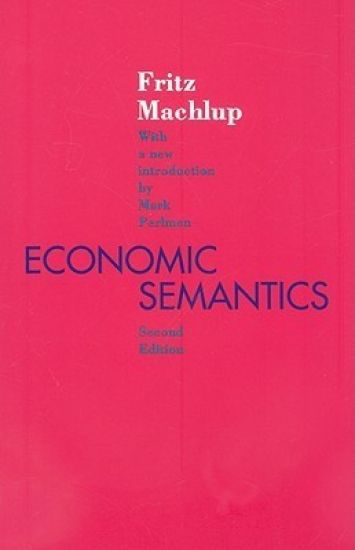
Economic Semantics

Economic Semantics

Fritz Machlup

Transaction Publishers
1990
nidottu
When the original edition was first published in 1963, Machlip observed ' I hope that the availibility of this collection will dispel semantic and concpetual; fog and allow greather visibility...'. The work is divided into five sections with a new essay in this edition on 'Are the Social Sciences Really Inferior?' There is also a new introduction by Mark Perlman, University Professor of Economics at the University of Pittsburgh.
Economic Semantics

Economic Semantics

Fritz Machlup

Routledge
2020
sidottu
When the original edition was first published in 1963, Machlip observed ' I hope that the availibility of this collection will dispel semantic and concpetual; fog and allow greather visibility...'. The work is divided into five sections with a new essay in this edition on 'Are the Social Sciences Really Inferior?' There is also a new introduction by Mark Perlman, University Professor of Economics at the University of Pittsburgh.
The Production and Distribution of Knowledge in the United States
The Production And Distribution Of Knowledge In The United States is a comprehensive book written by Fritz Machlup that explores the ways in which knowledge is produced and disseminated in the United States. The book covers a wide range of topics related to knowledge production and distribution, including the role of universities, scientific research, and intellectual property rights. Machlup also examines the impact of technology on knowledge production and distribution, as well as the ways in which knowledge is used in various sectors of the economy. The book provides a detailed analysis of the complex processes involved in the creation and dissemination of knowledge, and offers insights into the challenges and opportunities facing knowledge-based industries in the United States. Overall, The Production And Distribution Of Knowledge In The United States is a valuable resource for anyone interested in understanding the dynamics of knowledge production and distribution in modern society.This scarce antiquarian book is a facsimile reprint of the old original and may contain some imperfections such as library marks and notations. Because we believe this work is culturally important, we have made it available as part of our commitment for protecting, preserving, and promoting the world's literature in affordable, high quality, modern editions, that are true to their original work.
The Production and Distribution of Knowledge in the United States
The book ""The Production And Distribution Of Knowledge In The United States"" by Fritz Machlup is a comprehensive analysis of the ways in which knowledge is created, disseminated, and utilized in the United States. The author explores the various institutions and mechanisms that contribute to the production and distribution of knowledge, including universities, research centers, libraries, and publishing houses.Machlup examines the historical development of these institutions and their role in shaping the intellectual landscape of the United States. He also discusses the economic and social factors that influence the production and distribution of knowledge, such as funding sources, intellectual property laws, and cultural norms.Throughout the book, Machlup emphasizes the importance of knowledge as a valuable resource in a modern society, and the need for efficient and effective systems for producing and sharing it. He also considers the challenges and opportunities presented by new technologies and changing social and economic conditions, and offers insights into how these developments may shape the future of knowledge production and distribution.Overall, ""The Production And Distribution Of Knowledge In The United States"" provides a thoughtful and insightful analysis of a critical aspect of modern society, and is essential reading for anyone interested in the role of knowledge in shaping our world.This scarce antiquarian book is a facsimile reprint of the old original and may contain some imperfections such as library marks and notations. Because we believe this work is culturally important, we have made it available as part of our commitment for protecting, preserving, and promoting the world's literature in affordable, high quality, modern editions, that are true to their original work.