Kirjojen hintavertailu. Mukana 11 717 486 kirjaa ja 12 kauppaa.

Kirjahaku

Etsi kirjoja tekijän nimen, kirjan nimen tai ISBN:n perusteella.

11 kirjaa tekijältä Fritz Stern

The Failure of Illiberalism

The Failure of Illiberalism

Fritz Stern

Columbia University Press
1992
sidottu
Fritz Stern argues that the best way to describe the character of Imperial Germany after 1878 is "illiberal", which describes the German commitment in mind and policy against any further concession to democracy. Stern argues that from Bismarck to the end of World War II, German society embraced the impulse toward totalitarianism that this illiberal stance fostered. He also examines the efforts of German scholars to explain the phenomenon of Nazism, the attempt of the German people to come to terms with their past, and the failure of illiberalism in the 1950s.
The Failure of Illiberalism

The Failure of Illiberalism

Fritz Stern

Columbia University Press
1992
pokkari
Fritz Stern argues that the best way to describe the character of Imperial Germany after 1878 is "illiberal", which describes the German commitment in mind and policy against any further concession to democracy. Stern argues that from Bismarck to the end of World War II, German society embraced the impulse toward totalitarianism that this illiberal stance fostered. He also examines the efforts of German scholars to explain the phenomenon of Nazism, the attempt of the German people to come to terms with their past, and the failure of illiberalism in the 1950s.
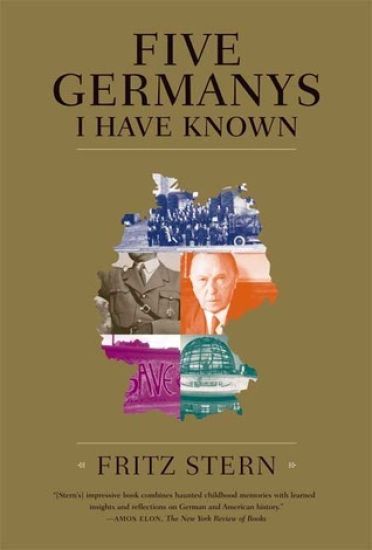
Five Germanys I Have Known: A History & Memoir

Five Germanys I Have Known: A History & Memoir

Fritz Stern

Farrar, Straus and Giroux
2007
nidottu
The "German question" haunts the modern world: How could so civilized a nation be responsible for the greatest horror in Western history? In this unusual fusion of personal memoir and history, the celebrated scholar Fritz Stern refracts the question through the prism of his own life. Born in the Weimar Republic, exposed to five years of National Socialism before being forced into exile in 1938 in America, he became a world-renowned historian whose work opened new perspectives on the German past. Stern brings to life the five Germanys he has experienced: Weimar, the Third Reich, postwar West and East Germanys, and the unified country after 1990. Through his engagement with the nation from which he and his family fled, he shows that the tumultuous history of Germany, alternately the strength and the scourge of Europe, offers political lessons for citizens everywhere--especially those facing or escaping from tyranny. In this wise, tough-minded, and subtle book, Stern, himself a passionately engaged citizen, looks beyond Germany to issues of political responsibility that concern everyone. Five Germanys I Have Known vindicates his belief that, at its best, history is our most dramatic introduction to a moral civic life.
Einstein's German World

Einstein's German World

Fritz Stern

Princeton University Press
2016
pokkari
The French political philosopher Raymond Aron once observed that the twentieth century "could have been Germany's century." In 1900, the country was Europe's preeminent power, its material strength and strident militaristic ethos apparently balanced by a vital culture and extraordinary scientific achievement. It was poised to achieve greatness. In Einstein's German World, the eminent historian Fritz Stern explores the ambiguous promise of Germany before Hitler, as well as its horrifying decline into moral nihilism under Nazi rule, and aspects of its remarkable recovery since World War II. He does so by gracefully blending history and biography in a sequence of finely drawn studies of Germany's great scientists and of German-Jewish relations before and during Hitler's regime. Stern's central chapter traces the complex friendship of Albert Einstein and the Nobel Prize-winning chemist Fritz Haber, contrasting their responses to German life and to their Jewish heritage. Haber, a convert to Christianity and a firm German patriot until the rise of the Nazis; Einstein, a committed internationalist and pacifist, and a proud though secular Jew. Other chapters, also based on new archival sources, consider the turbulent and interrelated careers of the physicist Max Planck, an austere and powerful figure who helped to make Berlin a happy, productive place for Einstein and other legendary scientists; of Paul Ehrlich, the founder of chemotherapy; of Walther Rathenau, the German-Jewish industrialist and statesman tragically assassinated in 1922; and of Chaim Weizmann, chemist, Zionist, and first president of Israel, whose close relations with his German colleagues is here for the first time recounted. Stern examines the still controversial way that historians have dealt with World War I and Germans have dealt with their nation's defeat, and he analyzes the conflicts over the interpretations of Germany's past that persist to this day. He also writes movingly about the psychic cost of Germany's reunification in 1990, the reconciliation between Germany and Poland, and the challenges and prospects facing Germany today. At once historical and personal, provocative and accessible, Einstein's German World illuminates the issues that made Germany's and Europe's past and present so important in a tumultuous century of creativity and violence.
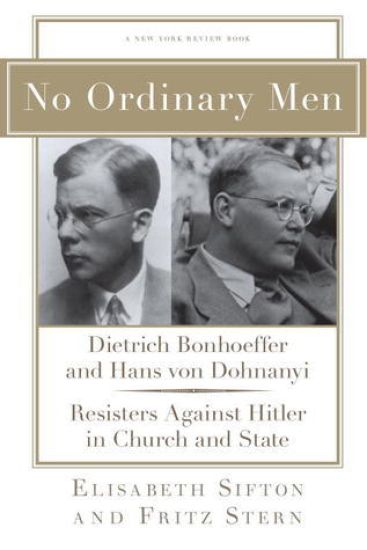
No Ordinary Men

No Ordinary Men

Fritz Stern

NYRB Classics
2013
nidottu
During the twelve years of Hitler's Third Reich, very few Germans took the risk of actively opposing his tyranny and terror, and fewer still did so to protect the sanctity of law and faith. In No Ordinary Men, Elisabeth Sifton and Fritz Stern focus on two remarkable, courageous men who did--the pastor and theologian Dietrich Bonhoeffer and his close friend and brother-in-law Hans von Dohnanyi--and offer new insights into the fearsome difficulties that resistance entailed. (Not forgotten is Christine Bonhoeffer Dohnanyi, Hans's wife and Dietrich's sister, who was indispensable to them both.) From the start Bonhoeffer opposed the Nazi efforts to bend Germany's Protestant churches to Hitler's will, while Dohnanyi, a lawyer in the Justice Ministry and then in the Wehrmacht's counterintelligence section, helped victims, kept records of Nazi crimes to be used as evidence once the regime fell, and was an important figure in the various conspiracies to assassinate Hitler. The strength of their shared commitment to these undertakings--and to the people they were helping--endured even after their arrest in April 1943 and until, after great suffering, they were executed on Hitler's express orders in April 1945, just weeks before the Third Reich collapsed. Bonhoeffer's posthumously published Letters and Papers from Prison and other writings found a wide international audience, but Dohnanyi's work is scarcely known, though it was crucial to the resistance and he was the one who drew Bonhoeffer into the anti-Hitler plots. Sifton and Stern offer dramatic new details and interpretations in their account of the extraordinary efforts in which the two jointly engaged. No Ordinary Men honors both Bonhoeffer's human decency and his theological legacy, as well as Dohnanyi's preservation of the highest standard of civic virtue in an utterly corrupted state.
Gold und Eisen

Gold und Eisen

Fritz Stern

C.H. BECK
2008
pokkari
"Gold und Eisen", die meisterhafte Doppelbiographie Bismarcks und seines jüdischen Bankiers Gerson von Bleichröder, ist das Hauptwerk von Fritz Stern. Der international renommierte Historiker zeichnet darin ein Bild von politischer Macht und Hochfinanz, Preußentum und Judentum im aufstrebenden Deutschen Reich der zweiten Hälfte des 19. Jahrhunderts. Zwei Welten treffen in seinem Buch aufeinander: die Welt des aristokratischen, agrarischen Junkertums und die moderne Industriegesellschaft. Denn Gerson von Bleichröder war nicht nur dreißig Jahre lang der private Bankier Bismarcks, sondern auch sein Vertrauter in Politik und Diplomatie. In glanzvoller Prosa erzählt Stern die Geschichte einer Wechselbeziehung von eminenter Wirkungsmacht: psychische Faktoren und materielle Interessen gewinnen in seinem Buch die oft vernachlässigte Bedeutung zurück, die sie in der historischen Wirklichkeit tatsächlich hatten.