Kirjojen hintavertailu. Mukana 12 464 810 kirjaa ja 12 kauppaa.

Kirjahaku

Etsi kirjoja tekijän nimen, kirjan nimen tai ISBN:n perusteella.

862 kirjaa tekijältä G. K. Chesterton

What's Wrong with the World: G.K. Chesterton

What's Wrong with the World: G.K. Chesterton

G. K. Chesterton

Createspace Independent Publishing Platform
2017
nidottu
What's Wrong with the World by G.K. Chesterton. What's Wrong with the World opens with an analysis of the predicament of modern humanity, too obsessed in the great age of political idealism with visions of the future. I originally called this book "What is Wrong," and it would have satisfied your sardonic temper to note the number of social misunderstandings that arose from the use of the title. Many a mild lady visitor opened her eyes when I remarked casually, "I have been doing 'What is Wrong' all this morning." And one minister of religion moved quite sharply in his chair when I told him (as he understood it) that I had to run upstairs and do what was wrong, but should be down again in a minute. Exactly of what occult vice they silently accused me I cannot conjecture, but I know of what I accuse myself; and that is, of having written a very shapeless and inadequate book, and one quite unworthy to be dedicated to you. As far as literature goes, this book is what is wrong and no mistake.
The Collected Works of G.K. Chesterton

The Collected Works of G.K. Chesterton

G. K. Chesterton

Ignatius Press
1986
nidottu
Contains three of Chesterton's most influential works. In Heretics, Chesterton sets forth one of the most telling critiques of contemporary religious notions ever. The Blatchford Controversies are the spirited public debate which led to the writing of Heretics. Then in Orthodoxy, Chesterton accepts the challenge of his opponents and sets forth his own reasons for accepting the Christian Faith.
The New Jerusalem (1920). By: Gilbert Keith Chesterton: The New Jerusalem is a 1920 book written by British writer G. K. Chesterton. Dale Ahlquist c
The New Jerusalem is a 1920 book written by British writer G. K. Chesterton. Dale Ahlquist calls it a "philosophical travelogue" of Chesterton's journey across Europe to Palestine. *Quotes* "On the road to Cairo one may see twenty groups exactly like that of the Holy Family in the pictures of the Flight into Egypt; with only one difference. The man is riding on the ass." "The real mistake of the Muslims is something much more modern in its application than any particular passing persecution of Christians as such. It lay in the very fact that they did think they had a simpler and saner sort of Christianity, as do many modern Christians. They thought it could be made universal merely by being made uninteresting. Now a man preaching what he thinks is a platitude is far more intolerant than a man preaching what he admits is a paradox. It was exactly because it seemed self-evident, to Muslims as to Bolshevists, that their simple creed was suited to everybody, that they wished in that particular sweeping fashion to impose it on everybody."....... Gilbert Keith Chesterton, KC*SG (29 May 1874 - 14 June 1936), better known as G. K. Chesterton, was an English writer, poet, philosopher, dramatist, journalist, orator, lay theologian, biographer, and literary and art critic. Chesterton is often referred to as the "prince of paradox". Time magazine has observed of his writing style: "Whenever possible Chesterton made his points with popular sayings, proverbs, allegories-first carefully turning them inside out." Chesterton is well known for his fictional priest-detective Father Brown, and for his reasoned apologetics. Even some of those who disagree with him have recognised the wide appeal of such works as Orthodoxy and The Everlasting Man.Chesterton, as a political thinker, cast aspersions on both Progressivism and Conservatism, saying, "The whole modern world has divided itself into Conservatives and Progressives. The business of Progressives is to go on making mistakes. The business of the Conservatives is to prevent the mistakes from being corrected."Chesterton routinely referred to himself as an "orthodox" Christian, and came to identify this position more and more with Catholicism, eventually converting to Catholicism from High Church Anglicanism. George Bernard Shaw, Chesterton's "friendly enemy" according to Time, said of him, "He was a man of colossal genius."Biographers have identified him as a successor to such Victorian authors as Matthew Arnold, Thomas Carlyle, Cardinal John Henry Newman, and John Ruskin.
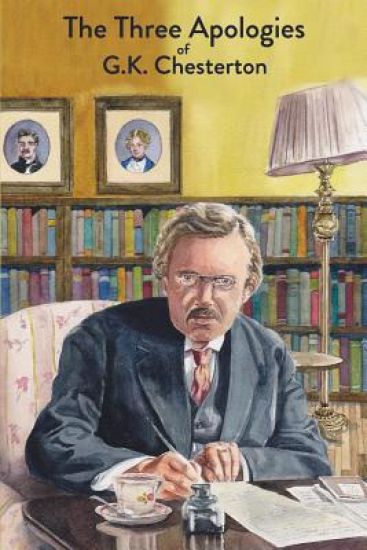
The Three Apologies of G.K. Chesterton: Heretics, Orthodoxy & The Everlasting Man
The three great apologies of G.K. Chesterton in one volume: Heretics, Orthodoxy & The Everlasting Man. Gilbert Keith Chesterton has become synonymous with modern Christian apologetics. But his impact goes beyond just those interested in a defense of Christian thought. His writings have influenced such diverse authors as C.S. Lewis, Marshall McLuhan, and Jorge Luis Borges, and remains a subtle and unseen presence in contemporary Catholic thought. At his funeral, Ronald Knox said "All of this generation has grown up under Chesterton's influence so completely that we do not even know when we are thinking Chesterton." Before his conversion from atheism to knowing God, C.S. Lewis, the author of Mere Christianity & The Great Divorce, said "in reading Chesterton, as in reading MacDonald, I did not know what I was letting myself in for. A young man who wishes to remain a sound atheist cannot be too careful of his reading. There are traps everywhere -" Chesterton wrote in a time when materialism and new forms of political theory were soon to cause havoc in the western world. His was a voice calling for restraint - pointing back to the fundamentals of Christian doctrine, the purpose and value of which was being lost in the noise and commotion of the post industrial age. Describing the rush towards less familiar and attractive ideologies, Chesterton wrote: "In the matter of reforming things, as distinct from deforming them, there is one plain and simple principle; a principle which will probably be called a paradox. There exists in such a case a certain institution or law; let us say, for the sake of simplicity, a fence or gate erected across a road. The more modern type of reformer goes gaily up to it and says, 'I don't see the use of this; let us clear it away.' To which the more intelligent type of reformer will do well to answer: 'If you don't see the use of it, I certainly won't let you clear it away. Go away and think. Then, when you can come back and tell me that you do see the use of it, I may allow you to destroy it.'" Chesterton was a man who continually showed us the use of orthodoxy in Christianity - most of all in his three great apologies: Heretics, Orthodoxy & The Everlasting Man. In Heretics, he first points to the flaws in the beliefs of the moderns. In Orthodoxy, he defends the values handed down through millennium of Christian dogma. In The Everlasting Man, he tells the grand story of Christianity itself and the often ignored miracle of its appearance in the life of man. Chesterton was a great debater, often trading blows with modern thinkers such as George Bernard Shaw, H.G. Wells, Bertrand Russell and Clarence Darrow. He became known as the "prince of paradox," He was also a prolific writer, producing biographies on St. Augustine and St. Francis, and touched on many of the varieties of religion in his writings. He wrote fiction as well, authoring the famous Father Brown books and the Man Who Was Thursday. Chesterton was certainly not the imitation of Christ in his personal life. A large man fond of food and drink, he was almost childlike in wonder of the magic of the world, while expressing the wit of an ancient. He gave no secret doctrine or systematic theology, but his "goodness" and basic "common sense" led many to the Church. One commenter stated: first you read C.S. Lewis, then Chesterton, then you become Catholic. Despite his less than temperate life, he is now under investigation by the Church for Beatification: such was his impact.
Lent and Easter Wisdom from G.K. Chesterton

Lent and Easter Wisdom from G.K. Chesterton

G. K. Chesterton; Thom (CON) Satterlee; Robert (CON) Moore-Jumonville

Liguori Publications,U.S.
2008
pokkari
G. K. Chesterton is one of the few Christian thinkers admired and quoted equally by Christians of all types and even by non-Christians. Each daily reflection in this book--from Ash Wednesday through the Second Sunday of Easter--begins with thoughts from the finest writings of Chesterton on an appropriate theme and supported by Scripture, a prayer, and a suggested activity for spiritual growth. View sample pages. "Paperback"