Kirjojen hintavertailu. Mukana 11 471 665 kirjaa ja 12 kauppaa.

Kirjahaku

Etsi kirjoja tekijän nimen, kirjan nimen tai ISBN:n perusteella.

12 kirjaa tekijältä G. W. Bowersock

From Gibbon to Auden: Essays on the Classical Tradition

From Gibbon to Auden: Essays on the Classical Tradition

G. W. Bowersock

Oxford University Press
2011
nidottu
For several decades G. W. Bowersock has been one of our leading historians of the classical world. This volume collects seventeen of his essays, each illustrating how the classical past has captured the imagination of some of the greatest figures in modern historiography and literature. The essays here range across three centuries, the eighteenth to the twentieth, and are divided chronologically. The great Enlightenment historian Edward Gibbon is in large part the unifying force of this collection as he appears prominently in the first four essays, beginning with Bowersock's engaging introduction to the methods and genius behind The Decline and Fall of the Roman Empire. Gibbon's profound influence is revealed in subsequent essays on Jacob Burckhardt, the nineteenth-century scholar famous for his history of the Italian Renaissance but whose work on late antiquity is only now being fully appreciated; the modern Greek poet Constantine Cavafy, whose annotations on Gibbon's Decline and Fall tell us much about his own historical poems; and finally W. H. Auden, whose poem and little known essay "The Fall of Rome" were, in quirky ways, tributes to Gibbon. The collection reprints Auden's poem and essay in full. The result is a rich survey of the early modern and modern uses of the classical past by one of its most important contemporary commentators.
Fiction as History

Fiction as History

G. W. Bowersock

University of California Press
2018
pokkari
Using pagan fiction produced in Greek and Latin during the early Christian era, G. W. Bowersock investigates the complex relationship between "historical" and "fictional" truths. This relationship preoccupied writers of the second century, a time when apparent fictions about both past and present were proliferating at an astonishing rate and history was being invented all over again. With force and eloquence, Bowersock illuminates social attitudes of this period and persuasively argues that its fiction was influenced by the emerging Christian Gospel narratives. Enthralling in its breadth and enhanced by two erudite appendices, this is a book that will be warmly welcomed by historians and interpreters of literature.This title is part of UC Press's Voices Revived program, which commemorates University of California Press’s mission to seek out and cultivate the brightest minds and give them voice, reach, and impact. Drawing on a backlist dating to 1893, Voices Revived makes high-quality, peer-reviewed scholarship accessible once again using print-on-demand technology. This title was originally published in 1994.
Fiction as History

Fiction as History

G. W. Bowersock

University of California Press
2024
sidottu
Using pagan fiction produced in Greek and Latin during the early Christian era, G. W. Bowersock investigates the complex relationship between "historical" and "fictional" truths. This relationship preoccupied writers of the second century, a time when apparent fictions about both past and present were proliferating at an astonishing rate and history was being invented all over again. With force and eloquence, Bowersock illuminates social attitudes of this period and persuasively argues that its fiction was influenced by the emerging Christian Gospel narratives. Enthralling in its breadth and enhanced by two erudite appendices, this is a book that will be warmly welcomed by historians and interpreters of literature.This title is part of UC Press's Voices Revived program, which commemorates University of California Press’s mission to seek out and cultivate the brightest minds and give them voice, reach, and impact. Drawing on a backlist dating to 1893, Voices Revived makes high-quality, peer-reviewed scholarship accessible once again using print-on-demand technology. This title was originally published in 1994.
Martyrdom and Rome

Martyrdom and Rome

G. W. Bowersock

Cambridge University Press
1995
sidottu
This book examines the historical context of the earliest Christian martyrs, and anchors their grisly and often wilful self-sacrifice to the everyday life and outlook of the cities of the Roman empire. Professor Bowersock begins by investigating both the time and the region in which martyrdom, as we know it, came into being. He also offers comparisons of the Graeco-Roman background with the martyrology of Jews and Muslims. A study of official protocols illuminates the bureaucratic institutions of the Roman state as they applied to the first martyrs; and the martyrdoms themselves are seen within the context of urban life (and public spectacle) in the great imperial cities. By considering martyrdom in relation to suicide, the author is also able to demonstrate the peculiarly Roman character of Christian self-sacrifice in relation to other forms of deadly resistance to authority.
Martyrdom and Rome

Martyrdom and Rome

G. W. Bowersock

Cambridge University Press
2002
pokkari
This book examines the historical context of the earliest Christian martyrs, and anchors their grisly and often wilful self-sacrifice to the everyday life and outlook of the cities of the Roman empire. Professor Bowersock begins by investigating both the time and the region in which martyrdom, as we know it, came into being. He also offers comparisons of the Graeco-Roman background with the martyrology of Jews and Muslims. A study of official protocols illuminates the bureaucratic institutions of the Roman state as they applied to the first martyrs; and the martyrdoms themselves are seen within the context of urban life (and public spectacle) in the great imperial cities. By considering martyrdom in relation to suicide, the author is also able to demonstrate the peculiarly Roman character of Christian self-sacrifice in relation to other forms of deadly resistance to authority.
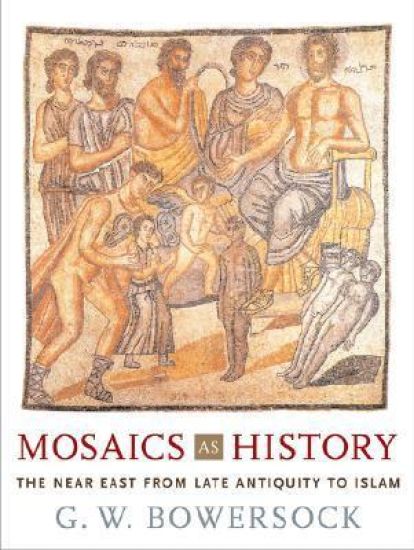
Mosaics as History

Mosaics as History

G. W. Bowersock

The Belknap Press
2006
sidottu
Over the past century, exploration and serendipity have uncovered mosaic after mosaic in the Near East--maps, historical images, mythical figures, and religious scenes that constitute an immense treasure of new testimony from antiquity. The stories these mosaics tell unfold in this brief, richly informed book by a preeminent scholar of the classical world. G. W. Bowersock considers these mosaics a critical part of the documentation of the region's ancient culture, as expressive as texts, inscriptions on stone, and architectural remains. In their complex language, often marred by time, neglect, and deliberate defacement, he finds historical evidence, illustrations of literary and mythological tradition, religious icons, and monuments to civic pride. Eloquently evoking a shared vision of a world beyond the boundaries of individual cities, the mosaics attest to a persistent tradition of Greek taste that could embrace Judaism, Christianity, and Islam in a fundamentally Semitic land, and they suggest the extent to which these three monotheistic religions could themselves embrace Hellenism.With copious color illustrations, Bowersock's efforts return us to Syrian Antioch, Arabia, Jewish and Samaritan settlements in Palestine, the Palmyrene empire in Syria, and the Nabataean kingdom in Jordan, and show us the overlay of Hellenism introduced by Alexander the Great as well as Roman customs imported by the imperial legions and governors. Attending to one of the most evocative languages of the ages, his work reveals a complex fusion of cultures and religions that speaks to us across time.
The Crucible of Islam

The Crucible of Islam

G. W. Bowersock

Harvard University Press
2019
nidottu
Little is known about Arabia in the sixth century, yet from this distant time and place emerged a faith and an empire that stretched from the Iberian peninsula to India. Today, Muslims account for nearly a quarter of the global population. A renowned classicist, G. W. Bowersock seeks to illuminate this obscure and dynamic period in the history of Islam—exploring why arid Arabia proved to be such fertile ground for Muhammad’s prophetic message, and why that message spread so quickly to the wider world. The Crucible of Islam offers a compelling explanation of how one of the world’s great religions took shape.“A remarkable work of scholarship.”—Wall Street Journal“A little book of explosive originality and penetrating judgment… The joy of reading this account of the background and emergence of early Islam is the knowledge that Bowersock has built it from solid stones… A masterpiece of the historian’s craft.”—Peter Brown, New York Review of Books
Julian the Apostate

Julian the Apostate

G. W. Bowersock

Harvard University Press
1997
nidottu
This portrayal of one of antiquity’s most enigmatic figures offers a vivid and compact assessment of the Apostate’s life and reign. Proceeding directly from an evaluation of the ancient sources—the testimony of friends and enemies of Julian as well as the writings of the emperor himself—the author traces Julian’s youth, his years as the commander of the Roman forces in Gaul, and his emergence as sole ruler in the course of a dramatic march to Constantinople. In G. W. Bowersock’s analysis of Julian’s religious revolution, the emperor’s ardent espousal of a lost cause is seen to have made intolerable demands upon pagans, Jews, and Christians alike.
Roman Arabia

Roman Arabia

G. W. Bowersock

Harvard University Press
1998
nidottu
The Roman province of Arabia occupied a crucial corner of the Mediterranean world, encompassing most of what is now Jordan, southern Syria, northwest Saudi Arabia, and the Negev. Mr. Bowersock's book is the first authoritative history of the region from the fourth century B.C. to the age of Constantine. The book opens with the arrival of the Nahataean Arabs in their magnificent capital at Petra and describes the growth of their hellenized culture based on trade in perfume and spices. It traces the transformation of the region from an Arab kingdom under Roman influence into an imperial province, one that played an increasingly important role in the Roman strategy for control of the Near East. While the primary emphasis is on the relations of the Arabs of the region with the Romans, their interactions with neighboring states, Jewish, Egyptian, and Syrian, are also stressed. The narrative concludes with the breakup of the Roman province at the start of the Byzantine age.
Empires in Collision in Late Antiquity

Empires in Collision in Late Antiquity

G. W. Bowersock

Brandeis University Press
2012
nidottu
In this book, based on lectures delivered at the Historical Society of Israel, the famed historian G. W. Bowersock presents a searching examination of political developments in the Arabian Peninsula on the eve of the rise of Islam. Recounting the growth of Christian Ethiopia and the conflict with Jewish Arabia, he describes the fall of Jerusalem at the hands of a late resurgent Sassanian (Persian) Empire. He concludes by underscoring the importance of the Byzantine Empire's defeat of the Sassanian forces, which destabilized the region and thus provided the opportunity for the rise and military success of Islam in the seventh century. Using close readings of surviving texts, Bowersock sheds new light on the complex causal relationships among the Byzantine, Ethiopian, Persian, and emerging Islamic forces.
Det romerska Arabien

Det romerska Arabien

G. W. Bowersock

Alhambra
2009
sidottu
"En oundgänglig bok... Det romerska Arabien är mer än en utmärkt redogörelse om en romersk provins. I boken diskuteras också ingående viktiga frågeställningar inom romersk, arabisk, och i bredare mening, Mellanösterns historia... Den innehåller viktigt material för alla forskare som intresserar sig för bakgrunden till islams uppkomst." Walter Emil Kaegi, Jr., American Historical Review