Kirjojen hintavertailu. Mukana 11 342 296 kirjaa ja 12 kauppaa.

Kirjahaku

Etsi kirjoja tekijän nimen, kirjan nimen tai ISBN:n perusteella.

9 kirjaa tekijältä G.W.F. Hegel

Hegel: Faith and Knowledge

Hegel: Faith and Knowledge

G.W.F. Hegel

State University of New York Press
1988
pokkari
As the title indicates, Faith and Knowledge deals with the relation between religious faith and cognitive beliefs, between the truth of religion and the truths of philosophy and science. Hegel is guided by his understanding of the historical situation: the individual alienated from God, nature, and community; and he is influenced by the new philosophy of Schelling, the Spinozistic Philosophy of Identity with its superb vision of the inner unity of God, nature, and rational man. Through a brilliant discussion of the philosophies of Kant, Fichte, and other luminaries of the period, Hegel shows that the time has finally come to give philosophy the authentic shape it has always been trying to reach, a shape in which philosophy's old conflicts with religion on the one hand and with the sciences on the other are suspended once for all. This is the first English translation of this important essay.Professor H. S. Harris offers a historical and analytic commentary to the text and Professor Cerf offers an introduction to the general reader which focuses on the concept of intellectual intuition and on the difference between authentic and inauthentic philosophy.
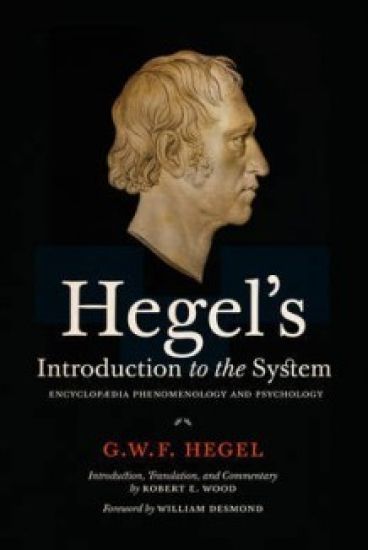
Hegel's Introduction to the System

Hegel's Introduction to the System

G.W.F. Hegel

University of Toronto Press
2014
pokkari
As an introduction to his own notoriously complex and challenging philosophy, Hegel recommended the sections on phenomenology and psychology from The Philosophy of Spirit, the third part of his Encyclopaedia of the Philosophic Sciences. These offered the best introduction to his philosophic system, whose main parts are Logic, Nature, and Sprit. Hegel’s Introduction to the System finally makes it possible for the modern reader to approach the philosopher’s work as he himself suggested. The book includes a fresh translation of “Phenomenology” and “Psychology,” an extensive section-by-section commentary, and a sketch of the system to which this work is an introduction. The book provides a lucid and elegant analysis that will be of use to both new and seasoned readers of Hegel.
Lectures on the Philosophy of Spirit 1827-8

Lectures on the Philosophy of Spirit 1827-8

G.W.F. Hegel

Oxford University Press
2007
sidottu
The Hegel Lectures Series Series Editor: Peter C. Hodgson Hegel's lectures have had as great a historical impact as the works he himself published. Important elements of his system are elaborated only in the lectures, especially those given in Berlin during the last decade of his life. The original editors conflated materials from different sources and dates, obscuring the development and logic of Hegel's thought. The Hegel Lectures series is based on a selection of extant and recently discovered transcripts and manuscripts. The original lecture series are reconstructed so that the structure of Hegel's argument can be followed. Each volume presents an accurate new translation accompanied by an editorial introduction and annotations on the text, which make possible the identification of Hegel's many allusions and sources. Lectures on the Philosophy of Spirit 1827-8 Robert Williams provides the first full view of Hegel's Philosophy of Subjective Spirit in his translation of this recently discovered manuscript. Hegel's lectures of 1827 go far beyond the previously published Encyclopedia outline, and provide a new introduction to the Philosophy of Spirit. Since they come from a single source, they are not editorial constructions like the previously published supplemental materials (Zusaetze). The new material provides the only explicit grounding of the concept of right presupposed by the Philosophy of Right, grounds Hegel's account of the virtues in love and mutual recognition, gives further insight into Hegel's theory of madness/dementia, and elaborates Hegel's difficult account of the role of mechanical memory in transcendental deduction of objectivity. The edition should stimulate and open up interest in Hegel's Philosophy of Spirit, a neglected area in Hegel scholarship, but one to which Hegel himself attached special importance and significance.
The Difference Between Fichte's and Schelling's System of Philosophy

The Difference Between Fichte's and Schelling's System of Philosophy

G.W.F. Hegel

State University of New York Press
1988
pokkari
In this essay, Hegel attempted to show how Fichte's Science of Knowledge was an advance from the position of Kant in the Critique of Pure Reason, and how Schelling (and incidentally Hegel himself) had made a further advance from the position of Fichte.In this essay, Hegel attempted to show how Fichte's Science of Knowledge was an advance from the position of Kant in the Critique of Pure Reason, and how Schelling (and incidentally Hegel himself) had made a further advance from the position of Fichte.Hegel finds the idealism of Fichte too abstractly subjective and formalistic, and he tries to show how Schelling's philosophy of nature is the remedy for these weaknesses. But the most important philosophical content of the essay is probably to be found in his general introduction to these critical efforts where he deals with a number of problems about philosophical method in a way which is of general interest to philosophers, and not merely interesting to those who accept the Hegelian "dialectic method" which grew out of these first beginnings. Finally, the Difference essay is important in the development of "Nature-Philosophy" as a movement in the history of science.
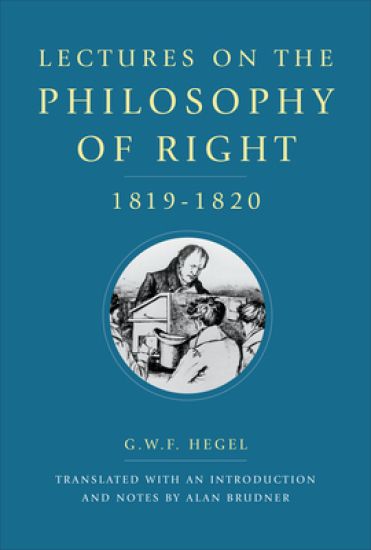
Lectures on the Philosophy of Right, 1819-1820

Lectures on the Philosophy of Right, 1819-1820

G.W.F. Hegel

UNIVERSITY OF TORONTO PRESS
2023
sidottu
Published in 1821, Outlines of the Philosophy of Right is considered the definitive articulation of the legal, moral, social, and political philosophy of G.W.F. Hegel. However, shortly before its publication, Hegel delivered a series of lectures on the subject matter of the work at the University of Berlin. These lectures are unlike any others Hegel gave on the philosophy of Right in that they do not supplement a published text but rather give a full and independent presentation of his mature political thought. Yet, they are also unlike Hegel’s formal treatise in that they form a smooth and flowing discourse, much like Hegel’s lectures on the philosophy of history, philosophy of art, philosophy of religion, and history of philosophy. Substantively, these lectures contain more extensive discussions of poverty and the proletariat than are found in Hegel’s published text – discussions that carry out the retreat from optimism about the present age intimated in the preface to Outlines but nowhere evident in the text itself. Translated with an introduction and notes by Alan Brudner, Hegel’s 1819/20 lectures on the philosophy of Right present his complete thoughts on law and the state in a manner that is more accessible and engaging than any other Hegelian text on these subjects.
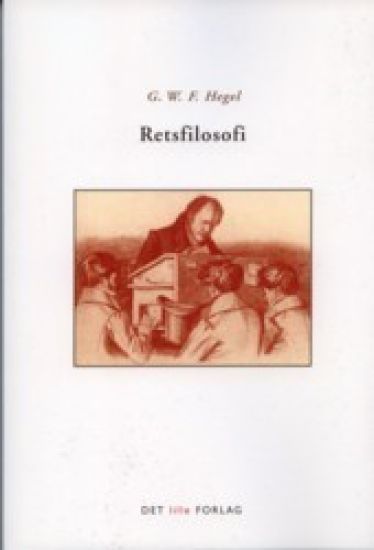
Retsfilosofi

Retsfilosofi

G.W.F. Hegel

Lindhardt og Ringhof
2004
nidottu
Et værks såkaldte virkningshistorie kan måles på to måder: den teoretisk-akademiske = dens indflydelse på den faglige diskussion sit felt. Og dets dagsordensættende effekt over årtier vs. den praktisk-konkrete, hvor en tekst viser sig at disponere politiske manøvrer. Hegels "Retsfilosofi" lever op til begge mål - sidstnævnte ved bl.a. (via Monrad) at øve indflydelse på strukturen af den danske Junigrundlov fra 1849. Mest kendt er ellers Marx´(og Engels´) opgør med Hegel og hans spekulativt-idealistiske redegørelse for (= legitimering af) det borgerlige samfund - i sin davarende preussiske udgave heraf. ´Verdensåndens gang gennem historie´ havde jo sat både ejendomsretten, familien, samfundet osv. og heraf fulgte gennem nye dialektiske bevægelser retten, moraliteten, sædeligheden og verdenshistorien. Mere og mere frihed efter Hegels mening - men men... Læs selv efter, og tag livtag med Hegels mange kritikere og ideologiske eftersnakkere. Det borgerlige samfund består, og på mærkværdig vis er Hegel rodet ind i dén historie.Oversat af Claus Bratt Østergaard.
Dialetik

Dialetik

G.W.F. Hegel

Forlaget Mindspace
2022
nidottu
En kriseramt verden kalder på en forandringslogik, og filosoffen G.W.F. Hegel (1770-1831) forsøgte med sin banebrydende dialektik netop at kortlægge strukturen i overgangsprocesser. Dialektikken har udgjort en kernedisciplin i filosofien siden Platons dialoger, men aldrig betaget og forarget så meget som i den form, den får hos Hegel. Det satiriske skrift “Hvem tænker abstrakt?” giver et originalt bud på, hvordan filosofien kan lære os at tænke konkret. Og de to nøgletekster fra Hegels dialektisk-spekulative logik – der her for første gang præsenteres på dansk – forklarer på pædagogisk vis, hvordan dialektisk tænkning virker, og viser os helt ind i begrebsbevægelsens maskinrum i den berømte sekvens, hvor væren og intet bliver til tilblivelse.Dialektik er en del af bogserien AFTRYK, der samler korte og vedkommende filosofiske tekster med væsentlig virkningshistorie. Teksterne er udvalgt og kommenteret af WilliamMathorne og Anna Cornelia Ploug, der ligeledes har skrevet en fyldig introduktion, som udfordrer misforståelsen, at dialektikken blot er et dødt tese/antitese/syntese-skema, der tankeløst kan presses ned over virkeligheden. Dialektikken bør snarere betragtes som en levende og kritisk metode, der kan bruges til at sætte spørgsmålstegn ved alt fra køn til kapitalisme.