Kirjojen hintavertailu. Mukana 11 342 296 kirjaa ja 12 kauppaa.

Kirjahaku

Etsi kirjoja tekijän nimen, kirjan nimen tai ISBN:n perusteella.

5 kirjaa tekijältä Gabriel Solis

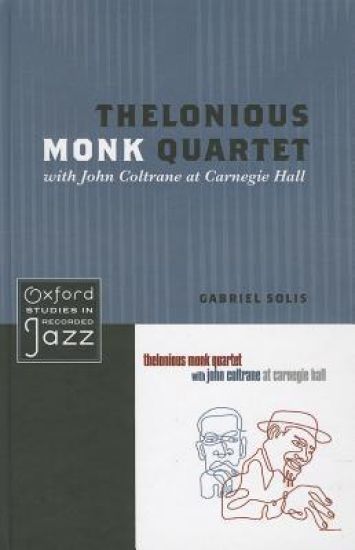
Thelonious Monk Quartet with John Coltrane at Carnegie Hall

Thelonious Monk Quartet with John Coltrane at Carnegie Hall

Gabriel Solis

Oxford University Press Inc
2014
sidottu
In early 2005, an engineer at the Library of Congress accidentally discovered, in an unmarked box, the recording of Thelonious Monk's and John Coltrane's performance at a 1957 benefit concert at Carnegie Hall. Long considered one of the most important musical meetings in modern jazz, Monk's and Coltrane's work together during a scant few months in 1957 had, until this discovery, been thought to be almost entirely undocumented. In this book, Gabriel Solis provides an historical, cultural, and analytical study of this landmark recording, which was released by Blue Note records later in 2005. Taking a wide-ranging approach to the recording, Solis addresses issues of "liveness," jazz teaching and learning, enculturation, and historiography. Because nearly a half century passed between when the recording was made and its public release, it is a particularly interesting lens through which to view jazz both as a historical tradition and as a contemporary cultural form. Most importantly Solis accounts for the music itself. Offering in depth analytical discussions of each composition, as well as Monk's and Coltrane's improvisational performances he provides insight into Monk's impact on Coltrane as he developed his signature "sheets of sound" style, as well as into the influence of a strong side-man, like Coltrane, on Monk at his creative and professional peak. The first study of one of the most significant jazz releases of the twenty-first century, Thelonious Monk Quartet with John Coltrane at Carnegie Hall is essential reading for all jazz scholars, students, musicians, and fans.
Thelonious Monk Quartet with John Coltrane at Carnegie Hall

Thelonious Monk Quartet with John Coltrane at Carnegie Hall

Gabriel Solis

Oxford University Press Inc
2014
nidottu
In early 2005, an engineer at the Library of Congress accidentally discovered, in an unmarked box, the recording of Thelonious Monk's and John Coltrane's performance at a 1957 benefit concert at Carnegie Hall. Long considered one of the most important musical meetings in modern jazz, Monk's and Coltrane's work together during a scant few months in 1957 had, until this discovery, been thought to be almost entirely undocumented. In this book, Gabriel Solis provides an historical, cultural, and analytical study of this landmark recording, which was released by Blue Note records later in 2005. Taking a wide-ranging approach to the recording, Solis addresses issues of "liveness," jazz teaching and learning, enculturation, and historiography. Because nearly a half century passed between when the recording was made and its public release, it is a particularly interesting lens through which to view jazz both as a historical tradition and as a contemporary cultural form. Most importantly Solis accounts for the music itself. Offering in depth analytical discussions of each composition, as well as Monk's and Coltrane's improvisational performances he provides insight into Monk's impact on Coltrane as he developed his signature "sheets of sound" style, as well as into the influence of a strong side-man, like Coltrane, on Monk at his creative and professional peak. The first study of one of the most significant jazz releases of the twenty-first century, Thelonious Monk Quartet with John Coltrane at Carnegie Hall is essential reading for all jazz scholars, students, musicians, and fans.

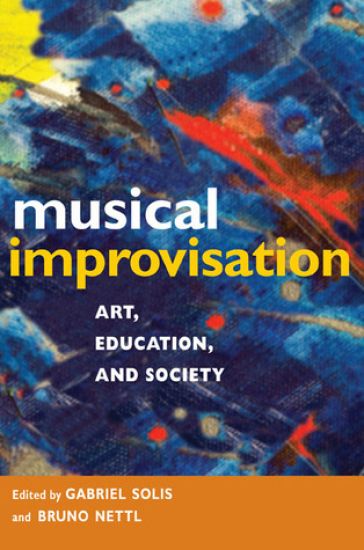
Musical Improvisation

Musical Improvisation

Gabriel Solis

University of Illinois Press
2009
sidottu
"Cutting across traditional subject boundaries in music and cultural studies, this admirably comprehensive work adopts a welcome interdisciplinary ideal and makes a truly significant contribution to our knowledge of musical improvisation."--Robert Witmer, professor emeritus of music, York University Contributors are Stephen Blum, Patricia Shehan Campbell, Sabine M. Feisst, Lawrence Gushee, Robert S. Hatten, William Kinderman, Natalie Kononenko, Robert Levin, Charlotte Mattax Moersch, Ingrid Monson, John P. Murphy, Bruno Nettl, A. Jihad Racy, Anne K. Rasmussen, Stephen Slawek, Gabriel Solis, Nicholas Temperley, John Toenjes, and Thomas Turino.
Musical Improvisation

Musical Improvisation

Gabriel Solis

University of Illinois Press
2009
nidottu
"Cutting across traditional subject boundaries in music and cultural studies, this admirably comprehensive work adopts a welcome interdisciplinary ideal and makes a truly significant contribution to our knowledge of musical improvisation."--Robert Witmer, professor emeritus of music, York University Contributors are Stephen Blum, Patricia Shehan Campbell, Sabine M. Feisst, Lawrence Gushee, Robert S. Hatten, William Kinderman, Natalie Kononenko, Robert Levin, Charlotte Mattax Moersch, Ingrid Monson, John P. Murphy, Bruno Nettl, A. Jihad Racy, Anne K. Rasmussen, Stephen Slawek, Gabriel Solis, Nicholas Temperley, John Toenjes, and Thomas Turino.
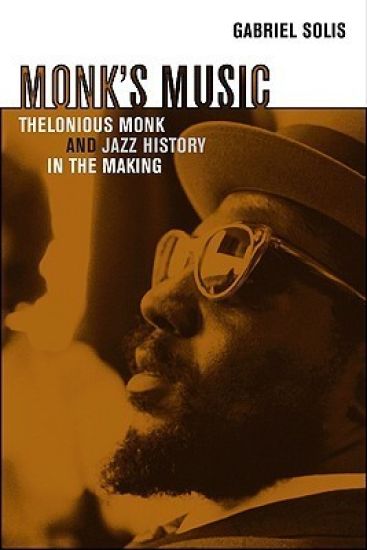
Monk's Music

Monk's Music

Gabriel Solis

University of California Press
2007
pokkari
Thelonious Monk (1917-1982) was one of jazz's greatest and most enigmatic figures. As a composer, pianist, and bandleader, Monk both extended the piano tradition known as Harlem stride and was at the center of modern jazz's creation during the 1940s, setting the stage for the experimentalism of the 1960s and '70s. This pathbreaking study combines cultural theory, biography, and musical analysis to shed new light on Monk's music and on the jazz canon itself. Gabriel Solis shows how the work of this stubbornly nonconformist composer emerged from the jazz world's fringes to find a central place in its canon. Solis reaches well beyond the usual life-and-times biography to address larger issues in jazz scholarship - ethnography and the role of memory in history's construction. He considers how Monk's stature has grown, from the narrowly focused wing of the avant-garde in the 1960s and '70s to the present, where he is claimed as an influence by musicians of all kinds. He looks at the ways musical lineages are created in the jazz world and, in the process, addresses the question of how musicians use performance itself to maintain, interpret, and debate the history of the musical tradition we call jazz.