The 18th century was a wealth of knowledge, exploration and rapidly growing technology and expanding record-keeping made possible by advances in the printing press. In its determination to preserve the century of revolution, Gale initiated a revolution of its own: digitization of epic proportions to preserve these invaluable works in the largest archive of its kind. Now for the first time these high-quality digital copies of original 18th century manuscripts are available in print, making them highly accessible to libraries, undergraduate students, and independent scholars.Western literary study flows out of eighteenth-century works by Alexander Pope, Daniel Defoe, Henry Fielding, Frances Burney, Denis Diderot, Johann Gottfried Herder, Johann Wolfgang von Goethe, and others. Experience the birth of the modern novel, or compare the development of language using dictionaries and grammar discourses. ++++The below data was compiled from various identification fields in the bibliographic record of this title. This data is provided as an additional tool in helping to insure edition identification: ++++Harvard University Houghton LibraryN012190Translation by John Nott.London: printed for J. Johnson, 1795. 2v., plates; 8
The 18th century was a wealth of knowledge, exploration and rapidly growing technology and expanding record-keeping made possible by advances in the printing press. In its determination to preserve the century of revolution, Gale initiated a revolution of its own: digitization of epic proportions to preserve these invaluable works in the largest archive of its kind. Now for the first time these high-quality digital copies of original 18th century manuscripts are available in print, making them highly accessible to libraries, undergraduate students, and independent scholars.Western literary study flows out of eighteenth-century works by Alexander Pope, Daniel Defoe, Henry Fielding, Frances Burney, Denis Diderot, Johann Gottfried Herder, Johann Wolfgang von Goethe, and others. Experience the birth of the modern novel, or compare the development of language using dictionaries and grammar discourses. ++++The below data was compiled from various identification fields in the bibliographic record of this title. This data is provided as an additional tool in helping to insure edition identification: ++++Harvard University Houghton LibraryN012190Translation by John Nott.London: printed for J. Johnson, 1795. 2v., plates; 8
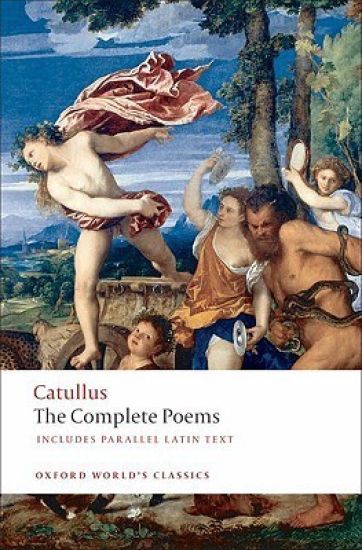
Of all the classical poets Gaius Valerius Catullus (c. 84-54 BC) is the most accessible to the modern reader. Presented alongside the original Latin text, this new translation reflects Catullus' mastery of poetic forms as diverse as the lyric, the inventive epigram, and the romantic legend, and shows his passionate, and sometimes dedicated to his lover Lesbia. This edition also includes a introduction to the poet's life and work, and full explanatory notes. ABOUT THE SERIES: For over 100 years Oxford World's Classics has made available the widest range of literature from around the globe. Each affordable volume reflects Oxford's commitment to scholarship, providing the most accurate text plus a wealth of other valuable features, including expert introductions by leading authorities, helpful notes to clarify the text, up-to-date bibliographies for further study, and much more.
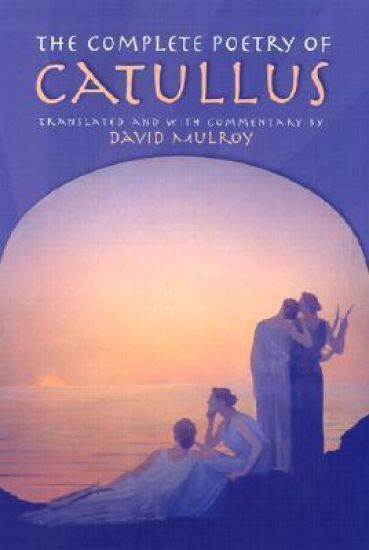
In these translated poems, David Mulroy aims to bring to life the witty, poignant and brutally direct voice of a flesh-and-blood man, a young provincial in Julius Caesar's Rome, reacting to real people and events in a city full of violent conflict among individuals marked by genius and megalomaniacal passions. These translations are accompanied by: an introduction and commentary that provide biographical and bibliographical information about Catullus; a history of his times; a discussion of the translations; and definitions and notes.
A vivid and musical rendering of the poetry of Catullus, whose passionate verses have captivated readers for centuries “Catullus’s verses still ring true, reminding readers that the habits of the heart haven’t changed in millennia.”—Publishers Weekly In the fourteenth century, a manuscript surfaced in Verona that had been lost for more than a thousand years: the poems of Catullus (c. 84–c. 54 BCE), considered by many to be one of the greatest poets who ever lived. These poems, with their beauty, wit, tenderness, and heartbreak, are still as alive and moving today as they were two thousand years ago. They are dense, subtle, witty, ardent, fearless, deeply uncensored, nasty (sometimes), petty (sometimes), and always beautiful. It’s especially his love poems that have earned readers’ admiration over the centuries; the joy and the savage self-inflicted torments that he underwent in his “miserable, disastrous love affair” have been shaped into poems that for honesty and emotional power have few parallels in world literature. Stephen Mitchell, who is known for bringing ancient texts to vibrant new life, has now translated Catullus’s poems for a new generation of readers. These are the first translations of Catullus to reimagine his rhythms in English and thus to let contemporary readers hear the formal beauty of his verse as well as its content, which Robert Lowell calls “much more raw and direct than anything in English.”
A vivid and musical rendering of the poetry of Catullus, whose passionate verses have captivated readers for centuries “Catullus’s verses still ring true, reminding readers that the habits of the heart haven’t changed in millennia.”—Publishers Weekly In the fourteenth century, a manuscript surfaced in Verona that had been lost for more than a thousand years: the poems of Catullus (c. 84–c. 54 BCE), considered by many to be one of the greatest poets who ever lived. These poems, with their beauty, wit, tenderness, and heartbreak, are still as alive and moving today as they were two thousand years ago. They are dense, subtle, witty, ardent, fearless, deeply uncensored, nasty (sometimes), petty (sometimes), and always beautiful. It’s especially his love poems that have earned readers’ admiration over the centuries; the joy and the savage self-inflicted torments that he underwent in his “miserable, disastrous love affair” have been shaped into poems that for honesty and emotional power have few parallels in world literature. Stephen Mitchell, who is known for bringing ancient texts to vibrant new life, has now translated Catullus’s poems for a new generation of readers. These are the first translations of Catullus to reimagine his rhythms in English and thus to let contemporary readers hear the formal beauty of his verse as well as its content, which Robert Lowell calls “much more raw and direct than anything in English.”
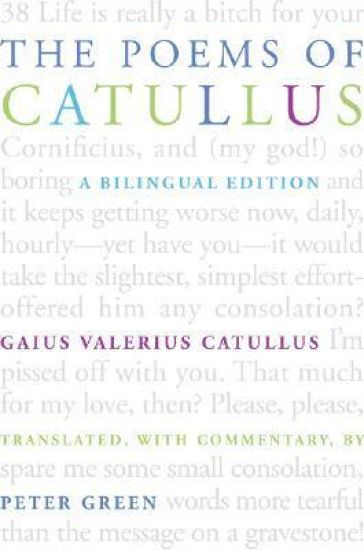
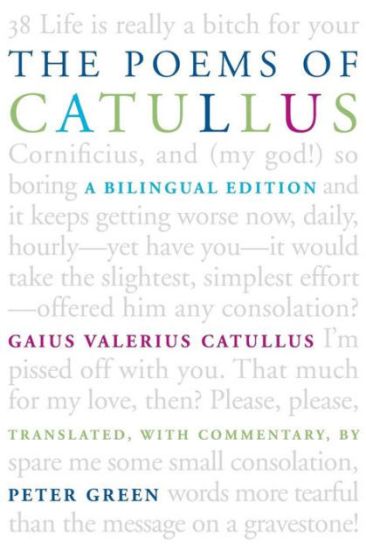
Catullus, who lived during some of the most interesting and tumultuous years of the late Roman Republic, spent his short but intense life (?84-54 B.C.E.) in high Roman society, rubbing shoulders with various cultural and political luminaries, including Caesar, Cicero, and Pompey. Catullus's poetry is by turns ribald, lyric, romantic, satirical; sometimes obscene and always intelligent, it offers us vivid pictures of the poet's friends, enemies, and lovers. The verses to his friends are bitchy, funny, and affectionate; those to his enemies are often wonderfully nasty. Many poems brilliantly evoke his passionate affair with Lesbia, often identified as Clodia Metelli, a femme fatale ten years his senior and the smart, adulterous wife of an arrogant aristocrat. Cicero later claimed she poisoned her husband. This new bilingual translation of Catullus's surviving poems by Peter Green is fresh, bawdy, and utterly engaging. Unlike its predecessors, it adheres to the principle that the rhythm of a poem, whether familiar or not, is among the most crucial elements for its full appreciation. Green provides an essay on the poet's life and literary background, a historical sketch of the politically fraught late Roman Republic in which Catullus lived, copious notes on the poems, a wide-ranging bibliography for further reading, and a full glossary.
Catullus, who lived during some of the most interesting and tumultuous years of the late Roman Republic, spent his short but intense life (?84-54 B.C.E.) in high Roman society, rubbing shoulders with various cultural and political luminaries, including Caesar, Cicero, and Pompey. Catullus' poetry is by turns ribald, lyric, romantic, satirical; sometimes obscene and always intelligent, it offers us vivid pictures of the poet's friends, enemies, and lovers. The verses to his friends are bitchy, funny, and affectionate; those to his enemies are often wonderfully nasty. Many poems brilliantly evoke his passionate affair with Lesbia, often identified as Clodia Metelli, a femme fatale ten years his senior and the smart, adulterous wife of an arrogant aristocrat. Cicero later claimed she poisoned her husband. This new bilingual translation of Catullus' surviving poems by Peter Green is fresh, bawdy, and utterly engaging. Unlike its predecessors, it adheres to the principle that the rhythm of a poem, whether familiar or not, is among the most crucial elements for its full appreciation. Green provides an essay on the poet's life and literary background, a historical sketch of the politically fraught late Roman Republic in which Catullus lived, copious notes on the poems, a wide-ranging bibliography for further reading, and a full glossary.