Kirjojen hintavertailu. Mukana 11 577 823 kirjaa ja 12 kauppaa.

Kirjahaku

Etsi kirjoja tekijän nimen, kirjan nimen tai ISBN:n perusteella.

5 kirjaa tekijältä Galit Shmueli

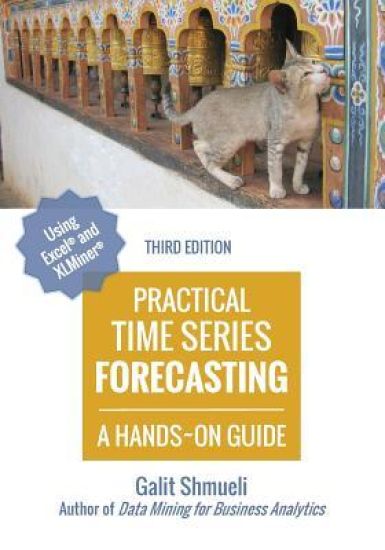
Practical Time Series Forecasting

Practical Time Series Forecasting

Galit Shmueli

Axelrod Schnall Publishers
2016
pokkari
Practical Time Series Forecasting: A Hands-On Guide, Third Edition provides an applied approach to time-series forecasting. Forecasting is an essential component of predictive analytics. The book introduces popular forecasting methods and approaches used in a variety of business applications. The book offers clear explanations, practical examples, and end-of-chapter exercises and cases. Readers will learn to use forecasting methods using the Excel(R) add-in XLMiner(R) to develop effective forecasting solutions that extract business value from time-series data. Featuring improved organization and new material, the Third Edition also includes: Popular forecasting methods including smoothing algorithms, regression models, and neural networksA practical approach to evaluating the performance of forecasting solutionsA business-analytics exposition focused on linking time-series forecasting to business goalsGuided cases for integrating the acquired knowledge using real dataEnd-of-chapter problems to facilitate active learningA companion site with data sets, learning resources, and instructor materials (solutions to exercises, case studies, and slides)Globally-available textbook, available in both softcover and Kindle formats Practical Time Series Forecasting: A Hands-On Guide, Third Edition is the perfect textbook for upper-undergraduate, graduate and MBA-level courses as well as professional programs in data science and business analytics. The book is also designed for practitioners in the fields of operations research, supply chain management, marketing, economics, finance and management.For more information, visit forecastingbook.com
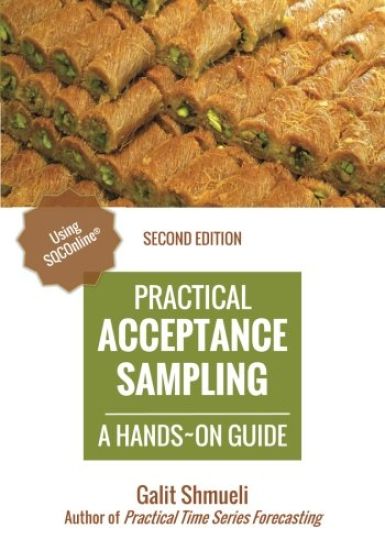
Practical Acceptance Sampling

Practical Acceptance Sampling

Galit Shmueli

Axelrod Schnall Publishers
2016
pokkari
New to the second edition: A section on Acceptance-on-Zero plans, additional screenshots from the newly-designed SQCOnline.com with several new calculators, and improved book design for enhanced readability.Practical Acceptance Sampling is a hands-on introduction to the inspection of products and services for quality assurance using statistically-based sampling plans.In today's era of global supply chains, the path from raw materials to final product often takes place over multiple companies and across multiple continents. Acceptance sampling is key in the 21st century environment.Acceptance sampling plans provide criteria and decision rules for determining whether to accept or reject a batch based on a sample. They are therefore widely used by manufacturers, suppliers, contractors and subcontractors, and service providers in a wide range of industries.The book introduces readers to the most popular sampling plans, including Military Standards and civilian ISO and ANSI/ASQC/BS standards. It covers the design, choice and performance evaluation of different types of plans, including single- and double-stage plans, rectifying and non-rectifying plans, plans for pass/fail and continuous measurements, continuous sampling plans, and more.Practical Acceptance Sampling is suitable for courses on quality control and for quality practitioners with basic knowledge of statistics. It offers clear explanations, examples, end-of-chapter problems, and illustrations of state-of-the-art online resources. Methods are illustrated using Microsoft Excel, online calculators, and SQCOnline.com. However, any statistical software can be used with the book.A companion website to the book is available at www.SamplingBook.com
Practical Risk Analysis for Project Planning

Practical Risk Analysis for Project Planning

Galit Shmueli

Axelrod Schnall Publishers
2016
pokkari
Projects are investments of resources for achieving a particular objective or set of objectives. Resources include time, money, manpower, and sometimes lives. Objectives include financial gain, social and health benefits, national goals, educational and scientific achievements, and reduction of suffering, among many others. Projects are undertaken by large and small organizations, by governments, non-profit organizations, private businesses, and by individuals. Determining whether to execute a project, or which project to execute among a set of possibilities is often a challenge with high stakes. Assessing the potential outcomes of a project can therefore be detrimental, leading to the importance of making informative decisions.Practical Risk Analysis for Project Planning is a hands-on introduction to integrating numerical data and domain knowledge into popular spreadsheet software such as Microsoft Excel or Google Spreadsheets, to arrive at informed project-planning decisions. The focus of the book is on formalizing domain expertise into numerical data, providing tools for assessing potential project performance, and evaluating performance under realistic uncertainty. The book introduces basic principles for assessing potential project performance and risk under different scenarios, by addressing uncertainty that arises at different levels. It describes measures of expected performance and risk, presents approaches such as scenario building and Monte Carlo simulation for addressing uncertainty, and introduces methods for comparing competing projects and reducing risk via project portfolios.A companion website to the book is available at www.RiskAnalysisBook.comNo special software is required except Excel or another spreadsheet software. While the book assumes no knowledge of statistics, operations research, or management science, it does rely on basic familiarity with Excel. Chapter exercises and examples of real projects are aimed at hands-on learning.
Run Related Probability Functions and their Application to Industrial Statistics: Ph.D. Thesis
Various procedures that are used in the field of industrial statistics, include switching/stopping rules between different levels of inspection. These rules are usually based on a sequence of previous inspections, and involve the concept of runs. A run is a sequence of identical events, such as a sequence of successes in a slot machine. However, waiting for a run to occur is not merely a superstitious act. In quality control, as in many other fields (e.g. reliability of engineering systems, DNA sequencing, psychology, ecology, and radar astronomy), the concept of runs is widely applied as the underlying basis for many rules. Rules that are based on the concept of runs, or "run-rules", are very intuitive and simple to apply (for example: "use reduced inspection following a run of 5 acceptable batches"). In fact, in many cases they are designed according to empirical rather than probabilistic considerations. Therefore, there is a need to investigate their theoretical properties and to assess their performance in light of practical requirements. In order to investigate the properties of such systems their complete probabilistic structure should be revealed. Various authors addressed the occurrence of runs from a theoretical point of view, with no regard to the field of industrial statistics or quality control. The main problem has been to specify the exact probability functions of variables which are related to runs. This problem was tackled by different methods (especially for the family of "order k distributions"), some of them leading to expressions for the probability function. In this work we present a method for computing the exact probability functions of variables which originate in systems with switching or stopping rules that are based on runs (including k-order variables as a special case). We use Feller's (1968) methods for obtaining the probability generating functions of run related variables, as well as for deriving the closed form of the probability function from its generating function by means of partial fraction expansion. We generalize Feller's method for other types of distributions that are based on runs, and that are encountered in the field of industrial statistics. We overcome the computational complexity encountered by Feller for computing the exact probability function, using efficient numerical methods for finding the roots of polynomials, simple recursive formulas, and popular mathematical software packages (e.g. Matlab and Mathematica). We then assess properties of some systems with switching/stopping run rules, and propose modifications to such rules.