Kirjojen hintavertailu. Mukana 11 244 527 kirjaa ja 12 kauppaa.

Kirjahaku

Etsi kirjoja tekijän nimen, kirjan nimen tai ISBN:n perusteella.

9 kirjaa tekijältä Gary B. Nash

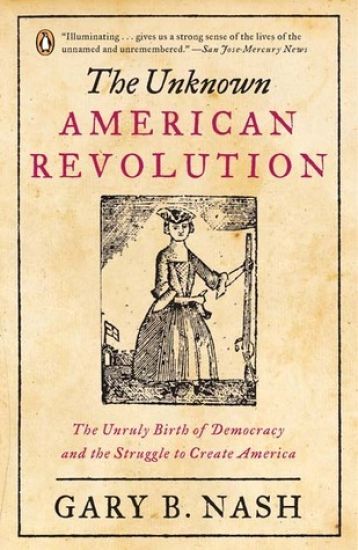
The Unknown American Revolution: The Unruly Birth of Democracy and the Struggle to Create America
An exploration of the ideas and radical sentiments that prompted the American Revolution cites uprisings within every facet of American society, arguing that the war was a people's revolution and civil war, as well as an insurrection against colonial control. By the author of Red, White, and Black. Reprint. 25,000 first printing.
The Liberty Bell

The Liberty Bell

Gary B. Nash

Yale University Press
2011
pokkari
The distinguished historian Gary B. Nash recasts the legacy of one of America’s most enduring icons of freedom Each year, more than two million visitors line up near Philadelphia’s Independence Hall and wait to gaze upon a flawed mass of metal forged more than two and a half centuries ago. Since its original casting in England in 1751, the Liberty Bell has survived a precarious journey on the road to becoming a symbol of the American identity, and in this masterful work, Gary B. Nash reveals how and why this voiceless bell continues to speak such volumes about our nation.A serious cultural history rooted in detailed research, Nash’s book explores the impetus behind the bell’s creation, as well as its evolutions in meaning through successive generations. With attention to Pennsylvania’s Quaker roots, he analyzes the biblical passage from Leviticus that provided the bell’s inscription and the valiant efforts of Philadelphia’s unheralded brass founders who attempted to recast the bell after it cracked upon delivery from London’s venerable Whitechapel Foundry. Nash fills in much-needed context surrounding the bell’s role in announcing the Declaration of Independence and recounts the lesser-known histories of its seven later trips around the nation, when it served as a reminder of America’s indomitable spirit in times of conflict. Drawing upon fascinating primary source documents, Nash’s book continues a remarkable dialogue about a symbol of American patriotism second only in importance to the Stars and Stripes.
The Forgotten Fifth

The Forgotten Fifth

Gary B. Nash

Harvard University Press
2006
sidottu
As the United States gained independence, a full fifth of the country's population was African American. The experiences of these men and women have been largely ignored in the accounts of the colonies' glorious quest for freedom. In this compact volume, Gary B. Nash reorients our understanding of early America, and reveals the perilous choices of the founding fathers that shaped the nation's future. Nash tells of revolutionary fervor arousing a struggle for freedom that spiraled into the largest slave rebellion in American history, as blacks fled servitude to fight for the British, who promised freedom in exchange for military service. The Revolutionary Army never matched the British offer, and most histories of the period have ignored this remarkable story. The conventional wisdom says that abolition was impossible in the fragile new republic. Nash, however, argues that an unusual convergence of factors immediately after the war created a unique opportunity to dismantle slavery. The founding fathers' failure to commit to freedom led to the waning of abolitionism just as it had reached its peak. In the opening decades of the nineteenth century, as Nash demonstrates, their decision enabled the ideology of white supremacy to take root, and with it the beginnings of an irreparable national fissure. The moral failure of the Revolution was paid for in the 1860s with the lives of the 600,000 Americans killed in the Civil War. The Forgotten Fifth is a powerful story of the nation's multiple, and painful, paths to freedom.
The Urban Crucible

The Urban Crucible

Gary B. Nash

Harvard University Press
1979
sidottu
This book boldly reinterprets colonial life and the origins of the American Revolution. While retaining all the main points of analysis and interpretation, the author has reduced the full complement of statistics, sources, and technical data contained in the original edition to serve the needs of general readers and undergraduates.
Forging Freedom

Forging Freedom

Gary B. Nash

Harvard University Press
1991
nidottu
This book is the first to trace the good and bad fortunes, over more than a century, of the earliest large free black community in the United States. Gary Nash shows how, from colonial times through the Revolution and into the turbulent 1830s, blacks in the City of Brotherly Love struggled to shape a family life, gain occupational competence, organize churches, establish neighborhoods and social networks, advance cultural institutions, educate their children in schools, forge a political consciousness, and train black leaders who would help abolish slavery. These early generations of urban blacks—many of them newly emancipated—constructed a rich and varied community life.Nash’s account includes elements of both poignant triumph and profound tragedy. Keeping in focus both the internal life of the black community and race relations in Philadelphia generally, he portrays first the remarkable vibrancy of black institution-building, ordinary life, and relatively amicable race relations, and then rising racial antagonism. The promise of a racially harmonious society that took form in the postrevolutionary era, involving the integration into the white republic of African people brutalized under slavery, was ultimately unfulfilled. Such hopes collapsed amid racial conflict and intensifying racial discrimination by the 1820s. This failure of the great and much-watched “Philadelphia experiment” prefigured the course of race relations in America in our own century, an enduringly tragic part of this country’s past.
The Urban Crucible

The Urban Crucible

Gary B. Nash

Harvard University Press
1986
nidottu
The Urban Crucible boldly reinterprets colonial life and the origins of the American Revolution. Through a century-long history of three seaport towns—Boston, New York, and Philadelphia—Gary Nash discovers subtle changes in social and political awareness and describes the coming of the revolution through popular collective action and challenges to rule by custom, law and divine will. A reordering of political power required a new consciousness to challenge the model of social relations inherited from the past and defended by higher classes. While retaining all the main points of analysis and interpretation, the author has reduced the full complement of statistics, sources, and technical data contained in the original edition to serve the needs of general readers and undergraduates.
First City

First City

Gary B. Nash

University of Pennsylvania Press
2006
pokkari
With its rich foundation stories, Philadelphia may be the most important city in America's collective memory. By the middle of the eighteenth century William Penn's "greene countrie town" was, after London, the largest city in the British Empire. The two most important documents in the history of the United States, the Declaration of Independence and the Constitution, were drafted and signed in Philadelphia. The city served off and on as the official capital of the young country until 1800, and was also the site of the first American university, hospital, medical college, bank, paper mill, zoo, sugar refinery, public school, and government mint. In First City, acclaimed historian Gary B. Nash examines the complex process of memory making in this most historic of American cities. Though history is necessarily written from the evidence we have of the past, as Nash shows, rarely is that evidence preserved without intent, nor is it equally representative. Full of surprising anecdotes, First City reveals how Philadelphians-from members of elite cultural institutions, such as historical societies and museums, to relatively anonymous groups, such as women, racial and religious minorities, and laboring people-have participated in the very partisan activity of transmitting historical memory from one generation to the next.
Warner Mifflin

Warner Mifflin

Gary B. Nash

University of Pennsylvania Press
2017
sidottu
Warner Mifflin-energetic, uncompromising, and reviled-was the key figure connecting the abolitionist movements before and after the American Revolution. A descendant of one of the pioneering families of William Penn's "Holy Experiment," Mifflin upheld the Quaker pacifist doctrine, carrying the peace testimony to Generals Howe and Washington across the blood-soaked Germantown battlefield and traveling several thousand miles by horse up and down the Atlantic seaboard to stiffen the spines of the beleaguered Quakers, harried and exiled for their neutrality during the war for independence. Mifflin was also a pioneer of slave reparations, championing the radical idea that after their liberation, Africans in America were entitled to cash payments and land or shared crop arrangements. Preaching "restitution," Mifflin led the way in making Kent County, Delaware, a center of reparationist doctrine. After the war, Mifflin became the premier legislative lobbyist of his generation, introducing methods of reaching state and national legislators to promote antislavery action. Detesting his repeated exercise of the right of petition and hating his argument that an all-seeing and affronted God would punish Americans for "national sins," many Southerners believed Mifflin was the most dangerous man in America-"a meddling fanatic" who stirred the embers of sectionalism after the ratification of the Constitution of 1787. Yet he inspired those who believed that the United States had betrayed its founding principles of natural and inalienable rights by allowing the cancer of slavery and the dispossession of Indian lands to continue in the 1790s. Writing in beautiful prose and marshaling fascinating evidence, Gary B. Nash constructs a convincing case that Mifflin belongs in the Quaker antislavery pantheon with William Southeby, Benjamin Lay, John Woolman, and Anthony Benezet.
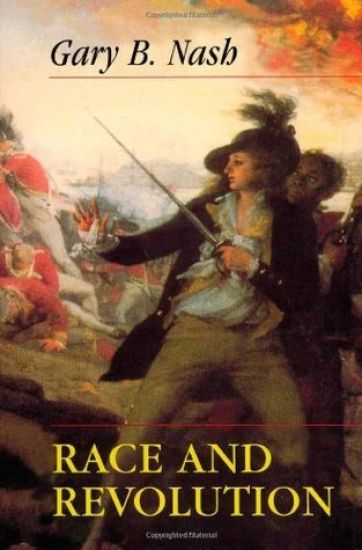
Race and Revolution

Race and Revolution

Gary B. Nash

Rowman Littlefield
1990
nidottu
The most profound crisis of conscience for white Americans at the end of the eighteenth century became their most tragic failure. Race and Revolution is a trenchant study of the revolutionary generation's early efforts to right the apparent contradiction of slavery and of their ultimate compromises that not only left the institution intact but provided it with the protection of a vastly strengthened government after 1788. Reversing the conventional view that blames slavery on the South's social and economic structures, Nash stresses the role of the northern states in the failure to abolish slavery. It was northern racism and hypocrisy as much as southern intransigence that buttressed "the peculiar institution." Nash also shows how economic and cultural factors intertwined to result not in an apparently judicious decision of the new American nation but rather its most significant lost opportunity. Race and Revolution describes the free black community's response to this failure of the revolution's promise, its vigorous and articulate pleas for justice, and the community's successes in building its own African-American institutions within the hostile environment of early nineteenth-century America. Included with the text of Race and Revolution are nineteen rare and crucial documents—letters, pamphlets, sermons, and speeches—which provide evidence for Nash's controversial and persuasive claims. From the words of Anthony Benezet and Luther Martin to those of Absalom Jones and Caesar Sarter, readers may judge the historical record for themselves. "In reality," argues Nash, "the American Revolution represents the largest slave uprising in our history." Race and Revolution is the compelling story of that failed quest for the promise of freedom.