Kirjojen hintavertailu. Mukana 11 342 296 kirjaa ja 12 kauppaa.

Kirjahaku

Etsi kirjoja tekijän nimen, kirjan nimen tai ISBN:n perusteella.

9 kirjaa tekijältä Gary Shapiro

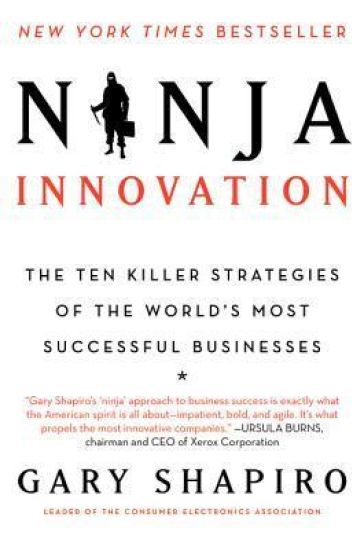
Ninja Innovation

Ninja Innovation

Gary Shapiro

William Morrow Paperbacks
2015
nidottu
New York Times * Wall Street Journal * USA Today Bestseller Taking readers inside the most cutting-edge businesses, Ninja Innovation is the ultimate guide to achieving victory in today's innovate-or-die economy Gary Shapiro has observed the world's most innovative businesses from his front-row seat as leader of the Consumer Electronics Association and its influential annual trade show, the International CES. Now he reveals the ten secrets of "ninja innovators" like Apple, Amazon, Google, Microsoft, and many others. What does it take to succeed? Discipline. Mission-oriented strategy. Adaptability. Decisiveness. And a will for victory. In short, today's most successful businesses are "ninja innovators." Drawn from Gary Shapiro's three decades of experience leading the consumer electronics industry, Ninja Innovation takes readers behind the scenes of today's top enterprises, uncovering their ten essential strategies for success.

Ninja Future

Ninja Future

Gary Shapiro

William Morrow
2019
sidottu
NATIONAL BESTSELLERNinja Future is an essential read for businesses and individuals striving to remain competitive in a rapidly evolving world: Gary Shapiro, the president and CEO of the Consumer Technology Association, casts his eye toward the future, charting how the innovative technologies of today will transform not only the way business is done but society itselfDuring his more than three decades at the head of the Consumer Technology Association, Gary Shapiro has witnessed, and been a part of, one of the most extraordinary periods of technological change in human history. Today’s world is almost unrecognizable from that of just a decade or two before: in just a few short years, the internet has already transformed how we access information, purchase goods, get from place to place, and do our jobs. And even greater changes are on the horizon. In Ninja Future, Shapiro explains the evolving technological landscape, breakthroughs underway now and those we can only envision. New innovations such as self-driving vehicles, blockchain, 5G, the Internet of Things, and countless others will forever change the economy as we know it. Shapiro uses case studies to identify companies and countries addressing today’s challenges particularly well—and relates lessons from those that have stumbled. Drawing on the insights he has gleaned as a martial arts black belt, he shows how businesses can move to succeed in today’s turbulent environment by adopting the mindset of “ninjas”—adapting to technological change to capitalize on opportunities at lightning speed.
Ninja Future

Ninja Future

Gary Shapiro

William Morrow Paperbacks
2020
nidottu
NATIONAL BESTSELLERNinja Future is an essential read for businesses and individuals striving to remain competitive in a rapidly evolving world: Gary Shapiro, the president and CEO of the Consumer Technology Association, casts his eye toward the future, charting how the innovative technologies of today will transform not only the way business is done but society itselfDuring his more than three decades at the head of the Consumer Technology Association, Gary Shapiro has witnessed, and been a part of, one of the most extraordinary periods of technological change in human history. Today’s world is almost unrecognizable from that of just a decade or two before: in just a few short years, the internet has already transformed how we access information, purchase goods, get from place to place, and do our jobs. And even greater changes are on the horizon. In Ninja Future, Shapiro explains the evolving technological landscape, breakthroughs underway now and those we can only envision. New innovations such as self-driving vehicles, blockchain, 5G, the Internet of Things, and countless others will forever change the economy as we know it. Shapiro uses case studies to identify companies and countries addressing today’s challenges particularly well—and relates lessons from those that have stumbled. Drawing on the insights he has gleaned as a martial arts black belt, he shows how businesses can move to succeed in today’s turbulent environment by adopting the mindset of “ninjas”—adapting to technological change to capitalize on opportunities at lightning speed.
Pivot or Die

Pivot or Die

Gary Shapiro

HARPERCOLLINS PUBLISHERS INC
2024
sidottu
From Gary Shapiro, New York Times bestselling author and head of CES and the Consumer Technology Association, a manifesto for today’s top executives, entrepreneurs, and leaders: pivot or die.As CEO of the Consumer Technology Association ®, owner and producer of CES ®, Gary Shapiro has had a front row seat to the launch of nearly every recent major technology. He's seen tech companies rise and fall, and bankrupt entrepreneurs become billionaires. After more than four decades in the industry, he knows that leaders who make it in the tech world have one thing in common: they know how to pivot. Drawing upon detailed case studies, economic theory, and personal experience, Pivot or Die offers a behind-the-scenes look at the development of innovative technology and business strategies. Along the way, Shapiro offers a "pivot" framework for leaders in technology and beyond to stay flexible and agile:The startup pivot: how startups can shake up industries and maximize the advantage of new ideasThe forced pivot: adapting to the unforeseeable (or simply unforeseen) and meeting shifting consumer demandsThe failure pivot: why failure can deliver better lessons than success and how to take those lessons forwardThe success pivot: Beating the market by seizing opportunity and out-pivoting your competitorsIn laying out each of these pivots, Shapiro shares unique lessons on how leaders can change minds and mindsets and steer their organizations to success in an increasingly competitive environment.
Nietzsche's Earth

Nietzsche's Earth

Gary Shapiro

University of Chicago Press
2016
sidottu
We have Nietzsche to thank for some of the most important accomplishments in intellectual history, but as Gary Shapiro shows in this unique look at Nietzsche's thought, the nineteenth-century philosopher actually anticipated some of the most pressing questions of our own era. Putting Nietzsche into conversation with contemporary philosophers such as Deleuze, Agamben, Foucault, Derrida, and others, Shapiro links Nietzsche's powerful ideas to topics that are very much on the contemporary agenda: globalization, the nature of the livable earth, and the geopolitical categories that characterize people and places. Shapiro explores Nietzsche's rejection of historical inevitability and its idea of the end of history. He highlights Nietzsche's prescient vision of today's massive human mobility and his criticism of the nation state's desperate efforts to sustain its exclusive rule by declaring emergencies and states of exception. Shapiro then explores Nietzsche's vision of a transformed garden earth and the ways it sketches an aesthetic of the Anthropocene. He concludes with an explanation of the deep political structure of Nietzsche's "philosophy of the Antichrist," by relating it to traditional political theology. By triangulating Nietzsche between his time and ours, between Bismarck's Germany and post-9/11 America, Nietzsche's Earth invites readers to rethink not just the philosopher himself but the very direction of human history.
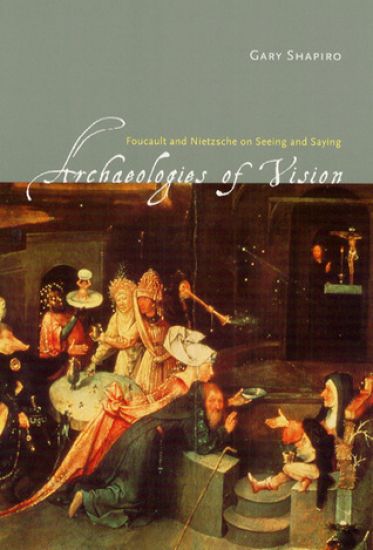
Archaeologies of Vision

Archaeologies of Vision

Gary Shapiro

University of Chicago Press
2003
sidottu
While many acknowledge that Friedrich Nietzsche and Michel Foucault have redefined our notions of time and history, few recognize the crucial role that "the infinite relation" between seeing and saying (as Foucault put it) plays in their work. Gary Shapiro reveals, for the first time, the full extent of Nietzsche and Foucault's concern with the visual. Shapiro explores the whole range of Foucault's writings on visual art, including the theory of visual resistance, the concept of the phantasm or simulacrum, and his interrogation of the relation of painting, language and power in artists from Bosch to Warhol. Shapiro also shows through an excavation of little-known writings that the visual is a major them in Nietzsche's thought. In addition to explaining the significance of Nietzsche's analysis of Raphael, Durer and Claude Lorrain, he examines the philosopher's understanding of the visual dimension of Greek theatre and Wagnerian opera and offers a powerful new reading of "Thus Spoke Zarathustra". "Archaeologies of Vision" should be a valuable work for all scholars of visual culture as well as for those engaged with continental philosophy.
Archaeologies of Vision

Archaeologies of Vision

Gary Shapiro

University of Chicago Press
2003
nidottu
While many acknowledge that Friedrich Nietzsche and Michel Foucault have redefined our notions of time and history, few recognize the crucial role that "the infinite relation" between seeing and saying (as Foucault put it) plays in their work. Gary Shapiro reveals, for the first time, the full extent of Nietzsche and Foucault's concern with the visual. Shapiro explores the whole range of Foucault's writings on visual art, including the theory of visual resistance, the concept of the phantasm or simulacrum, and his interrogation of the relation of painting, language and power in artists from Bosch to Warhol. Shapiro also shows through an excavation of little-known writings that the visual is a major them in Nietzsche's thought. In addition to explaining the significance of Nietzsche's analysis of Raphael, Durer and Claude Lorrain, he examines the philosopher's understanding of the visual dimension of Greek theatre and Wagnerian opera and offers a powerful new reading of "Thus Spoke Zarathustra". "Archaeologies of Vision" should be a valuable work for all scholars of visual culture as well as for those engaged with continental philosophy.
Nietzschean Narratives

Nietzschean Narratives

Gary Shapiro

Indiana University Press
1989
pokkari
" . . . Shapiro's book is bursting with thoughts, and if one is willing to mine them, one is sure to find items of interest or provocation." —The Journal of Aesthetics and Art Criticism Taking issue with a widely held view that Nietzsche's writings are essentially fragmentary or aphoristic, Gary Shapiro focuses on the narrative mode that Nietzsche adopted in many of his works. Such themes as eternal recurrence, the question of origins, and the problematics of self-knowledge are reinterpreted in the context of the narratives in which Nietzsche develops or employs them.