Kirjojen hintavertailu. Mukana 11 979 829 kirjaa ja 12 kauppaa.

Kirjahaku

Etsi kirjoja tekijän nimen, kirjan nimen tai ISBN:n perusteella.

3 kirjaa tekijältä Gary Weissman

Fantasies of Witnessing

Fantasies of Witnessing

Gary Weissman

Cornell University Press
2004
sidottu
Fantasies of Witnessing explores how and why those deeply interested in the Holocaust, yet with no direct, familial connection to it, endeavor to experience it vicariously through sites or texts designed to make it "real" for nonwitnesses. Gary Weissman argues that far from overwhelming nonwitnesses with its magnitude of horror, the Holocaust threatens to feel distant and unreal. A prevailing rhetoric of "secondary" memory and trauma, he contends, and efforts to portray the Holocaust as an immediate and personal experience, are responses to an encroaching sense of unreality: "In America, we are haunted not by the traumatic impact of the Holocaust, but by its absence. When we take an interest in the Holocaust, we are not overcoming a fearful aversion to its horror, but endeavoring to actually feel the horror of what otherwise eludes us."Weissman focuses on specific attempts to locate the Holocaust: in the person of Elie Wiesel, the most renowned survivor, and his classic memoir Night; in videotaped survivor stories and Lawrence L. Langer's celebrated book Holocaust Testimonies; and in the films Shoah and Schindler's List. These representations, he explains, constitute a movement away from the view popularized by Wiesel, that those who did not live through the Holocaust will never be able to grasp its horror, and toward re-creating the Holocaust as an "experience" nonwitnesses may put themselves through. "It is only by acknowledging the desire that gives shape to such representations, and by exploring their place in the ongoing contest over who really 'knows' the Holocaust and feels its horror, that we can arrive at a more candid assessment of our current and future relationships to the Holocaust," he says.
The Writer in the Well

The Writer in the Well

Gary Weissman

Ohio State University Press
2016
sidottu
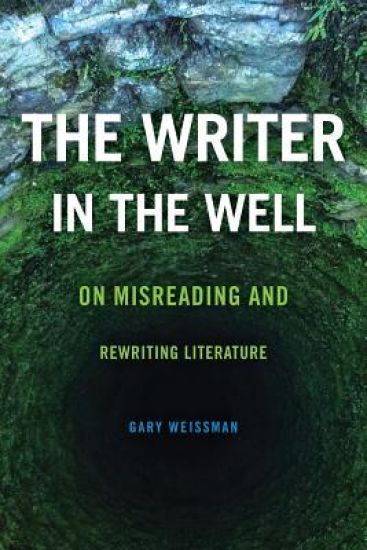
In The Writer in the Well: On Misreading and Rewriting Literature, Gary Weissman argues that the analysis of literature is fundamentally a writing-based practice, a practice in which the process of writing functions as a way of discovering one's interpretation (or "rewriting") of a text. Weissman takes readers inside Ira Sher's short story, "The Man in the Well," and uses his students' wide variety of interpretive responses to ask foundational questions about composition and interpretation: How is writing, rather than reading alone, central to literary interpretation? How does a diversity of interpretive responses give us deeper insight into a work of fiction? The Writer in the Well directly involves readers in the pleasurably absorbing process of reading and interpreting Sher's tale, a haunting story about a group of children who discover a man trapped in a well and choose not to save him. Weissman draws on dozens of his students' responses to the short story, as well as his dialogue with its author, to show that the deepest literary analysis occurs when we approach it as a collaborative, writing-based enterprise. The Writer in the Well also finds particular value in misreadings, suggesting that the richest understanding of a work of fiction lies in probing the various ways it has been misinterpreted and reconceived. Weissman's study redefines the nature of authorial intention and rethinks the methods and goals of literary analysis. Integrating writing pedagogy with older and newer schools of thought-from psychoanalysis, reader-response theory, and poststructuralism to rhetorical narrative theory and cognitive literary studies-and bridging the fields of literary studies, composition and rhetoric, and creative writing, The Writer in the Well offers a new "writer-response" theory. This highly accessible and rigorous book is designed to engage a wide range of scholars, teachers, and students.
The Writer in the Well

The Writer in the Well

Gary Weissman

Ohio State University Press
2018
pokkari
In The Writer in the Well: On Misreading and Rewriting Literature, Gary Weissman argues that the analysis of literature is fundamentally a writing-based practice, a practice in which the process of writing functions as a way of discovering one's interpretation (or "rewriting") of a text. Weissman takes readers inside Ira Sher's short story, "The Man in the Well," and uses his students' wide variety of interpretive responses to ask foundational questions about composition and interpretation: How is writing, rather than reading alone, central to literary interpretation? How does a diversity of interpretive responses give us deeper insight into a work of fiction? The Writer in the Well directly involves readers in the pleasurably absorbing process of reading and interpreting Sher's tale, a haunting story about a group of children who discover a man trapped in a well and choose not to save him. Weissman draws on dozens of his students' responses to the short story, as well as his dialogue with its author, to show that the deepest literary analysis occurs when we approach it as a collaborative, writing-based enterprise. The Writer in the Well also finds particular value in misreadings, suggesting that the richest understanding of a work of fiction lies in probing the various ways it has been misinterpreted and reconceived. Weissman's study redefines the nature of authorial intention and rethinks the methods and goals of literary analysis. Integrating writing pedagogy with older and newer schools of thought--from psychoanalysis, reader-response theory, and poststructuralism to rhetorical narrative theory and cognitive literary studies--and bridging the fields of literary studies, composition and rhetoric, and creative writing, The Writer in the Well offers a new "writer-response" theory. This highly accessible and rigorous book is designed to engage a wide range of scholars, teachers, and students.