Kirjojen hintavertailu. Mukana 11 627 220 kirjaa ja 12 kauppaa.

Kirjahaku

Etsi kirjoja tekijän nimen, kirjan nimen tai ISBN:n perusteella.

3 kirjaa tekijältä Geoffrey Hodgson

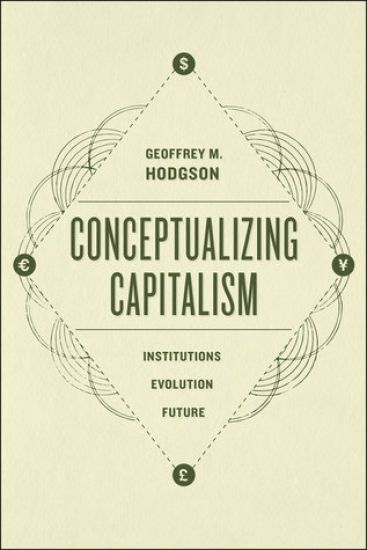
Conceptualizing Capitalism – Institutions, Evolution, Future

Conceptualizing Capitalism – Institutions, Evolution, Future

Geoffrey Hodgson

University of Chicago Press
2015
sidottu
A few centuries ago, capitalism set in motion an explosion of economic productivity. Markets and private property had existed for millennia, but what other key institutions fostered capitalism's relatively recent emergence? Until now, the conceptual toolkit available to answer this question has been inadequate, and economists and other social scientists have been diverted from identifying these key institutions. With Conceptualizing Capitalism, Geoffrey M Hodgson offers readers a more precise conceptual framework. Drawing on a new theoretical approach called legal institutionalism, Hodgson establishes that the most important factor in the emergence of capitalism - but also among the most often overlooked - is the constitutive role of law and the state. While private property and markets are central to capitalism, they depend upon the development of an effective legal framework. Applying this legally grounded approach to the emergence of capitalism in eighteenth - century Europe, Hodgson identifies the key institutional developments that coincided with its rise. That analysis enables him to counter the widespread view that capitalism is a natural and inevitable outcome of human societies, showing instead that it is a relatively recent phenomenon, contingent upon a special form of state that protects private property and enforces contracts. After establishing the nature of capitalism, the book considers what this more precise conceptual framework can tell us about the possible future of capitalism in the twenty-first century, where some of the most important concerns are the effects of globalization, the continuing growth of inequality, and the challenges to America's hegemony by China and others.
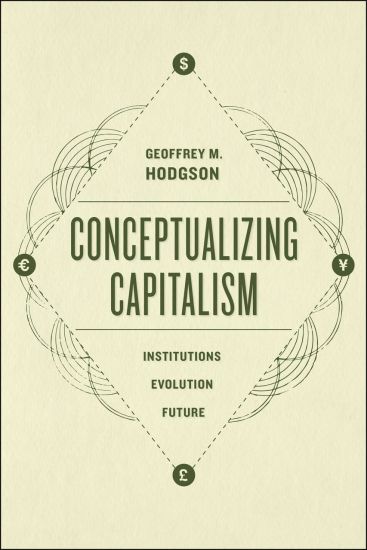
Conceptualizing Capitalism – Institutions, Evolution, Future

Conceptualizing Capitalism – Institutions, Evolution, Future

Geoffrey Hodgson

University of Chicago Press
2016
nidottu
A few centuries ago, capitalism set in motion an explosion of economic productivity. Markets and private property had existed for millennia, but what other key institutions fostered capitalism's relatively recent emergence? Until now, the conceptual toolkit available to answer this question has been inadequate, and economists and other social scientists have been diverted from identifying these key institutions. With Conceptualizing Capitalism, Geoffrey M. Hodgson offers readers a more precise conceptual framework. Drawing on a new theoretical approach called legal institutionalism, Hodgson establishes that the most important factor in the emergence of capitalism but also among the most often overlooked is the constitutive role of law and the state. While private property and markets are central to capitalism, they depend upon the development of an effective legal framework. Applying this legally grounded approach to the emergence of capitalism in eighteenth-century Europe, Hodgson identifies the key institutional developments that coincided with its rise. That analysis enables him to counter the widespread view that capitalism is a natural and inevitable outcome of human societies, showing instead that it is a relatively recent phenomenon, contingent upon a special form of state that protects private property and enforces contracts. After establishing the nature of capitalism, the book considers what this more precise conceptual framework can tell us about the possible future of capitalism in the twenty-first century, where some of the most important concerns are the effects of globalization, the continuing growth of inequality, and the challenges to America's hegemony by China and others.
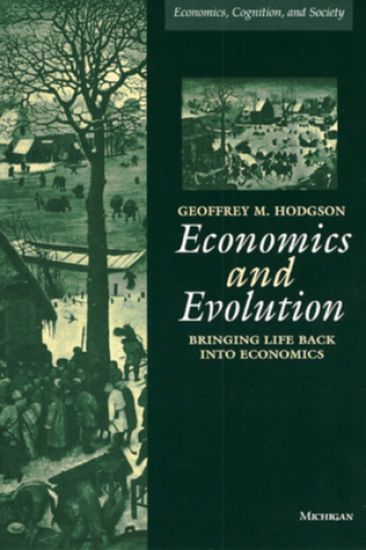
Economics and Evolution

Economics and Evolution

Geoffrey Hodgson

The University of Michigan Press
1996
nidottu
Economic theory is currently at a crossroads, where many leading mainstream economists are calling for a more realistic and practical orientation for economic science. Indeed, many are suggesting that economics should be reconstructed on evolutionary lines.This book is about the application to economics of evolutionary ideas from biology. It is not about selfish genes or determination of our behavior by genetic code. The idea that evolution supports a laissez-faire policy is rebutted. The conception of evolution as progress toward greater perfection, along with the competitive individualism sometimes inferred from the notion of the "survival of the fittest," is found to be problematic. Hodgson explores the ambiguities inherent in biology and the problems involved in applying ideas of past economic thinkers--including Malthus, Smith, Marx, Marshall, Veblen, Schumpeter, and Hayek--and argues that the new evolutionary economics can learn much from the many differing conceptions of economic evolution."This is a work of enormous perceptivity and subtlety as well as judiciousness of interpretation and critique . . . [that] establish[es] Hodgson as the leading institutional theorist, and as one of the leading evolutionary theorists, of his generation." --Warren J. Samuels"A daring and successful attempt to expunge the monopoly of reductionist and mechanistic thinking over evolutionary theory . . . a must for anyone who is interested not only in the foundations of economics, but also in the foundations of social theory." --Elias L. Khalil, Ohio State UniversityGeoffrey M. Hodgson is University Lecturer in Economics, Judge Institute for Management Studies, University of Cambridge.