Kirjojen hintavertailu. Mukana 11 342 296 kirjaa ja 12 kauppaa.

Kirjahaku

Etsi kirjoja tekijän nimen, kirjan nimen tai ISBN:n perusteella.

24 kirjaa tekijältä Geoffrey Samuel

Introducing Tibetan Buddhism

Introducing Tibetan Buddhism

Geoffrey Samuel

Routledge
2012
sidottu
This lively introduction is the ideal starting point for students wishing to undertake a comprehensive study of Tibetan religion. It covers the development and influence of Tibetan Buddhism and the key schools and traditions, including Bon. Geoffrey Samuel helps students get to grips with a complex set of beliefs and practices and provides a clear sense of the historical, cultural and textual background. Important contemporary issues such as gender, national identity and Tibetan Buddhism in the world today are also addressed. Illustrated throughout, the book includes a chronology, glossary, pronunciation guide, summaries, discussion questions and suggestions for further reading that will aid understanding and revision.
Introducing Tibetan Buddhism

Introducing Tibetan Buddhism

Geoffrey Samuel

Routledge
2012
nidottu
This lively introduction is the ideal starting point for students wishing to undertake a comprehensive study of Tibetan religion. It covers the development and influence of Tibetan Buddhism and the key schools and traditions, including Bon. Geoffrey Samuel helps students get to grips with a complex set of beliefs and practices and provides a clear sense of the historical, cultural and textual background. Important contemporary issues such as gender, national identity and Tibetan Buddhism in the world today are also addressed. Illustrated throughout, the book includes a chronology, glossary, pronunciation guide, summaries, discussion questions and suggestions for further reading that will aid understanding and revision.
Mind, Body and Culture

Mind, Body and Culture

Geoffrey Samuel

Cambridge University Press
1990
sidottu
Concerned with the aspects of human behaviour which have been traditionally described as cultural or social, the author draws on his background in physics to suggest a scientific approach involving a reconceptualization of many of our assumed concepts. Are culture, society and similar concepts from anthropology and sociology of any real use in making sense of human social life? How can we understand the relationship between the social group and the individual human beings, with their self-awareness and sense of personal identity, who make it up? Drawing on his background in physics, Dr Samuel suggests a scientific approach involving a reconceptualization of many of the concepts we take for granted. The multimodal framework, or MMF, derives from this approach. It incorporates many of the insights of social and cultural anthropology, particularly the work of Gregory Bateson and Victor Turner, as well as being influenced by recent developments in the philosophy of science and related fields. Finally, the book considers some of the implications of the MMF for biological approaches, and focuses on questions of brain structure and on evolutionary explanations for human social behaviour.
The Origins of Yoga and Tantra

The Origins of Yoga and Tantra

Geoffrey Samuel

Cambridge University Press
2008
pokkari
Yoga, tantra and other forms of Asian meditation are practised in modernized forms throughout the world today, but most introductions to Hinduism or Buddhism tell only part of the story of how they developed. This book is an interpretation of the history of Indic religions up to around 1200 CE, with particular focus on the development of yogic and tantric traditions. It assesses how much we really know about this period, and asks what sense we can make of the evolution of yogic and tantric practices, which were to become such central and important features of the Indic religious scene. Its originality lies in seeking to understand these traditions in terms of the total social and religious context of South Asian society during this period, including the religious practices of the general population with their close engagement with family, gender, economic life and other pragmatic concerns.
The Origins of Yoga and Tantra

The Origins of Yoga and Tantra

Geoffrey Samuel

Cambridge University Press
2008
sidottu
Yoga, tantra and other forms of Asian meditation are practised in modernized forms throughout the world today, but most introductions to Hinduism or Buddhism tell only part of the story of how they developed. This book is an interpretation of the history of Indic religions up to around 1200 CE, with particular focus on the development of yogic and tantric traditions. It assesses how much we really know about this period, and asks what sense we can make of the evolution of yogic and tantric practices, which were to become such central and important features of the Indic religious scene. Its originality lies in seeking to understand these traditions in terms of the total social and religious context of South Asian society during this period, including the religious practices of the general population with their close engagement with family, gender, economic life and other pragmatic concerns.
Dictionary of European Comparative Law and Legal Culture

Dictionary of European Comparative Law and Legal Culture

Geoffrey Samuel

Ashgate Publishing Limited
2020
sidottu
This volume provides a valuable companion for students and researchers of European Comparative Law. Arranged alphabetically and cross-referenced, each entry presents an introduction to key topics. Comprising approximately 1500 words, these short essays go beyond the merely descriptive to provide an informative resource for students of Comparative Law, Legal Philosophy and Legal Systems in general.
Tantric Revisionings

Tantric Revisionings

Geoffrey Samuel

Ashgate Publishing Limited
2005
sidottu
Tantric Revisionings presents stimulating new perspectives on Hindu and Buddhist religion, particularly their Tantric versions, in India, Tibet or in modern Western societies. Geoffrey Samuel adopts an historically and textually informed anthropological approach, seeking to locate and understand religion in its social and cultural context. The question of the relation between 'popular' (folk, domestic, village, 'shamanic') religion and elite (literary, textual, monastic) religion forms a recurring theme through these studies. Six chapters have not been previously published; the previously published studies included are in publications which are difficult to locate outside major specialist libraries.
Principia Iuris

Principia Iuris

Geoffrey Samuel

EDWARD ELGAR PUBLISHING LTD
2025
sidottu
This book provides a strong introduction to the principal domains of legal knowledge by examining a structured list of legal maxims, many originating in medieval Roman and canon law. Oriented by historical and methodological approaches, it explores legal thought and reasoning through a comparative lens.
Law of Obligations & Legal Remedies

Law of Obligations & Legal Remedies

Geoffrey Samuel

CRC Press
2017
sidottu
This book examines the notion of a law of obligations as a conceptual category in itself; and, in doing this, it presents the foundational material in a context that draws on some comparative and theoretical ideas while, at the same time, emphasising the special characteristics of the common law.The book is specifically designed to act as an introduction to the legal research skills of reasoning and method. It also looks at the foundations of civil liability in a way that emphasises the interrelationship of source materials, problem solving and conceptual analysis and justification.
Tantric Revisionings

Tantric Revisionings

Geoffrey Samuel

Routledge
2017
nidottu
Tantric Revisionings presents stimulating new perspectives on Hindu and Buddhist religion, particularly their Tantric versions, in India, Tibet or in modern Western societies. Geoffrey Samuel adopts an historically and textually informed anthropological approach, seeking to locate and understand religion in its social and cultural context. The question of the relation between 'popular' (folk, domestic, village, 'shamanic') religion and elite (literary, textual, monastic) religion forms a recurring theme through these studies. Six chapters have not been previously published; the previously published studies included are in publications which are difficult to locate outside major specialist libraries.
Epistemology and Method in Law

Epistemology and Method in Law

Geoffrey Samuel

Routledge
2016
nidottu
This book seeks to question the widely held assumption in Europe that to have knowledge of law is simply to have knowledge of rules. There is a knowledge dimension beyond the symbolic which reaches right into the way facts are perceived, constructed and deconstructed. In support of this thesis the book examines, generally, the question of what it is to have knowledge of law; and this examination embraces not just the conceptual foundations, methods, taxonomy and theories used by jurists. It also examines the epistemological schemes used by social scientists in general in order to show that such schemes are closely related to the schemes of intelligibility used by lawyers and judges.
A Short Introduction to the Common Law

A Short Introduction to the Common Law

Geoffrey Samuel

Edward Elgar Publishing Ltd
2013
sidottu
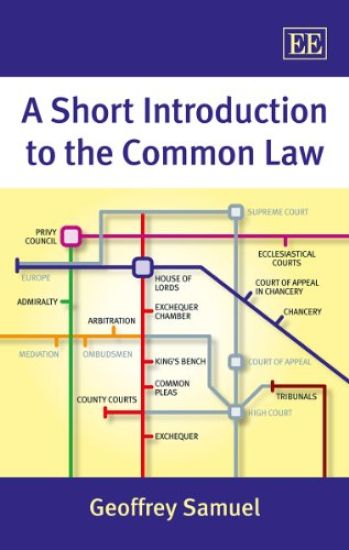
Geoffrey Samuel's distinctive approach is to present the English common law in the light of its history and its dominant ideas. A student will learn not only what are the major rules of private law and civil law procedure, but will grasp the spirit of the common law. He will thus learn why they exist in a particular form and how common lawyers make them work. Civilian terms are used to provide a guide for the student from a civil law system to understand the initially strange terms and approaches of the common lawyer. This book is clear and insightful. It should be read particularly by Masters students and those embarking on a doctorate involving study of the common law.'- John Bell, Pembroke College, UK'To write a good introduction to the common law aimed mainly at civil lawyers is a real challenge. One needs not only to master the common law, its history and its sociological backgrounds, but also to understand how the prospective readers think in their own civilian legal systems. With his longstanding teaching activities in civil law countries, his obvious deep knowledge of the historical roots of civil and common law, Geoffrey Samuel offers here a book which should be pressed into every hands across the civil law world. Finally, we get here an introduction to the common law truly written for civilian lawyers and students, which is easy to understand and thoughtful. A brilliant piece for which the author should be praised.'- Pascal Pichonnaz, University of Fribourg, Switzerland'Common law has remained enigmatic for lawyers from the civil law legal culture. This book presents a wonderfully compact introduction to the English common law and explains concisely why it is as it is today. Geoffrey Samuel offers insightful and scholarly first-rate representation of those characteristics which stand out for the civil law lawyer. Clarifying and supporting diagrams are especially helpful for non-common law lawyers. Samuel's A Short Introduction to the Common Law is highly recommended for anyone looking for clear and fluently written basic insight into the common law and its historical foundation.'- Jaakko Husa, University of Lapland, FinlandThis book provides a short, accessible introduction to the English common law tradition, in particular to the civil process.It adopts an approach which explains the historical development of the common law institutions and procedures whilst also setting them in perspective through a comparative outlook. Aspects of the common law are contrasted on occasions with structural or functional equivalents (or near equivalents) in the civil law. The key topics covered include: the English civil courts (and other dispute resolution institutions and alternatives), civil procedure, remedies, sources of law, legal reasoning, legal education, legal theories, legal institutions and concepts and legal categories. In addition to textual description and analysis, the book makes frequent use of visual diagrams to explain and to illustrate aspects of the common law.Providing both an overview of the English common law and an insight into the legal mentality of common lawyers, the book will appeal both to first year law students as well as to continental jurists who are investigating the common law for the first time.Contents: Preface Introduction 1. Development of the English Courts 2. Development of the English Procedural Tradition 3. English Law Remedies 4. English Legal Education and English Legal Thought (1): Sources and Methods 5. English Legal Education and English Legal Thought (2): Academic Theories 6. Legal Institutions and Concepts in the Common Law (1): Persons and Things 7. Legal Institutions and Concepts in the Common Law (2): Causes of Action and Obligations Concluding Remarks Bibliography Index
A Short Introduction to the Common Law

A Short Introduction to the Common Law

Geoffrey Samuel

Edward Elgar Publishing Ltd
2014
nidottu
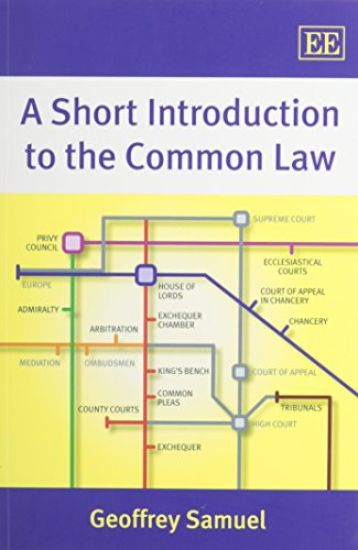
Geoffrey Samuel's distinctive approach is to present the English common law in the light of its history and its dominant ideas. A student will learn not only what are the major rules of private law and civil law procedure, but will grasp the spirit of the common law. He will thus learn why they exist in a particular form and how common lawyers make them work. Civilian terms are used to provide a guide for the student from a civil law system to understand the initially strange terms and approaches of the common lawyer. This book is clear and insightful. It should be read particularly by Masters students and those embarking on a doctorate involving study of the common law.'- John Bell, Pembroke College, UK'To write a good introduction to the common law aimed mainly at civil lawyers is a real challenge. One needs not only to master the common law, its history and its sociological backgrounds, but also to understand how the prospective readers think in their own civilian legal systems. With his longstanding teaching activities in civil law countries, his obvious deep knowledge of the historical roots of civil and common law, Geoffrey Samuel offers here a book which should be pressed into every hands across the civil law world. Finally, we get here an introduction to the common law truly written for civilian lawyers and students, which is easy to understand and thoughtful. A brilliant piece for which the author should be praised.'- Pascal Pichonnaz, University of Fribourg, Switzerland'Common law has remained enigmatic for lawyers from the civil law legal culture. This book presents a wonderfully compact introduction to the English common law and explains concisely why it is as it is today. Geoffrey Samuel offers insightful and scholarly first-rate representation of those characteristics which stand out for the civil law lawyer. Clarifying and supporting diagrams are especially helpful for non-common law lawyers. Samuel's A Short Introduction to the Common Law is highly recommended for anyone looking for clear and fluently written basic insight into the common law and its historical foundation.'- Jaakko Husa, University of Lapland, FinlandThis book provides a short, accessible introduction to the English common law tradition, in particular to the civil process.It adopts an approach which explains the historical development of the common law institutions and procedures whilst also setting them in perspective through a comparative outlook. Aspects of the common law are contrasted on occasions with structural or functional equivalents (or near equivalents) in the civil law. The key topics covered include: the English civil courts (and other dispute resolution institutions and alternatives), civil procedure, remedies, sources of law, legal reasoning, legal education, legal theories, legal institutions and concepts and legal categories. In addition to textual description and analysis, the book makes frequent use of visual diagrams to explain and to illustrate aspects of the common law.Providing both an overview of the English common law and an insight into the legal mentality of common lawyers, the book will appeal both to first year law students as well as to continental jurists who are investigating the common law for the first time.Contents: Preface Introduction 1. Development of the English Courts 2. Development of the English Procedural Tradition 3. English Law Remedies 4. English Legal Education and English Legal Thought (1): Sources and Methods 5. English Legal Education and English Legal Thought (2): Academic Theories 6. Legal Institutions and Concepts in the Common Law (1): Persons and Things 7. Legal Institutions and Concepts in the Common Law (2): Causes of Action and Obligations Concluding Remarks Bibliography Index

Rethinking Legal Reasoning

Rethinking Legal Reasoning

Geoffrey Samuel

Edward Elgar Publishing Ltd
2018
sidottu
‘'Rethinking’' legal reasoning seems a bold aim given the large amount of literature devoted to this topic. In this thought-provoking book, Geoffrey Samuel proposes a different way of approaching legal reasoning by examining the topic through the context of legal knowledge (epistemology). What is it to have knowledge of legal reasoning? At a more specific level the pursuit of this understanding is conducted through posing a number of questions that are founded on different approaches. What has legal reasoning been? What are the institutional and conceptual legacies of this history? What is the literature and textual heritage? How does it compare with medical reasoning and with reasoning in the humanities? Can it be demystified? In exploring these questions Samuel suggests a number of frameworks that offer some new insights into the nature of legal reasoning. The author also puts forward two key ideas. First, that the legal notion of an '‘interest’' might perhaps be a very suitable artefact for rethinking legal reasoning; and, secondly, that fiction theory might be the most viable ‘'epistemological attitude’' for understanding, if not rethinking, reasoning in law. This book will be of great interest to academics who are researching legal method and legal reasoning, as well as epistemology of the social sciences and aspects of comparative law. It will also be an insightful text for those interested in legal history and historical perspectives on legal reasoning.
Rethinking Legal Reasoning

Rethinking Legal Reasoning

Geoffrey Samuel

Edward Elgar Publishing Ltd
2020
nidottu
‘'Rethinking’' legal reasoning seems a bold aim given the large amount of literature devoted to this topic. In this thought-provoking book, Geoffrey Samuel proposes a different way of approaching legal reasoning by examining the topic through the context of legal knowledge (epistemology). What is it to have knowledge of legal reasoning? At a more specific level the pursuit of this understanding is conducted through posing a number of questions that are founded on different approaches. What has legal reasoning been? What are the institutional and conceptual legacies of this history? What is the literature and textual heritage? How does it compare with medical reasoning and with reasoning in the humanities? Can it be demystified? In exploring these questions Samuel suggests a number of frameworks that offer some new insights into the nature of legal reasoning. The author also puts forward two key ideas. First, that the legal notion of an '‘interest’' might perhaps be a very suitable artefact for rethinking legal reasoning; and, secondly, that fiction theory might be the most viable ‘'epistemological attitude’' for understanding, if not rethinking, reasoning in law. This book will be of great interest to academics who are researching legal method and legal reasoning, as well as epistemology of the social sciences and aspects of comparative law. It will also be an insightful text for those interested in legal history and historical perspectives on legal reasoning.
A Short Introduction to Judging and to Legal Reasoning

A Short Introduction to Judging and to Legal Reasoning

Geoffrey Samuel

Edward Elgar Publishing Ltd
2016
sidottu
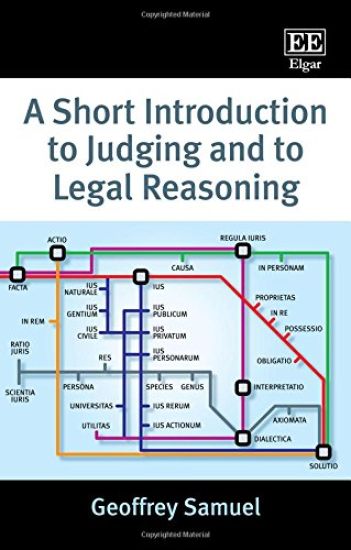
This Short Introduction looks at judging and reasoning from three perspectives: what legal reasoning has been; what legal reasoning is from the view of judges and jurists; and what legal reasoning is from the view of a social scientist epistemologist or humanities specialist. Geoffrey Samuel begins by identifying the main institutional focal points of legal reasoning (ius, regulae iuris, Interpretatio, utilitas and actiones). While examining legal reasoning from both an internal and external viewpoint, the book simultaneously incorporates theory and scholarship from a range of other disciplines including social science and film studies. The author also includes a discussion of fiction theory, schemes of intelligibility, and other epistemological issues as well as standard reasoning devices such as induction, deduction and analogy.Combining cases and materials with original text, this unique, concise format is designed to be accessible for students who are starting out on their law programs, as well as providing insights for students and researchers who would like to examine judging and legal reasoning in more depth.
A Short Introduction to Judging and to Legal Reasoning

A Short Introduction to Judging and to Legal Reasoning

Geoffrey Samuel

Edward Elgar Publishing Ltd
2017
nidottu
This Short Introduction looks at judging and reasoning from three perspectives: what legal reasoning has been; what legal reasoning is from the view of judges and jurists; and what legal reasoning is from the view of a social scientist epistemologist or humanities specialist. Geoffrey Samuel begins by identifying the main institutional focal points of legal reasoning (ius, regulae iuris, Interpretatio, utilitas and actiones). While examining legal reasoning from both an internal and external viewpoint, the book simultaneously incorporates theory and scholarship from a range of other disciplines including social science and film studies. The author also includes a discussion of fiction theory, schemes of intelligibility, and other epistemological issues as well as standard reasoning devices such as induction, deduction and analogy.Combining cases and materials with original text, this unique, concise format is designed to be accessible for students who are starting out on their law programs, as well as providing insights for students and researchers who would like to examine judging and legal reasoning in more depth.
Rethinking Historical Jurisprudence

Rethinking Historical Jurisprudence

Geoffrey Samuel

EDWARD ELGAR PUBLISHING LTD
2022
sidottu
This stimulating book considers the ways in which historical jurisprudence deserves to be rethought, arguing that there is much more to the history of legal thought than the ideas, and ideology, of the nineteenth and early twentieth century jurists, such as Karl von Savigny and Sir Henry Maine.
Law of Obligations

Law of Obligations

Geoffrey Samuel

Edward Elgar Publishing Ltd
2010
sidottu
This comprehensive book presents the English law of contract and tort in the context of a European law of obligations.Law of Obligations provides the reader with an overview of contract and tort as well as an introduction to the law of obligations in the civil (or continental) law tradition. The book is considered an extensive introduction to the western law of obligations, but with an emphasis on English law. Arising out of the analysis of the two legal traditions, Geoffrey Samuel raises questions about the appropriateness of importing the obligations category into the common law. He also highlights what has been termed the ‘harmonisation debate’; should the law of obligations be harmonised at a European – or even international level? The debate raises some fundamental issues not just about legal traditions and about the law of obligations itself, but also about comparative law theory and methodology.Designed with English law students and jurists in mind, this book will be an invaluable tool for researching contract, tort and the law of obligations. It is an original contribution not only to European private law but equally to comparative legal studies.
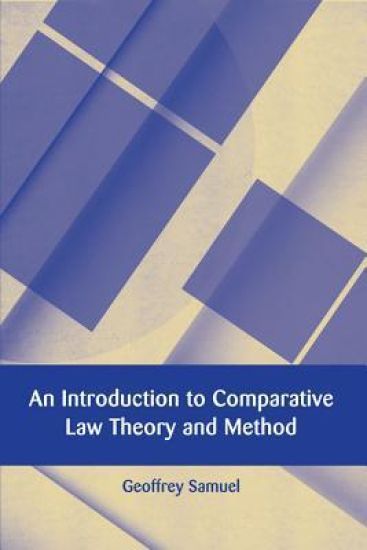
An Introduction to Comparative Law Theory and Method
This short book on comparative law theory and method is designed primarily for postgraduate research students whose work involves comparison between legal systems. It is, accordingly, a book on research methods, although it will also be of relevance to all students (undergraduate and postgraduate) taking courses in comparative law and to academics entering the field of comparison. The substance of the book has been developed over many years of teaching general theory of comparative law, primarily on the European Academy of Legal Theory programme in Brussels but also on other programmes in French, Belgian and English universities. It is arguable that there has been to date no single introductory work exclusively devoted to comparative law methodology and thus this present book aims to fill this gap.