Kirjojen hintavertailu. Mukana 11 342 296 kirjaa ja 12 kauppaa.

Kirjahaku

Etsi kirjoja tekijän nimen, kirjan nimen tai ISBN:n perusteella.

9 kirjaa tekijältä Geoffrey Stone

But Where is the Rainbow?

But Where is the Rainbow?

Geoffrey Stone

Tellwell Talent
2023
pokkari
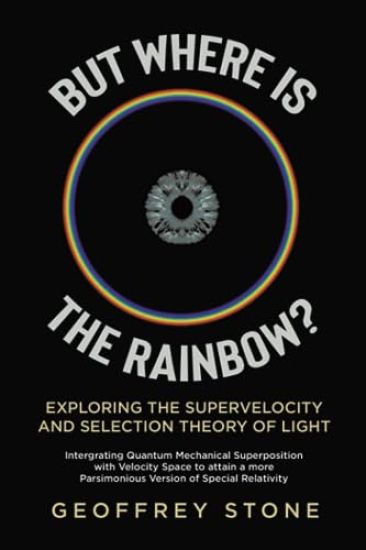
This book introduces and defends a new theory about the speed of light. The Supervelocity and Selection theory of Light adheres to the original core postulates of special relativity while also circumventing the need for its relativistic distortions in time and space. This novel theory explains the observer-centred and observer-dependent traits of the speed of light much more efficiently than any prior theory, and it dispenses with the notion of the speed of light as a cosmic speed limit. A supervelocity is essentially a quantum superposition, except that it occupies velocity space, which is a special framework that provides us with an objective way to map out relative velocities. According to this theory, light is neither a particle, nor a wave, but a superwave. A superwave travels at multiple speeds at the same time, while seeming to travel at a single speed. The effect is similar to how the arc of a rainbow appears to stand in a particular location, but it really doesn't. Light waves only appear to travel at a specific speed after having been selected and made visible, according to their distance from the observer's current location in velocity space. This selection process is analogous to how an observer filters out all of the light that isn't directed at their pupil, but the light itself travels in all directions, simultaneously.The Supervelocity and Selection theory of Light makes testable predictions. It could either be confirmed or refuted, merely by observing the rhythms of pulsars in the Andromeda galaxy. The purported evidence for inertial time dilation and length contraction will also be reviewed and debunked.
But Where is the Rainbow?

But Where is the Rainbow?

Geoffrey Stone

Tellwell Talent
2023
sidottu
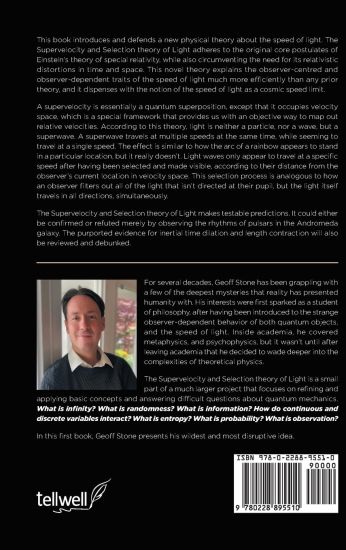
This book introduces and defends a new theory about the speed of light. The Supervelocity and Selection theory of Light adheres to the original core postulates of special relativity while also circumventing the need for its relativistic distortions in time and space. This novel theory explains the observer-centred and observer-dependent traits of the speed of light much more efficiently than any prior theory, and it dispenses with the notion of the speed of light as a cosmic speed limit. A supervelocity is essentially a quantum superposition, except that it occupies velocity space, which is a special framework that provides us with an objective way to map out relative velocities. According to this theory, light is neither a particle, nor a wave, but a superwave. A superwave travels at multiple speeds at the same time, while seeming to travel at a single speed. The effect is similar to how the arc of a rainbow appears to stand in a particular location, but it really doesn't. Light waves only appear to travel at a specific speed after having been selected and made visible, according to their distance from the observer's current location in velocity space. This selection process is analogous to how an observer filters out all of the light that isn't directed at their pupil, but the light itself travels in all directions, simultaneously.The Supervelocity and Selection theory of Light makes testable predictions. It could either be confirmed or refuted, merely by observing the rhythms of pulsars in the Andromeda galaxy. The purported evidence for inertial time dilation and length contraction will also be reviewed and debunked.
Speaking Out! Reflections on Law, Liberty and Justice
Speaking Out! is a compilation of constitutional law professor Geoffrey R. Stone's op-eds and blog posts addressing a range of controversial issues, including government-authorized torture, electronic surveillance, military tribunals, religion and the law, same-sex marriage, freedom of speech, freedom of the press, Supreme Court nominations and confirmations, and the role and responsibilities of the Supreme Court in our democratic society.