Kirjojen hintavertailu. Mukana 12 016 292 kirjaa ja 12 kauppaa.

Kirjahaku

Etsi kirjoja tekijän nimen, kirjan nimen tai ISBN:n perusteella.

9 kirjaa tekijältä Georg Cavallar

Imperfect Cosmopolis

Imperfect Cosmopolis

Georg Cavallar

University of Wales Press
2011
nidottu
In current debates, the term cosmopolitanismA" often remains quite vague and leads to sweeping generalizations. Unlike many recent publications, this book looks at the notion from a decidedly historical perspective, trying to give depth and texture to the concept.
The Rights of Strangers

The Rights of Strangers

Georg Cavallar

Ashgate Publishing Limited
2002
sidottu
This study investigates the thinking of European authors from Vitoria to Kant about political justice, the global community, and the rights of strangers as one special form of interaction among individuals of divergent societies, political communities, and cultures. Taking an interdisciplinary approach, it covers historical material from a predominantly philosophical perspective, interpreting authors who have tackled problems related to the rights of strangers under the heading of international hospitality. Their analyses of the civitas maxima or the societas humani generis covered the nature of the global commonwealth. Their doctrines of natural law (ius naturae) were supposed to provide what we nowadays call theories of political justice. The focus of the work is on international hospitality as part of the law of nations, on its scope and justification. It follows the political ideas of Francisco de Vitoria and the Second Scholastic in the 16th century, of Alberico Gentili, Hugo Grotius, Samuel Pufendorf, Christian Wolff, Emer de Vattel, Johann Jacob Moser, and Immanuel Kant. It draws attention to the international dimension of political thought in Thomas Hobbes, John Locke, Jean-Jacques Rousseau, David Hume, Adam Smith, and others. This is predominantly a study in intellectual history which contextualizes ideas, but also emphasizes their systematic relevance.
Kant and the Theory and Practice of International Right

Kant and the Theory and Practice of International Right

Georg Cavallar

University of Wales Press
2020
nidottu
This book argues that Kant’s theory of international relations should be interpreted as an attempt to apply the principles of reason to history in general, and in particular to political conditions of the late eighteenth century. It demonstrates how Kant attempts to mediate between a priori theory and practice, and how this works in the field of international law and international relations. Kant appreciates how the precepts of theory have to be tested against the facts, before the theory is enriched to deal with the complexities of their application. In the central chapters of this book, the starting points are apparent contradictions in Kant’s writings; assuming that Kant is a systematic and profound thinker, Cavallar seeks to use these contradictions to discover Kant’s ‘deep structure’, a dynamic and evolutionary theory that tries to anticipate a world where the idea of international justice might be more fully realized.
Theories of Dynamic Cosmopolitanism in Modern European History
It is often assumed that cosmopolitan thinkers since the Renaissance have simply adopted and refined concepts from classical antiquity. This study argues that modern European cosmopolitanism should be perceived as a unique phenomenon, distinct from Greek and Roman forms of cosmopolitan thinking. One key feature is its dynamism, or the idea of change built into modern theories of cosmopolitanism. Covering the period from the 1530s to the 1920s, this book investigates various manifestations of cosmopolitanism, including normative individualism, the dawn of historical thinking, and the dynamic conceptions of law and rights and of the international community. It analyses the international legal theories of selected authors from Francisco de Vitoria to Austrian lawyers Heinrich Lammasch and Alfred Verdross. The author focuses in particular on the development of hospitality rights and the right to immigration, republicanism and cosmopolitanism, and cosmopolitan education.
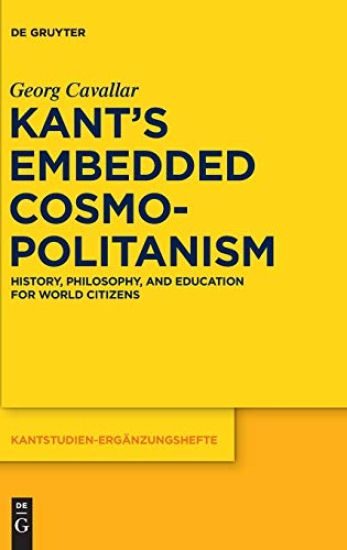
Kant’s Embedded Cosmopolitanism

Kant’s Embedded Cosmopolitanism

Georg Cavallar

De Gruyter
2015
sidottu
Kant’s omnipresence in contemporary cosmopolitan discourses contrasts with the fact that little is known about the historical origins and the systematic status of his cosmopolitan theory. This study argues that Kant’s cosmopolitanism should be understood as embedded and dynamic. Inspired by Rousseau, Kant developed a form of cosmopolitanism rooted in a modified form of republican patriotism. In contrast to static forms of cosmopolitanism, Kant conceived the tensions between embedded, local attachments and cosmopolitan obligations in dynamic terms. He posited duties to develop a cosmopolitan disposition (Gesinnung), to establish common laws or cosmopolitan institutions, and to found and promote legal, moral, and religious communities which reform themselves in a way that they can pass the test of cosmopolitan universality. This is the cornerstone of Kant’s cosmopolitanism, and the key concept is the vocation (Bestimmung) of the individual as well as of the human species. Since realizing or at least approaching this vocation is a long-term, arduous, and slow process, Kant turns to the pedagogical implications of this cosmopolitan project and spells them out in his later writings. This book uncovers Kant’s hidden theory of cosmopolitan education within the framework of his overall practical philosophy.
Kant’s Embedded Cosmopolitanism

Kant’s Embedded Cosmopolitanism

Georg Cavallar

De Gruyter
2017
isokokoinen pokkari
Kant’s omnipresence in contemporary cosmopolitan discourses contrasts with the fact that little is known about the historical origins and the systematic status of his cosmopolitan theory. This study argues that Kant’s cosmopolitanism should be understood as embedded and dynamic. Inspired by Rousseau, Kant developed a form of cosmopolitanism rooted in a modified form of republican patriotism. In contrast to static forms of cosmopolitanism, Kant conceived the tensions between embedded, local attachments and cosmopolitan obligations in dynamic terms. He posited duties to develop a cosmopolitan disposition (Gesinnung), to establish common laws or cosmopolitan institutions, and to found and promote legal, moral, and religious communities which reform themselves in a way that they can pass the test of cosmopolitan universality. This is the cornerstone of Kant’s cosmopolitanism, and the key concept is the vocation (Bestimmung) of the individual as well as of the human species. Since realizing or at least approaching this vocation is a long-term, arduous, and slow process, Kant turns to the pedagogical implications of this cosmopolitan project and spells them out in his later writings. This book uncovers Kant’s hidden theory of cosmopolitan education within the framework of his overall practical philosophy.
Failed Enlightenment?

Failed Enlightenment?

Georg Cavallar

De Gruyter
2026
isokokoinen pokkari
This concise yet comprehensive introduction to the philosophy of the Enlightenment is designed for a general academic audience. Combining historical context with philosophy, it targets both students and researchers. It is of relevance for historians, philosophers and anyone interested in the Enlightenment, the eighteenth century, modernity, and contemporary discussions on reason, emotions, science, religion, freedom, justice, and progress.
Gescheiterte Aufklarung?: Ein Philosophischer Essay
Gerade im popularwissenschaftlichen, gesellschaftlichen, politischen und journalistischen Diskurs ist der Begriff der europaischen Aufklarung sachlich haufig unterbestimmt, wenn nicht sogar durch Klischees verzerrt oder entstellt. Daher stellt der vorliegende Band die philosophischen Inhalte dieser Epoche gut verstandlich dar und fokussiert die grossen Linien. Ziel ist eine philosophische Aneignung der europaischen Aufklarung des 18. Jahrhunderts aus einer historischen Distanz heraus und unter Berucksichtigung der dazwischenliegenden Ereignisse und Entwicklungen, um zu einer heute gesellschaftlich tragfahigen Rezeption zu gelangen.