Kirjojen hintavertailu. Mukana 11 712 565 kirjaa ja 12 kauppaa.

Kirjahaku

Etsi kirjoja tekijän nimen, kirjan nimen tai ISBN:n perusteella.

9 kirjaa tekijältä George Dyson

Turing's Cathedral

Turing's Cathedral

George Dyson

Penguin Books Ltd
2013
pokkari
George Dyson's fascinating account of the early years of computers: Turing's Cathedral is the story behind how the PC, ipod, smartphone and almost every aspect of modern life came into being.In 1945 a small group of brilliant engineers and mathematicians gathered at the Institute for Advanced Study in Princeton, determined to build a computer that would make Alan Turing's theory of a 'universal machine' reality. Led by the polymath émigré John von Neumann, they created the numerical framework that underpins almost all modern computing - and ensured that the world would never be the same again.George Dyson is a historian of technology whose interests include the development (and redevelopment) of the Aleut kayak. He is the author of Baidarka; Project Orion; and Darwin Among the Machines.'Unusual, wonderful, visionary' Francis Spufford, Guardian'Fascinating . . . the story Dyson tells is intensely human . . . a gripping account of ideas and inventionFascinating . . . the story Dyson tells is intensely human . . . a gripping account of ideas and invention' Jenny Uglow'Glorious . . . as much a story of the personalities involved as of the discoveries they made, and you do not need any knowledge of computers or mathematics to enjoy the ride . . . a ripping yarn' John Gribbin, Literary Review
Darwin among the Machines

Darwin among the Machines

George Dyson

Basic Books
2012
pokkari
As timely now as it was when it was first published in 1997, Darwin Among the Machines tells the story of humankind's long journey into the digital age. Historian of technology George Dyson traces the course of the information revolution, illuminating the lives and work of visionaries- from Thomas Hobbes to John von Neumann- who foresaw the development of artificial intelligence, artificial life, and artificial mind. Weaving a convincing, occasionally frightening narrative of the evolution of the global network, Dyson explores the limits of Darwinian evolution to suggest what lies ahead. Computer programs and worldwide networks are combining to produce an evolutionary theatre in which the distinctions between nature and technology are increasingly obscured, he argues. We are living in the midst of an experiment- one that echoes the prehistory of human intelligence and the origins of life. Now in a new paperback edition, this classic work on the emergence of collective mechanical intelligence will resonate for generations to come.
Darwin Among the Machines

Darwin Among the Machines

George Dyson

Penguin Books Ltd
2012
pokkari
'Full of historical anecdotes . . . but this is much more than a history book. [George Dyson] weaves his threads together for a purpose. Using voices of the past and present, he describes a fresh and sometimes startling viewpoint of the emerging relationship between nature and machines. From vignettes about Olaf Stapledon, George Boole, John von Neumann, and Samuel Butler, a larger story develops in which the twin processes of intelligence and evolution are inseparably intertwined' Danny Hillis, Wired
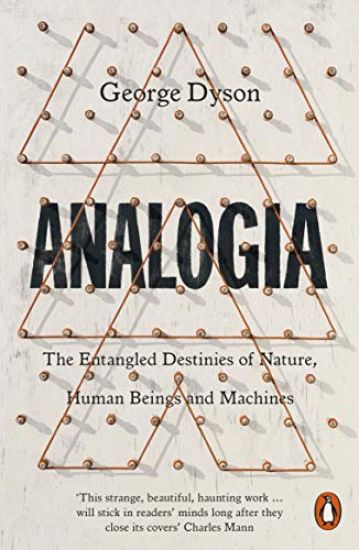
Analogia

Analogia

George Dyson

Picador USA
2021
nidottu
Named one of WIRED's "The Best Pop Culture That Got Us Through 2020" In Analogia, technology historian George Dyson presents a startling look back at the analog age and life before the digital revolution--and an unsettling vision of what comes next. In 1716, the philosopher and mathematician Gottfried Wilhelm Leibniz spent eight days taking the cure with Peter the Great at Bad Pyrmont in Saxony, trying to persuade the tsar to launch a voyage of discovery from Russia to America and to adopt digital computing as the foundation for a remaking of life on earth. In two classic books, Darwin Among the Machines and Turing's Cathedral, George Dyson chronicled the realization of the second of Leibniz's visions. In Analogia, his pathbreaking new book, he brings the story full circle, starting with the Russian American expedition of 1741 and ending with the beyond-digital revolution that will completethe transformation of the world. Dyson enlists a startling cast of characters, from the time of Catherine the Great to the age of machine intelligence, and draws heavily on his own experiences at the Institute for Advanced Study in Princeton, New Jersey, and onward to the rain forest of the Northwest Coast. We are, Dyson reveals, entering a new epoch in human history, one driven by a generation of machines whose powers are no longer under programmable control. Includes black-and-white illustrations
100 149 The Progress Of Music

100 149 The Progress Of Music

George Dyson

Palala Press
2018
pokkari
This work has been selected by scholars as being culturally important, and is part of the knowledge base of civilization as we know it. This work was reproduced from the original artifact, and remains as true to the original work as possible. Therefore, you will see the original copyright references, library stamps (as most of these works have been housed in our most important libraries around the world), and other notations in the work.This work is in the public domain in the United States of America, and possibly other nations. Within the United States, you may freely copy and distribute this work, as no entity (individual or corporate) has a copyright on the body of the work.As a reproduction of a historical artifact, this work may contain missing or blurred pages, poor pictures, errant marks, etc. Scholars believe, and we concur, that this work is important enough to be preserved, reproduced, and made generally available to the public. We appreciate your support of the preservation process, and thank you for being an important part of keeping this knowledge alive and relevant.
Turing's Cathedral: The Origins of the Digital Universe
A Wall Street Journal Best Business Book of 2012A Kirkus Reviews Best Book of 2012In this revealing account of how the digital universe exploded in the aftermath of World War II, George Dyson illuminates the nature of digital computers, the lives of those who brought them into existence, and how code took over the world. In the 1940s and '50s, a small group of men and women--led by John von Neumann--gathered in Princeton, New Jersey, to begin building one of the first computers to realize Alan Turing's vision of a Universal Machine. The codes unleashed within this embryonic, 5-kilobyte universe--less memory than is allocated to displaying a single icon on a computer screen today--broke the distinction between numbers that mean things and numbers that do things, and our universe would never be the same. Turing's Cathedral is the story of how the most constructive and most destructive of twentieth-century inventions--the digital computer and the hydrogen bomb--emerged at the same time.