Kirjojen hintavertailu. Mukana 11 529 891 kirjaa ja 12 kauppaa.

Kirjahaku

Etsi kirjoja tekijän nimen, kirjan nimen tai ISBN:n perusteella.

4 kirjaa tekijältä George M. Phillips

Interpolation and Approximation by Polynomials

Interpolation and Approximation by Polynomials

George M. Phillips

Springer-Verlag New York Inc.
2003
sidottu
This book is intended as a course in numerical analysis and approximation theory for advanced undergraduate students or graduate students, and as a reference work for those who lecture or research in this area. Its title pays homage to Interpolation and Approximation by Philip J. Davis, published in 1963 by Blaisdell and reprinted by Dover in 1976. My book is less g- eral than Philip Davis’s much respected classic, as the quali?cation “by polynomials” in its title suggests, and it is pitched at a less advanced level. I believe that no one book can fully cover all the material that could appearinabookentitledInterpolation and Approximation by Polynomials. Nevertheless, I have tried to cover most of the main topics. I hope that my readers will share my enthusiasm for this exciting and fascinating area of mathematics, and that, by working through this book, some will be encouraged to read more widely and pursue research in the subject. Since my book is concerned with polynomials, it is written in the language of classical analysis and the only prerequisites are introductory courses in analysis and linear algebra.
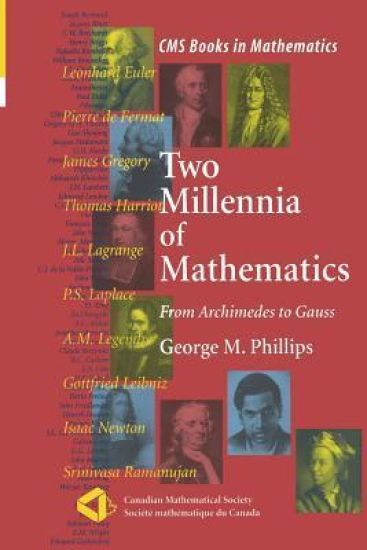
Two Millennia of Mathematics

Two Millennia of Mathematics

George M. Phillips

Springer-Verlag New York Inc.
2000
sidottu
This book is intended for those who love mathematics, including under­ graduate students of mathematics, more experienced students, and the vast number of amateurs, in the literal sense of those who do something for the love of it. I hope it will also be a useful source of material for those who teach mathematics. It is a collection of loosely connected topics in areas of mathematics that particularly interest me, ranging over the two millennia from the work of Archimedes, who died in the year 212 Be, to the Werke of Gauss, who was born in 1777, although there are some references outside this period. In view of its title, I must emphasize that this book is certainly not pretending to be a comprehensive history of the mathematics of this period, or even a complete account of the topics discussed. However, every chapter is written with the history of its topic in mind. It is fascinating, for example, to follow how both Napier and Briggs constructed their log­ arithms before many of the most relevant mathematical ideas had been discovered. Do I really mean "discovered"? There is an old question, "Is mathematics created or discovered?" Sometimes it seems a shame not to use the word "create" in praise of the first mathematician to write down some outstanding result. Yet the inner harmony that sings out from the best of mathematics seems to demand the word "discover.
Interpolation and Approximation by Polynomials

Interpolation and Approximation by Polynomials

George M. Phillips

Springer-Verlag New York Inc.
2011
nidottu
This book is intended as a course in numerical analysis and approximation theory for advanced undergraduate students or graduate students, and as a reference work for those who lecture or research in this area. Its title pays homage to Interpolation and Approximation by Philip J. Davis, published in 1963 by Blaisdell and reprinted by Dover in 1976. My book is less g- eral than Philip Davis’s much respected classic, as the quali?cation “by polynomials” in its title suggests, and it is pitched at a less advanced level. I believe that no one book can fully cover all the material that could appearinabookentitledInterpolation and Approximation by Polynomials. Nevertheless, I have tried to cover most of the main topics. I hope that my readers will share my enthusiasm for this exciting and fascinating area of mathematics, and that, by working through this book, some will be encouraged to read more widely and pursue research in the subject. Since my book is concerned with polynomials, it is written in the language of classical analysis and the only prerequisites are introductory courses in analysis and linear algebra.
Two Millennia of Mathematics

Two Millennia of Mathematics

George M. Phillips

Springer-Verlag New York Inc.
2012
nidottu
This book is intended for those who love mathematics, including under­ graduate students of mathematics, more experienced students, and the vast number of amateurs, in the literal sense of those who do something for the love of it. I hope it will also be a useful source of material for those who teach mathematics. It is a collection of loosely connected topics in areas of mathematics that particularly interest me, ranging over the two millennia from the work of Archimedes, who died in the year 212 Be, to the Werke of Gauss, who was born in 1777, although there are some references outside this period. In view of its title, I must emphasize that this book is certainly not pretending to be a comprehensive history of the mathematics of this period, or even a complete account of the topics discussed. However, every chapter is written with the history of its topic in mind. It is fascinating, for example, to follow how both Napier and Briggs constructed their log­ arithms before many of the most relevant mathematical ideas had been discovered. Do I really mean "discovered"? There is an old question, "Is mathematics created or discovered?" Sometimes it seems a shame not to use the word "create" in praise of the first mathematician to write down some outstanding result. Yet the inner harmony that sings out from the best of mathematics seems to demand the word "discover.