Kirjojen hintavertailu. Mukana 11 717 486 kirjaa ja 12 kauppaa.

Kirjahaku

Etsi kirjoja tekijän nimen, kirjan nimen tai ISBN:n perusteella.

4 kirjaa tekijältä George W. Stocking

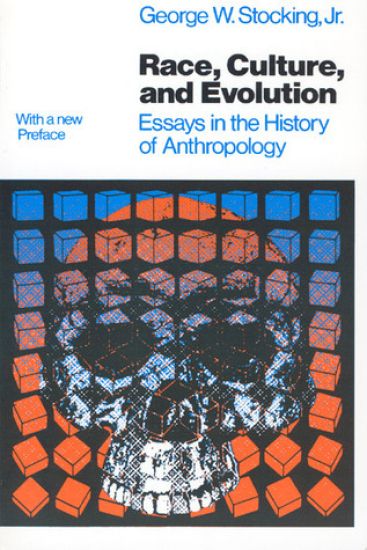
Race, Culture, and Evolution

Race, Culture, and Evolution

George W. Stocking

University of Chicago Press
1982
nidottu
"We have, at long last, a real historian with real historical skills and no intra-professional ax to grind. . . . All these pieces show the virtues one finds missing in . . . nearly all of anthropological history work but [Stocking's]: extensive and critical use of archival sources, tracing of real rather than merely plausible intellectual connections, and contextualization of ideas and movements in terms of broader social and cultural currents. Stocking writes very clearly; attacks important topics—race and evolution, the influence of scientism, the interaction between anthropology and other disciplines; and is methodologically very sophisticated. Though his main theme is the development of racialism and of opposition to it, his book bears on a range of issues very much alive in anthropology. . . . I would think no apprentice anthropologist ought to be pronounced a journeyman until he or she has absorbed what Stocking has to say."—Clifford Geertz, The Institute for Advanced Study, Princeton
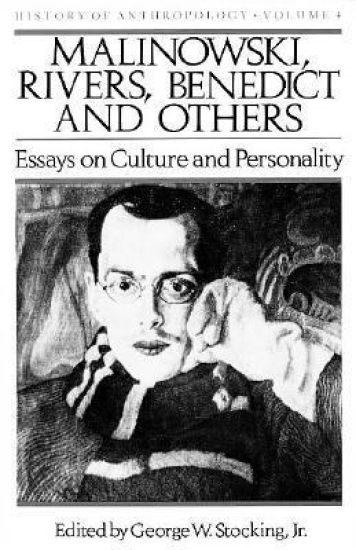
Malinowski, Rivers, Benedict and Others

Malinowski, Rivers, Benedict and Others

George W. Stocking

University of Wisconsin Press
1988
nidottu
History of Anthropology is a series of annual volumes, inaugurated in 1983, each of which treats a theme of major importance in both the history and current practice of anthropological inquiry. Drawing its title from a poem of W. H. Auden’s, the present volume, Malinowski, Rivers, Benedict and Others focuses on the emergence of anthropological interest in “culture and personality” during the 1920s and 1930s. It also explores the historical, cultural, literary, and biological background of major figures associated with the movement, including Bronislaw Malinowski, Edward Sapir, Abram Kardiner, Ruth Benedict, Margaret Mead, and Gregory Bateson. Born in the aftermath of World War I, flowering in the years before and after World War II, severely attacked in the 1950s and 1960s, “culture and personality” was subsequently reborn as “psychological anthropology.” Whether this foreshadows the emergence of a major anthropological subdiscipline (equivalent to cultural, social, biological, or linguistic anthropology) from the current welter of “adjectival” anthropologies remain to be seen. In the meantime, the essays collected in the volume may encourage a rethinking of the historical roots of many issues of current concern.
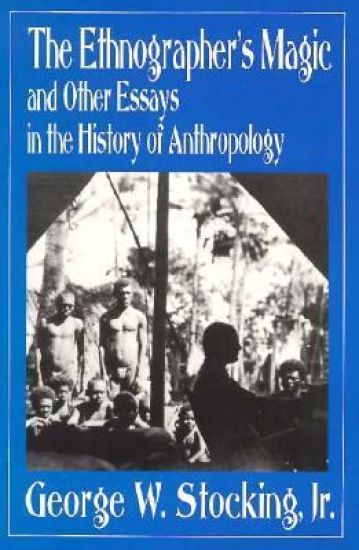
The Ethnographer's Magic

The Ethnographer's Magic

George W. Stocking

University of Wisconsin Press
2018
nidottu
The Ethnographer's Magic may be read at several levels by practitioners from several disciplines: intellectual history, history of science, anthropology, even comparative literature, new cultural history, and literary criticism. Original in its design, it presents the historiographer as composer, responsive to his own lived experience and to those whom he encounters deliberately and by chance, defensive at times, disengaging himself from academic political sensibilities over certain issues, but, above all, a primary researcher into the further reaches of anthropology as a profession and as a discipline. For this collection, Stocking has written comments on each of the eight essays included, as well as an introduction providing autobiographical and historiographical context and an afterwork reconsidering major themes of the essays in relation to the recent past and present situation of academic anthropology. The essays themselves address the work and influence of Franz Boas and Bronislaw Malinowski; anthropology's powerfully mythic aspect and persistent strain of romantic primitivism; the contradictions of its relationship to the larger sociopolitical sphere; its problematic integration of a variety of natural scientific and humanistic inquiries; and the tension between its scientific aspirations and its subjectively acquired ""data"".