Kirjojen hintavertailu. Mukana 11 342 296 kirjaa ja 12 kauppaa.

Kirjahaku

Etsi kirjoja tekijän nimen, kirjan nimen tai ISBN:n perusteella.

60 kirjaa tekijältä Georges Bataille

The Poetry of Georges Bataille

The Poetry of Georges Bataille

Georges Bataille

State University of New York Press
2018
pokkari
Presents a new window into the literary, philosophical, and theological concerns of this enigmatic thinker and writer.Despite its relative rarity, and the condensed brevity of the poems themselves, poetry occupies a striking place in the literary and philosophical oeuvre of Georges Bataille. For Bataille, poetry had no meaning "except in the violence of revolt," which it could attain "only by evoking the impossible." Toward this end, he wrote poetry, as he says in Inner Experience, "with necessity-in accordance with my life." Although poems appear in four of his major works, and others were published independently in a small collection and in magazines, much of Bataille's poetry remained unpublished at the time of his death. This volume presents a nearly complete edition of the poems in chronological order. Stuart Kendall provides an extensive introduction and notes highlighting the literary, philosophical, and theological significance of Bataille's poetry. He also explores the influence of Nietzsche, St. John of the Cross, Blake, Baudelaire, and other poètes maudits and situates the poems in relation to Bataille's other writings and the period in which he wrote.
Fiche de lecture Ma mère de Georges Bataille (Analyse littéraire de référence et résumé complet)
La collection Conna tre une oeuvre vous offre la possibilit de tout savoir du livre Ma m re, de Georges Bataille, gr ce une fiche de lecture aussi compl te que d taill e. La r daction, claire et accessible, a t confi e un sp cialiste universitaire. Cette fiche de lecture r pond une charte qualit mise en place par une quipe d'enseignants. Ce livre contient la biographie de Georges Bataille, la pr sentation de l'oeuvre, le r sum d taill , les raisons du succ s, les th mes principaux et l' tude du mouvement litt raire de l'auteur.
Ma mère de Georges Bataille (fiche de lecture et analyse complète de l'oeuvre)
Venez d couvrir Ma m re de Georges Bataille gr ce une analyse litt raire de r f rence crite par un sp cialiste universitaire, cette fiche de lecture est recommand e par de nombreux enseignants. Cet ouvrage contient la biographie de l' crivain, le r sum d taill , le mouvement litt raire, le contexte de publication de l'oeuvre et l'analyse compl te. Retrouvez tous nos titres sur: www.fichedelecture.fr.
Story of the Eye

Story of the Eye

Georges Bataille

Penguin Classics
2001
pokkari
A masterpiece of transgressive, surrealist erotica, George Bataille's Story of the Eye was the Fifty Shades of Grey of its era. This Penguin Modern Classics edition is translated by Joachim Neugroschal, and published with essays by Susan Sontag and Roland Barthes.Bataille's first novel, published under the pseudonym 'Lord Auch', is still his most notorious work. In this explicit pornographic fantasy, the young male narrator and his lovers Simone and Marcelle embark on a sexual quest involving sadism, torture, orgies, madness and defilement, culminating in a final act of transgression. Shocking and sacrilegious, Story of the Eye is the fullest expression of Bataille's obsession with the closeness of sex, violence and death. Yet it is also hallucinogenic in its power, and is one of the erotic classics of the twentieth century.This edition also includes Susan Sontag's superb study of pornography as art, 'The Pornographic Imagination', as well as Roland Barthes' essay 'The Metaphor of the Eye'.Georges Bataille (1897-1962), French essayist and novelist, was born in Billom, France. He converted to Catholicism, then later to Marxism, and was interested in psychoanalysis and mysticism, forming a secret society dedicated to glorifying human sacrifice. Leading a simple life as the curator of a municipal library, Bataille was involved on the fringes of Surrealism, founding the Surrealist magazine Documents in 1929, and editing the literary review Critique from 1946 until his death. Among his other works are the novels Blue of Noon (1957) and My Mother (1966), and the essays Eroticism (1957) and Literature and Evil (1957).If you enjoyed Story of the Eye, you might like Anaïs Nin's Delta of Venus, also available in Penguin Modern Classics.'His black masterpiece ... [a] brilliant, exquisitely fetishistic tale of sexual agitaion'New Statesman
L'Abbé C

L'Abbé C

Georges Bataille

Penguin Classics
2012
pokkari
L'Abbé C is a shocking, unnerving narrative about the intense and terrifying relationship between twin brothers. Charles is a modern libertine, dedicated to vice and depravity, while Robert is a priest so devout that he is nicknamed 'l'Abbé'. When the sexually wild Eponine intrudes upon their suffocating relationship, anguish, delirium, and death ensue. Charged with sensuality and a heightened, dreamlike atmosphere, this novel portrays the darkest and most profound aspects of human experience.
Blue of Noon

Blue of Noon

Georges Bataille

Penguin Classics
2012
pokkari
Set against the backdrop of Europe's slide into Fascism, Blue of Noon is a blackly compelling account of depravity and violence. As its narrator lurches despairingly from city to city in a surreal sexual and mental nightmare of squalor, sadism and drunken encounters, his internal collapse mirrors the fighting and marching on the streets outside. Exploring the dark forces beneath the surface of civilization, this is a novel torn between identifying with history's victims and being seduced by the monstrous glamour of its terrible victors, and is one of the twentieth century's great nihilist works.
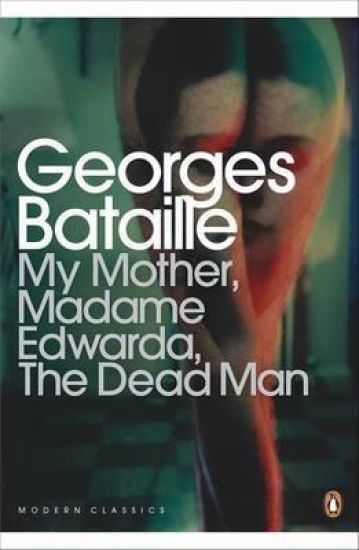
My Mother, Madame Edwarda, The Dead Man

My Mother, Madame Edwarda, The Dead Man

Georges Bataille

Penguin Classics
2012
pokkari
In these three works of erotic prose Georges Bataille fuses sex and spirituality in a highly personal and philosophical vision of the self. My Mother is a frank and intense depiction of a young man's sexual initiation and corruption by his mother, where the profane becomes sacred, and intense experience is shown as the only way to transcend the boundaries of society and morality. Madame Edwarda is the story of a prostitute who calls herself God, and The Dead Man, published in 1964 after Bataille's death, is a startling short tale of cruelty and desire. This volume also contains Bataille's own introductions to his texts as well as essays by Yukio Mishima and Ken Hollings.
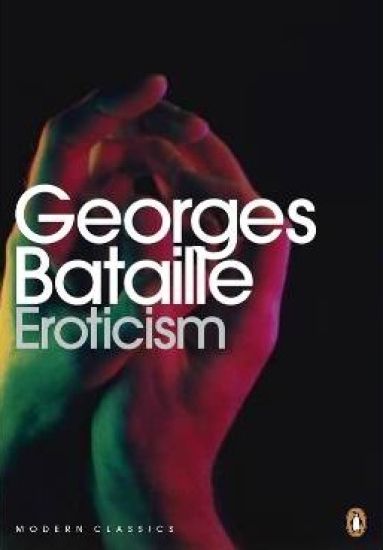
Eroticism

Eroticism

Georges Bataille

Penguin Classics
2012
pokkari
A philosopher, essayist, novelist, pornographer and fervent Catholic who came to regard the brothels of Paris as his true 'churches', Georges Bataille ranks among the boldest and most disturbing of twentieth-century thinkers. In this influential study he links the underlying sexual basis of religion to death, offering a dazzling array of insights into incest, prostitution, marriage, murder, sadism, sacrifice and violence, as well as including comments on Freud, Sade and Saint Theresa. Everywhere, Eroticism argues, sex is surrounded by taboos, which we must continually transgress in order to overcome the sense of isolation that faces us all.
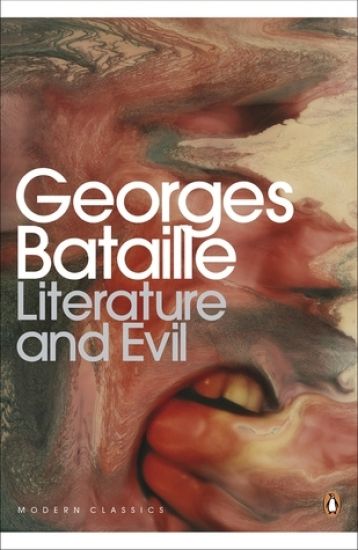
Literature and Evil

Literature and Evil

Georges Bataille

Penguin Classics
2012
pokkari
'Literature is not innocent,' stated Georges Bataille in this extraordinary 1957 collection of essays, arguing that only by acknowledging its complicity with the knowledge of evil can literature communicate fully and intensely. These literary profiles of eight authors and their work, including Emily Brontë's Wuthering Heights, Baudelaire's Les Fleurs du Mal and the writings of Sade, Kafka and Sartre, explore subjects such as violence, eroticism, childhood, myth and transgression, in a work of rich allusion and powerful argument.
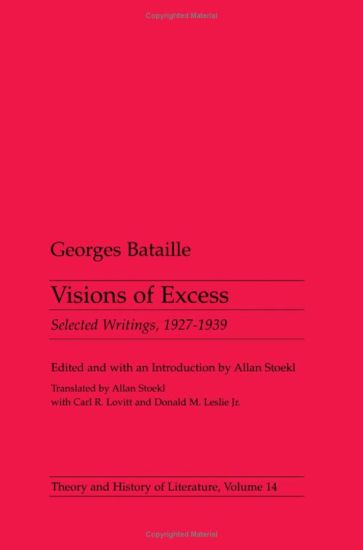
Visions of Excess

Visions of Excess

Georges Bataille

University of Minnesota Press
1985
nidottu
Since the publication of Visions of Excess in 1985, there has been an explosion of interest in the work of Georges Bataille. The French surrealist continues to be important for his groundbreaking focus on the visceral, the erotic, and the relation of society to the primeval. This collection of prewar writings remains the volume in which Batailles's positions are most clearly, forcefully, and obsessively put forward.This book challenges the notion of a "closed economy" predicated on utility, production, and rational consumption, and develops an alternative theory that takes into account the human tendency to lose, destroy, and waste. This collection is indispensible for an understanding of the future as well as the past of current critical theory.Georges Bataille (1897-1962), a librarian by profession, was founder of the French review Critique. He is the author of several books, including Story of the Eye, The Accused Share, Erotism, and The Absence of Myth.
Unfinished System of Nonknowledge

Unfinished System of Nonknowledge

Georges Bataille

University of Minnesota Press
2004
nidottu
A deft reconstruction of what Georges Bataille envisioned as a continuation of his work La Somme Athéologique, this volume brings together the writings of one of the foremost French thinkers of the twentieth century on the central topic of his oeuvre. Gathering Bataille's most intimate writings, these essays, aphorisms, notes, and lectures on nonknowledge, sovereignty, and sacrifice clarify and extend Bataille's radical theology, his philosophy of history, and his ecstatic method of meditation. Following Bataille's lead, as laid out in his notebooks, editor Stuart Kendall assembles the fragments that Bataille anticipated collecting for his summa. Kendall's introduction offers a clear picture of the author's overall project, its historical and biographical context, and the place of these works within it. The "system" that emerges from these articles, notes, and lectures is "atheology," understood as a study of the effects of nonknowledge. At the other side of realism, Bataille's writing in La Somme pushes language to its silent end. And yet, writing toward the ruin of language, in search of words that slip from their meanings, Bataille uses language—and the discourses of theology, philosophy, and literature—against itself to return us to ourselves, endlessly. The system against systems is in fact systematic, using systems and depending on discourses to achieve its own ends—the end of systematic thought.A medievalist librarian by training, Georges Bataille (1897–1962) was active in the French intellectual scene from the 1920s through the 1950s. He founded the journal Critique and was a member of the Acéphale group and the Collège de Sociologie. Among his works available in English are Visions of Excess (Minnesota, 1985), Tears of Eros (1989), and Erotism (1990).
On Nietzsche

On Nietzsche

Georges Bataille

Continuum International Publishing Group Ltd.
2004
pokkari
Takes up Nietzschean thought where Nietzsche left off - with the death of God. Written against the backdrop of Germany under the Third Reich the book explores the possibility of a spiritual life outside religion. In so doing it weaves an astonishing tapestry of confession, theology, philosophy, myth and eroticism.
Story of the Eye

Story of the Eye

Georges Bataille

City Lights Books
1987
pokkari
In 1928, Georges Bataille published this first novel under a pseudonym, a legendary shocker that uncovers the dark side of the erotic by means of forbidden obsessive fantasies of excess and sexual extremes. A classic of pornographic literature, Story of the Eye finds the parallels in Sade and Nietzsche and in the investigations of contemporary psychology; it also forecasts Bataille's own theories of ecstasy, death and transgression which he developed in later work.
The Tears of Eros

The Tears of Eros

Georges Bataille

City Lights Books
2001
pokkari
Tears of Eros is the culmination of Georges Bataille's inquiries into the relationship between violence and the sacred. Taking up such figures as Giles de Rais, Erzebet Bathory, the Marquis de Sade, El Greco, Gustave Moreau, Andre Breton, Voodoo practitioners, and Chinese torture victims, Bataille reveals their common obsession: death. This essay, illustrated with artwork from every era, was developed out of ideas explored in Erotism: Death and Sexuality and Prehistoric Painting: Lascaux or the Birth of Art. In it Bataille examines death--the "little death" that follows sexual climax, the proximate death in sadomasochistic practices, and death as part of religious ritual and sacrifice. "Bataille is one of the most important writers of the century."-- Michel Foucault Georges Bataille was born in Billom, France, in 1897. He was a librarian by profession. Also a philosopher, novelist, and critic he was founder of the College of Sociology. In 1959, Bataille began Tears of Eros, and it was completed in 1961, his final work. City Lights published two of his other works: Story of the Eye and The Impossible. Bataille died in 1962.
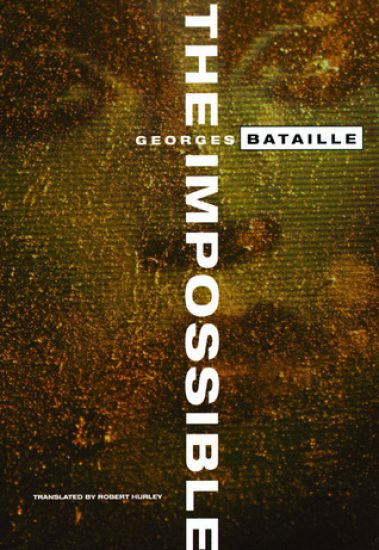
The Impossible

The Impossible

Georges Bataille

City Lights Books
1991
pokkari
In a philosophical erotic narrative, an essay on poetry, and in poems Georges Bataille pursues his guiding concept, the impossible. The narrator engages in a journey, one reminiscent of the Grail quest; failing, he experiences truth. He describes a movement toward a disappearing object, the same elusive object that moved Theresa of Avila and Catherine of Siena to ecstasy. "Humanity is faced with a double perspective: in one direction, violent pleasure, horror and death - precisely the perspective of poetry - and in the opposite direction, that of science or the real world of utility. Only the useful, the real, have a serious character. We are never within our rights in preferring seduction to it: truth has rights over us. Indeed it has every right. And yet we can, and indeed we must respond to something which, not being God, is stronger than every right, that impossible to which we accede only by forgetting the truth of all these rights." -Georges Bataille Georges Bataille (1897-1962) was a French intellectual and literary icon who wrote essays, novels, and poems exploring philosophical and sociological subjects such as eroticism and surrealism. City Lights published more of Bataille's works including Erotism, The Tears of Eros, and Story of the Eye.
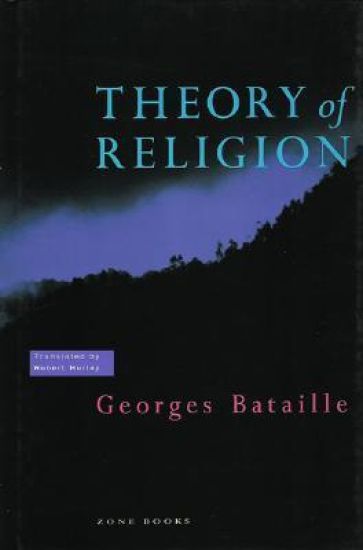
Theory of Religion

Theory of Religion

Georges Bataille

Zone Books
1992
pokkari
Theory of Religion brings to philosophy what Bataille's earlier book, The Accursed Share, brought to anthropology and history; namely, an analysis based on notions of excess and expenditure. Bataille brilliantly defines religion as so many different attempts to respond to the universe's relentless generosity. Framed within his original theory of generalized economics and based on his masterly reading of archaic religious activity, Theory of Religion constitutes, along with The Accursed Share, the most important articulation of Bataille's work.Georges Bataille (1897-1962), founder of the French review Critique, wrote fiction and essays on a wide range of topics. His books in English translation include Story of the Eye, Blue of Noon, Literature and Evil, Manet and Erotism.Robert Hurley is the translator of The History of Sexuality by Michel Foucault and cotranslator of Anti Oedipus by Gilles Deleuze and Felix Guattari. Distributed for Zone Books.
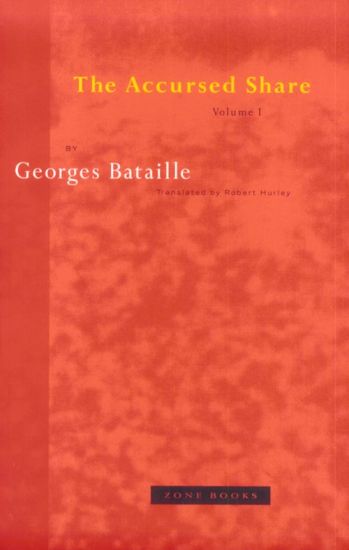
The Accursed Share

The Accursed Share

Georges Bataille

Zone Books
1991
pokkari
Most Anglo-American readers know Bataille as a novelist. The Accursed Share provides an excellent introduction to Bataille the philosopher. Here he uses his unique economic theory as the basis for an incisive inquiry into the very nature of civilization. Unlike conventional economic models based on notions of scarcity, Bataille's theory develops the concept of excess: a civilization, he argues, reveals its order most clearly in the treatment of its surplus energy. The result is a brilliant blend of ethics, aesthetics, and cultural anthropology that challenges both mainstream economics and ethnology.
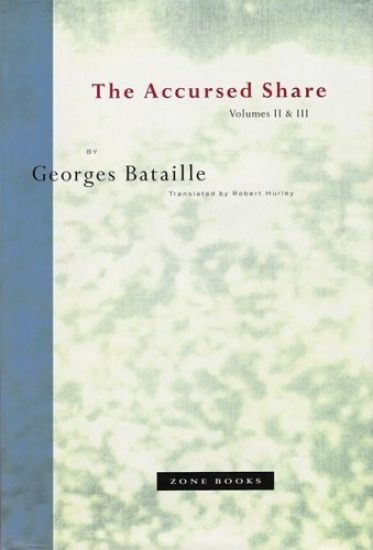
The Accursed Share

The Accursed Share

Georges Bataille

Zone Books
1993
pokkari
The three volumes of The Accursed Share address what Georges Bataille sees as the paradox of utility: namely, if being useful means serving a further end, then the ultimate end of utility can only be uselessness. The first volume of The Accursed Share, the only one published before Bataille's death, treated this paradox in economic terms, showing that "it is not necessity but its contrary, luxury, that presents living matter and mankind with their fundamental problems." This Zone edition includes in a single volume a reconstruction, based on the versions published in Bataille's posthumous collected works, of his intended continuation of The Accursed Share.In the second and third volumes, The History of Eroticism and Sovereignty, Bataille explores the same paradox of utility, respectively from an anthropological and an ethical perspective. He first analyzes the fears and fascination, the prohibitions and the transgressions attached to the realm of eroticism as so many expressions of the "uselessness" of erotic life. It is just this expenditure of excess energy that demarcates the realm of human autonomy, of independence relative to "useful" ends. The study of eroticism therefore leads naturally to the examination of human sovereignty, in which Bataille defines the sovereign individual as one who consumes and does not labor, creating a life beyond the realm of utility.Georges Bataille, a philosopher and novelist sui generis, died in 1962.
Death and Sensuality: A Study of Eroticism and the Taboo

Death and Sensuality: A Study of Eroticism and the Taboo

Georges Bataille

Literary Licensing, LLC
2011
sidottu
Death and Sensuality: A Study of Eroticism and the Taboo is a philosophical exploration of the relationship between sex and death, written by the French author Georges Bataille. In this book, Bataille argues that eroticism is intimately tied to taboo and transgression, and that the experience of pleasure is often linked to the fear of death. He explores the ways in which eroticism can be both liberating and destructive, and how it can challenge traditional moral and social norms. Bataille draws on a range of sources, from anthropology and psychoanalysis to literature and art, to offer a provocative and insightful analysis of the human experience of desire and mortality. This book is a seminal work in the field of erotic philosophy and remains a challenging and thought-provoking read for anyone interested in the intersections of sex, death, and taboo.This scarce antiquarian book is a facsimile reprint of the old original and may contain some imperfections such as library marks and notations. Because we believe this work is culturally important, we have made it available as part of our commitment for protecting, preserving, and promoting the world's literature in affordable, high quality, modern editions, that are true to their original work.