Kirjojen hintavertailu. Mukana 11 627 220 kirjaa ja 12 kauppaa.

Kirjahaku

Etsi kirjoja tekijän nimen, kirjan nimen tai ISBN:n perusteella.

6 kirjaa tekijältä Gerald A. Cory Jr.

Toward Consilience

Toward Consilience

Gerald A. Cory Jr.

Kluwer Academic/Plenum Publishers
2000
sidottu
The present work is the second in a series constituting an extension of my doctoral thesis done at Stanford in the early 1970s. Like the earlier work, The Reciprocal Modular Brain in Economics and Politics, Shaping the Rational and Moral Basis ofOrganization, Exchange, and Choice (Plenum Publishing, 1999), it may also be considered to respond to the call for consilience by Edward O. Wilson. I agree with Wilson that there is a pressing need in the sciences today for the unification of the social with the natural sciences. I consider the present work to proceed from the perspective of behavioral ecology, specifically a subfield which I choose to call interpersonal behavioral ecology th Ecology, as a general field, has emerged in the last quarter of the 20 century as a major theme of concern as we have become increasingly aware that we must preserve the planet whose limited resources we share with all other earthly creatures. Interpersonal behavioral ecology, however, focuses not on the physical environment, but upon our social environment. It concerns our interpersonal behavioral interactions at all levels, from simple dyadic one-to-one personal interactions to our larger, even global, social, economic, and political interactions.
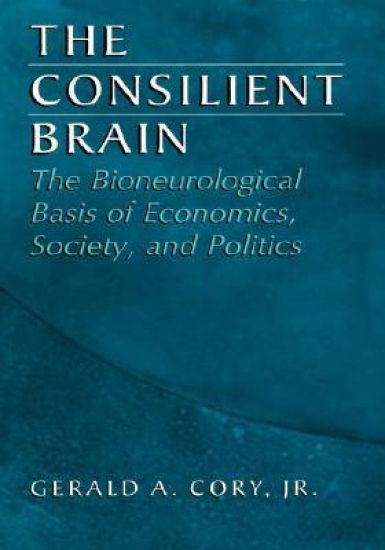
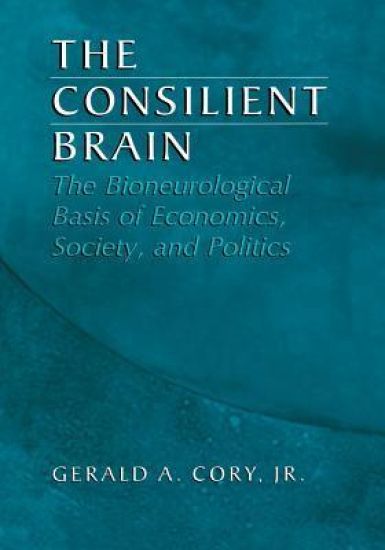
The Consilient Brain

The Consilient Brain

Gerald A. Cory Jr.

Kluwer Academic/Plenum Publishers
2003
sidottu
The present work is the third in a series constituting an extension of my doctoral thesis done at Stanford in the early 1970s. Like the earlier works, The Reciprocal Modular Brain in Economics and Politics, Shaping the Rational and Moral Basis of Organization, Exchange, and Choice (Kluwer AcademicfPlenum Publishing, 1999) and Toward Consilience: The Bioneurological Basis of Behavior, Thought, Experience, and Language (Kluwer AcademicfPlenum Publishing, 2000), it may also be considered to respond to the call for consilience by Edward O. Wilson. I agree with Wilson that there is a pressing need in the sciences today for the unification of the social with the natural sciences. I consider the present work to proceed from the perspective of behavioral ecology, specifically a subfield which I choose to call interpersonal behavioral ecology. Ecology, as a general field, has emerged in the last quarter of the 20th century as a major theme of concern as we have become increasingly aware that we must preserve the planet whose limited resources we share with all other earthly creatures. Interpersonal behavioral ecology, however, focuses not on the physical environment, but upon our social environment. It concerns our interpersonal behavioral interactions at all levels, from simple dyadic one-to-one personal interactions to our larger, even global, social, economic, and political interactions.
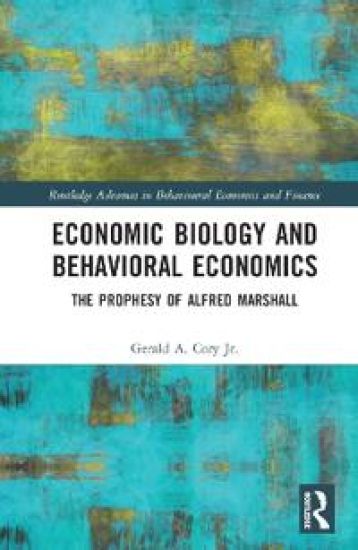
Economic Biology and Behavioral Economics

Economic Biology and Behavioral Economics

Gerald A. Cory Jr.

TAYLOR FRANCIS LTD
2022
sidottu
Economic Biology and Behavioral Economics: The Prophesy of Alfred Marshall explores the prophesy of Alfred Marshall, the grand synthesizer of neoclassical economics, that the "Mecca of the economist lies in economic biology".The book presents the proof of that prophesy through examination and establishment of the fundamental biological science necessary and then applying that science to the examination of current economic theory. In doing so, the book focuses primarily on the fundamentals of neoclassical economic theory— which is the reigning theory and the general framework of which is taught as "science" in first courses in college economics. These courses are at best an idealization, if not an ideology, of the discipline—presented to fresh minds misleadingly as confirmed science. The book examines the bases and the history of these idealizations, points to the sources of their error from the biological perspective and suggests a path forward for the discipline. Through this process, the book demonstrates the power of the biological perspective anticipated by Marshall.This book provides invaluable reading for anyone interested in the future of economics and economic theory, and particularly those interested in behavioral economics and neuroeconomics.
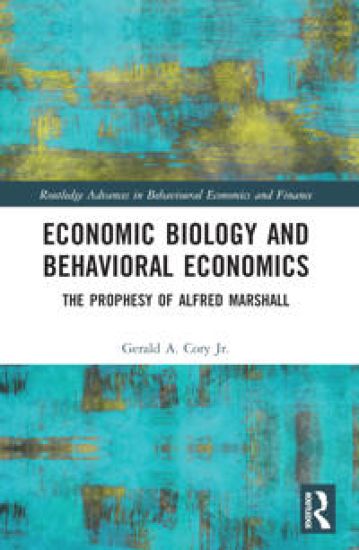
Economic Biology and Behavioral Economics

Economic Biology and Behavioral Economics

Gerald A. Cory Jr.

TAYLOR FRANCIS LTD
2024
nidottu
Economic Biology and Behavioral Economics: The Prophesy of Alfred Marshall explores the prophesy of Alfred Marshall, the grand synthesizer of neoclassical economics, that the "Mecca of the economist lies in economic biology".The book presents the proof of that prophesy through examination and establishment of the fundamental biological science necessary and then applying that science to the examination of current economic theory. In doing so, the book focuses primarily on the fundamentals of neoclassical economic theory— which is the reigning theory and the general framework of which is taught as "science" in first courses in college economics. These courses are at best an idealization, if not an ideology, of the discipline—presented to fresh minds misleadingly as confirmed science. The book examines the bases and the history of these idealizations, points to the sources of their error from the biological perspective and suggests a path forward for the discipline. Through this process, the book demonstrates the power of the biological perspective anticipated by Marshall.This book provides invaluable reading for anyone interested in the future of economics and economic theory, and particularly those interested in behavioral economics and neuroeconomics.
The Consilient Brain

The Consilient Brain

Gerald A. Cory Jr.

Springer-Verlag New York Inc.
2012
nidottu
The present work is the third in a series constituting an extension of my doctoral thesis done at Stanford in the early 1970s. Like the earlier works, The Reciprocal Modular Brain in Economics and Politics, Shaping the Rational and Moral Basis of Organization, Exchange, and Choice (Kluwer AcademicfPlenum Publishing, 1999) and Toward Consilience: The Bioneurological Basis of Behavior, Thought, Experience, and Language (Kluwer AcademicfPlenum Publishing, 2000), it may also be considered to respond to the call for consilience by Edward O. Wilson. I agree with Wilson that there is a pressing need in the sciences today for the unification of the social with the natural sciences. I consider the present work to proceed from the perspective of behavioral ecology, specifically a subfield which I choose to call interpersonal behavioral ecology. Ecology, as a general field, has emerged in the last quarter of the 20th century as a major theme of concern as we have become increasingly aware that we must preserve the planet whose limited resources we share with all other earthly creatures. Interpersonal behavioral ecology, however, focuses not on the physical environment, but upon our social environment. It concerns our interpersonal behavioral interactions at all levels, from simple dyadic one-to-one personal interactions to our larger, even global, social, economic, and political interactions.
Toward Consilience

Toward Consilience

Gerald A. Cory Jr.

Springer-Verlag New York Inc.
2012
nidottu
The present work is the second in a series constituting an extension of my doctoral thesis done at Stanford in the early 1970s. Like the earlier work, The Reciprocal Modular Brain in Economics and Politics, Shaping the Rational and Moral Basis ofOrganization, Exchange, and Choice (Plenum Publishing, 1999), it may also be considered to respond to the call for consilience by Edward O. Wilson. I agree with Wilson that there is a pressing need in the sciences today for the unification of the social with the natural sciences. I consider the present work to proceed from the perspective of behavioral ecology, specifically a subfield which I choose to call interpersonal behavioral ecology th Ecology, as a general field, has emerged in the last quarter of the 20 century as a major theme of concern as we have become increasingly aware that we must preserve the planet whose limited resources we share with all other earthly creatures. Interpersonal behavioral ecology, however, focuses not on the physical environment, but upon our social environment. It concerns our interpersonal behavioral interactions at all levels, from simple dyadic one-to-one personal interactions to our larger, even global, social, economic, and political interactions.