NEW EDITION FOR July 2021This book is intended as an introduction to the species of art music which bears the misleading appellation of Classical Music. It contains brief summaries of the most important creators in the artform over the past millennium, the forms it uses, as well as a recommendation for a core collection, notes on how to collect and where, how to stay current, and other topics associated with experiencing fully the art of what we have come to call Classical Music. It is not an encyclopedia (nor a music dictionary, which I recommend as an adjunct to this book.); it is a primer.The book shall be updated regulary (expanded features, new composers, technical details, new distribution schemes change quickly).
Jophiel, Angel of the Beauty of the Divine Presence, incarnates in a mid-western town to a lovely woman and her outlaw husband in this tale set in near-future America. The Arts and Sciences are in decay and the Angel Jophiel comes to the aid of a young composer, guiding him in the making of a new Renaissance, offering a fresh creative impulse for a world on the brink.Beauty is vanishing from the EarthThe Western World is in upheaval.Cities are in turmoil.Culture is in decay.The Arts are dead.Science and technology are worshiped.Matter is the only reality.Humanity alone doesn't have the power to defeat the enemy arrayed against it.
-The Sinfonia Matrix is a practically infinite repository of music, from which the composer may extract countless performance versions for orchestras of any size up to 100 players. -This piece uses traditional music notation with no random or chance elements. -Performances from the Sinfonia Matrix draw attention to the significance of the individual voice within the community. Each player has his or her own part to play - the idea of a "1st violin section" or "horn section" playing music in unison is not a principle in performances from the Sinfonia Matrix, nor do traditional ideas of Harmony and Counterpoint apply. -Each part is related to every other as members of a family or community relate to one another. -Most parts are written within the realm of traditional tonality, but the organizational principle of the work is completely serial: In the 100 total parts, all 24 major/minor keys are represented 3 times, all authentic and plagal modes are employed once, along with the 2 whole-tone scales, pentatonic scales, and 12 full chromatic settings. -Each player's part is comprised of an 8-measure signature. -During performance, every 8 measures counts as an episode, and every episode is comprised of one of the practically infinite number of combinations possible among ensemble members. -Each episode follows another in seamless succession. -No combination is repeated. -When the specified number of episodes selected for performance has been executed, the performance ends. -Though it is theoretically possible to present a complete performance of the Sinfonia Matrix, it would take more than 1-septillion years to do so. -Therefore, performance versions must be extracted from the Sinfonia Matrix by the composer, each version specifically tailored for the requirements of that commission, based upon precise instrumentation, number of performers, and occasion. -Scores extracted for performance are distinguished by number and type of combinations designated for inclusion, tempo, number of movements, and most especially, by careful manipulation of individual dynamics and articulation.
A selection of piano music by Gerald Brennan, including: SonatinaIlluminations on the I ChingToccata & Poem3 Miniatures3 PreludesChild's Song & Nocturnal Fantasy
Song of Blood and Ashes by Gerald Brennan is a Vampire novel set in Ireland and Ann Arbor, Michigan.An ancient Vampire finally creates a prot g after centuries of searching for the one. Blinded by her beauty and innocence, his choice was unwise. She is desperately in love with a 'mortal' who does not reciprocate her affection. Her twisted and depraved appetites provoke a most horrifying catastrophe.A tale out-of-the-ordinary, and a unique addition to a timeless genre.
The social order is crumbling, and a northern Michigan man (John Wheelwright) flees disaster to find refuge with his family in the Upper Peninsula. But the U.P. has become a savage wasteland of criminals, resistors, and a paramilitary empire controlled by a sadistic colossus ("X" - Xavier Blount). When John arrives at the family farm he discovers that X wants his father's land, now, or total pillage will result.The novella is full of combat and romance set in the emerald jungle of the Michigan Upper Peninsula.
Four pieces by Gerald Brennan for orchestra and chamber ensemble. Included are Pi for septet, Anticanon for any number of instruments, Hypercanon for orchestra, and Upon Reflection... for strings.
June, 1968.An air force astronaut flies to an orbiting observation platform for a forty-day stint spying on the Soviet Union from space--and discovers a plot that will determine the fate of the world. The fourth book in the Altered Space series, Infinite Blues imagines a militarized Space Race in a Cold War that never was, with America trying to find its way back to normalcy after the MacArthur presidency, and warily watching as Beria's Soviet Union builds the ballistic missiles that threaten to destroy it on a half-hour's notice. A thoroughly researched thriller full of political paranoia and imaginative intrigue, it's also a look at today's America through the lens of an alternate past, as well as a literary examination of observation and participation, individualism and collectivism, the ideas and attitudes that hold our country together--and the ones that might send it careening towards catastrophe. The titles in the Altered Space series are wholly separate narratives, but all deal with the mysteries of space and time, progress and circularity. Each one is an ensō of words in which orbits of spacecraft, moons, planets, and people allow us fresh perspectives on the cycles of our own lives.
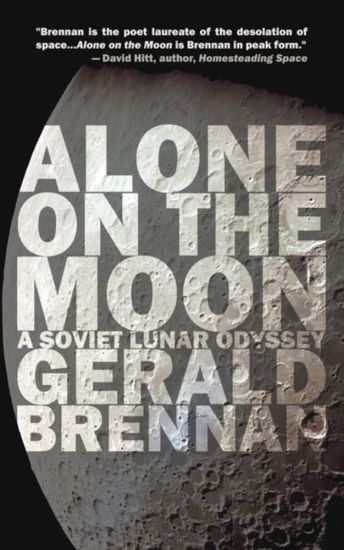
May, 1970. A two-person Soviet crew approaches the moon, ready to accomplish the greatest feat in human history--provided they can overcome their own petty jealousies, and the unforgiving harshness of space. Alone on the Moon chronicles a Soviet moon mission through the eyes of Boris Volynov, a backup who's been pressed into service helping Alexei Leonov (a man he despises) attempt humanity's first lunar landing. Thoroughly researched, it's a detailed and plausible rendition of two larger-than-life personalities facing incredible challenges. It's also a meditation on luck, trust, the nature of observation, and the burden of being chosen--plus the way our personal narratives can shape (or poison) our perceptions of the present. Do the stories we tell ourselves shape our fate, or can we write a new chapter? The answer awaits. The titles in the Altered Space series are wholly separate narratives, but all deal with the mysteries of space and time, progress and circularity. Each one is an ensō of words in which orbits of spacecraft, moons, planets, and people allow us fresh perspectives on the cycles of our own lives.