Kirjojen hintavertailu. Mukana 11 244 527 kirjaa ja 12 kauppaa.

Kirjahaku

Etsi kirjoja tekijän nimen, kirjan nimen tai ISBN:n perusteella.

8 kirjaa tekijältä Gerald D. Mahan

Many-Particle Physics

Many-Particle Physics

Gerald D. Mahan

Kluwer Academic/Plenum Publishers
1990
sidottu
This textbook is for a course in advanced solid-state theory. It is aimed at graduate students in their third or fourth year of study who wish to learn the advanced techniques of solid-state theoretical physics. The method of Green's functions is introduced at the beginning and used throughout. Indeed, it could be considered a book on practical applications of Green's functions, although I prefer to call it a book on physics. The method of Green's functions has been used by many theorists to derive equations which, when solved, provide an accurate numerical description of many processes in solids and quantum fluids. In this book I attempt to summarize many of these theories in order to show how Green's functions are used to solve real problems. My goal, in writing each section, is to describe calculations which can be compared with experiments and to provide these comparisons whenever available. The student is expected to have a background in quantum mechanics at the level acquired from a graduate course using the textbook by either L. I. Schiff, A. S. Davydov, or I. Landau and E. M. Lifshiftz. Similarly, a prior course in solid-state physics is expected, since the reader is assumed to know concepts such as Brillouin zones and energy band theory. Each chapter has problems which are an important part of the lesson; the problems often provide physical insights which are not in the text. Sometimes the answers to the problems are provided, but usually not.
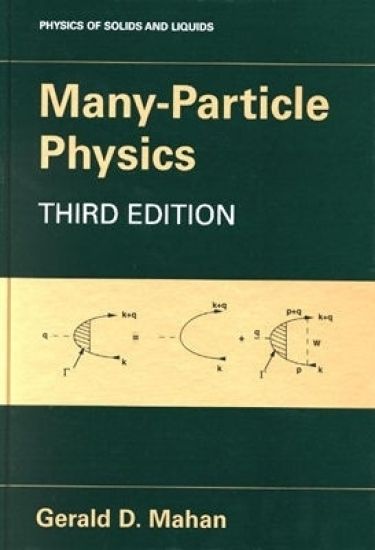
Many-Particle Physics

Many-Particle Physics

Gerald D. Mahan

Kluwer Academic/Plenum Publishers
2000
sidottu
The first, second, and third editions of this book seem to occur at ten year intervals. The intent is to keep the book up-to-date. Many-body theory is a field which continually evolves in time. Journals only publish new results, conferences only invite speakers to report new phenomena, and agencies only fund scientists to do new physics. Today's physics is old hat by tomorrow. Students want to learn new material, and textbooks must be modified to keep up with the times. The early chapters in this book teach the techniques of many-body theory. They are largely unchanged in format. The later chapters apply the techniques to specific problems. The third edition increases the number of applications. New sections have been added, while old sections have been modified to include recent applications. The previous editions were set in type using pre-computer technology. No computer file existed of the prior editions. The publisher scanned the second edition and gave me a disk with the contents. This scan recorded the words accurately and scrambled the equations into unintelligible form. So I retyped the equations using LaTeX. Although tedious, it allowed me to correct the infinite numbers of typographical errors in the previous edition. The earlier typesetting methods did not permit such corrections. The entire book was edited sentence-by­ sentence. Most old sections of the book were shortened by editing sentences and paragraphs.
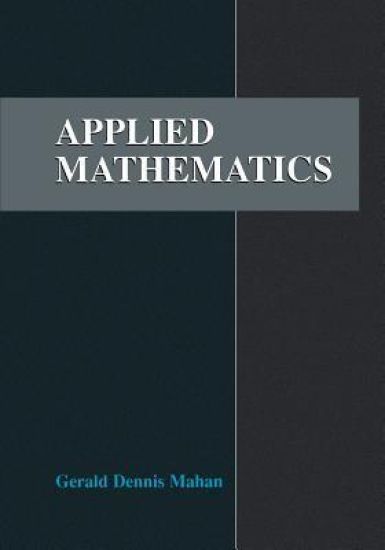
Applied Mathematics

Applied Mathematics

Gerald D. Mahan

Kluwer Academic/Plenum Publishers
2001
sidottu
This volume is a textbook for a year-long graduate level course in All research universities have applied mathematics for scientists and engineers. such a course, which could be taught in different departments, such as mathematics, physics, or engineering. I volunteered to teach this course when I realized that my own research students did not learn much in this course at my university. Then I learned that the available textbooks were too introduc­ tory. While teaching this course without an assigned text, I wrote up my lecture notes and gave them to the students. This textbook is a result of that endeavor. When I took this course many, many, years ago, the primary references were the two volumes of P. M. Morse and H. Feshbach, Methods of Theoretical Physics (McGraw-Hill, 1953). The present text returns the contents to a similar level, although the syllabus is quite different than given in this venerable pair of books.
Quantum Mechanics in a Nutshell

Quantum Mechanics in a Nutshell

Gerald D. Mahan

Princeton University Press
2009
sidottu
Covering the fundamentals as well as many special topics of current interest, this is the most concise, up-to-date, and accessible graduate-level textbook on quantum mechanics available. Written by Gerald Mahan, a distinguished research physicist and author of an acclaimed textbook on many-particle physics, Quantum Mechanics in a Nutshell is the distillation of many years' teaching experience. Emphasizing the use of quantum mechanics to describe actual quantum systems such as atoms and solids, and rich with interesting applications, the book proceeds from solving for the properties of a single particle in potential; to solving for two particles (the helium atom); to addressing many-particle systems. Applications include electron gas, magnetism, and Bose-Einstein Condensation; examples are carefully chosen and worked; and each chapter has numerous homework problems, many of them original. Quantum Mechanics in a Nutshell expertly addresses traditional and modern topics, including perturbation theory, WKBJ, variational methods, angular momentum, the Dirac equation, many-particle wave functions, Casimir Force, and Bell's Theorem. And it treats many topics--such as the interactions between photons and electrons, scattering theory, and density functional theory--in exceptional depth. A valuable addition to the teaching literature, Quantum Mechanics in a Nutshell is ideally suited for a two-semester course. * The most concise, up-to-date, and accessible graduate textbook on the subject * Contains the ideal amount of material for a two-semester course * Focuses on the description of actual quantum systems, including a range of applications * Covers traditional topics, as well as those at the frontiers of research * Treats in unprecedented detail topics such as photon-electron interaction, scattering theory, and density functional theory * Includes numerous homework problems at the end of each chapter
Condensed Matter in a Nutshell

Condensed Matter in a Nutshell

Gerald D. Mahan

Princeton University Press
2010
sidottu
Condensed Matter in a Nutshell is the most concise, accessible, and self-contained introduction to this exciting and cutting-edge area of modern physics. This premier textbook covers all the standard topics, including crystal structures, energy bands, phonons, optical properties, ferroelectricity, superconductivity, and magnetism. It includes in-depth discussions of transport theory, nanoscience, and semiconductors, and also features the latest experimental advances in this fast-developing field, such as high-temperature superconductivity, the quantum Hall effect, graphene, nanotubes, localization, Hubbard models, density functional theory, phonon focusing, and Kapitza resistance. Rich in detail and full of examples and problems, this textbook is the complete resource for a two-semester graduate course in condensed matter and material physics. * Covers standard topics like crystal structures, energy bands, and phonons * Features the latest advances like high-temperature superconductivity and more * Full of instructive examples and challenging problems * Solutions manual (available only to teachers)
Many-Particle Physics

Many-Particle Physics

Gerald D. Mahan

Springer-Verlag New York Inc.
2010
nidottu
The first, second, and third editions of this book seem to occur at ten year intervals. The intent is to keep the book up-to-date. Many-body theory is a field which continually evolves in time. Journals only publish new results, conferences only invite speakers to report new phenomena, and agencies only fund scientists to do new physics. Today's physics is old hat by tomorrow. Students want to learn new material, and textbooks must be modified to keep up with the times. The early chapters in this book teach the techniques of many-body theory. They are largely unchanged in format. The later chapters apply the techniques to specific problems. The third edition increases the number of applications. New sections have been added, while old sections have been modified to include recent applications. The previous editions were set in type using pre-computer technology. No computer file existed of the prior editions. The publisher scanned the second edition and gave me a disk with the contents. This scan recorded the words accurately and scrambled the equations into unintelligible form. So I retyped the equations using LaTeX. Although tedious, it allowed me to correct the infinite numbers of typographical errors in the previous edition. The earlier typesetting methods did not permit such corrections. The entire book was edited sentence-by­ sentence. Most old sections of the book were shortened by editing sentences and paragraphs.
Many-Particle Physics

Many-Particle Physics

Gerald D. Mahan

Springer-Verlag New York Inc.
2011
nidottu
This textbook is for a course in advanced solid-state theory. It is aimed at graduate students in their third or fourth year of study who wish to learn the advanced techniques of solid-state theoretical physics. The method of Green's functions is introduced at the beginning and used throughout. Indeed, it could be considered a book on practical applications of Green's functions, although I prefer to call it a book on physics. The method of Green's functions has been used by many theorists to derive equations which, when solved, provide an accurate numerical description of many processes in solids and quantum fluids. In this book I attempt to summarize many of these theories in order to show how Green's functions are used to solve real problems. My goal, in writing each section, is to describe calculations which can be compared with experiments and to provide these comparisons whenever available. The student is expected to have a background in quantum mechanics at the level acquired from a graduate course using the textbook by either L. I. Schiff, A. S. Davydov, or I. Landau and E. M. Lifshiftz. Similarly, a prior course in solid-state physics is expected, since the reader is assumed to know concepts such as Brillouin zones and energy band theory. Each chapter has problems which are an important part of the lesson; the problems often provide physical insights which are not in the text. Sometimes the answers to the problems are provided, but usually not.
Applied Mathematics

Applied Mathematics

Gerald D. Mahan

Springer-Verlag New York Inc.
2012
nidottu
This volume is a textbook for a year-long graduate level course in All research universities have applied mathematics for scientists and engineers. such a course, which could be taught in different departments, such as mathematics, physics, or engineering. I volunteered to teach this course when I realized that my own research students did not learn much in this course at my university. Then I learned that the available textbooks were too introduc­ tory. While teaching this course without an assigned text, I wrote up my lecture notes and gave them to the students. This textbook is a result of that endeavor. When I took this course many, many, years ago, the primary references were the two volumes of P. M. Morse and H. Feshbach, Methods of Theoretical Physics (McGraw-Hill, 1953). The present text returns the contents to a similar level, although the syllabus is quite different than given in this venerable pair of books.