Kirjojen hintavertailu. Mukana 12 016 292 kirjaa ja 12 kauppaa.

Kirjahaku

Etsi kirjoja tekijän nimen, kirjan nimen tai ISBN:n perusteella.

5 kirjaa tekijältä Gerald J. Postema

Law's Rule

Law's Rule

Gerald J. Postema

OXFORD UNIVERSITY PRESS INC
2023
sidottu
The rule of law, once widely embraced and emulated, now faces serious threats to its viability. To get our bearings we must return to first principles. This book articulates and defends a comprehensive, coherent, and compelling conception of the rule of law and defends it against serious challenges to its intelligibility, relevance, and normative force. The rule of law's ambition, it argues, is to provide protection and recourse against the arbitrary exercise of power using the distinctive tools of the law. Law provides a bulwark of protection, a bridle on the powerful, and a bond constituting and holding together the polity and giving public expression to an ideal mode of association. Two principles immediately follow from this core: sovereignty of law, demanding that those who exercise ruling power govern with law and that law governs them, and equality in the eyes of the law, demanding that law's protection extend to all bound by it. Animating law's rule, the ethos of fidelity commits all members of the political community, officials and lay members alike, to take responsibility for holding each other accountable under the law. Part I articulates this conception and locates its moral foundation in a commitment to common membership of each person, recognizing their freedom, dignity, and status as peers. Part II addresses serious challenges currently facing law's rule: finding a place in the legal system for equity, mercy, and effective responses to emergencies, taming the new leviathans of the digital world, and extending law's rule beyond national borders.
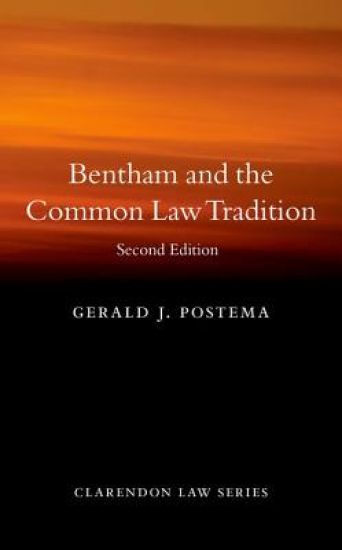
Bentham and the Common Law Tradition

Bentham and the Common Law Tradition

Gerald J. Postema

Oxford University Press
2019
sidottu
This work explores the relationship between Bentham's utilitarian practical philosophy and his positivist jurisprudence. These theories appear to be in tension because his utilitarian commitment to the sovereignty of utility as a practical decision principle seems inconsistent with his positivist insistence on the sovereignty of the will of the lawmaker. Two themes emerge from the attempt in this work to reconcile these two core elements of Bentham's practical thought. First, Bentham's conception of law does not fit the conventional model of legal positivism. Bentham was not just a utilitarian and a positivist; he was a positivist by virtue of his commitment to a utilitarian understanding of the fundamental task of law. Moreover, his emphasis on the necessary publicity and the systemic character of law, led him to insist on an essential role for utilitarian reasons in the regular public functioning of law. Second, Bentham's radical critique of common law theory and practice convinced him of the necessity to reconcile the need for certainty of law with an equally great need for its flexibility. He eventually developed a constitutional framework for adjudication in the shadow of codified law that accorded to judges discretion to decide particular cases according to their best judgment of the balance of utilities, guaranteeing the accountability and appropriate motivation of judicial decision-making through institutional incentives. The original text of this work, first published in 1986, remains largely unchanged, but an afterword reconsiders and revises some themes in response to criticism.
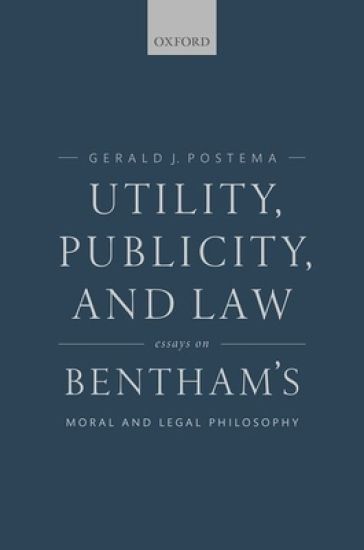
Utility, Publicity, and Law

Utility, Publicity, and Law

Gerald J. Postema

Oxford University Press
2019
sidottu
The essays in this volume offer a reassessment of Jeremy Bentham's strikingly original legal philosophy. Early on, Bentham discovered his 'genius for legislation' - 'legislation' included not only lawmaking and code writing, but also political and social institution building and engineering of public spaces for effective control of the exercise of political power. In his general philosophical work, Bentham sought to articulate a public philosophy to guide and direct all of his 'legislative' efforts. Part I explores the philosophical foundations of his public philosophy: his theory of meaning and framework for analysis and definition of key concepts, his theory of human affections and motivations, and his utilitarian theory of value. It is argued that, while concepts of pleasure and happiness play nominal roles in his theory of value, concepts of publicity, equality, and interests emerge as the dominant concepts of his public philosophy. Part II explores several dimensions of Bentham's jurisprudence, including his radically revised command model of law, his early reflections on justice and law in adjudication, his theories of judicial evidence, constitutional rights, the rule of law, and international law. The concluding essay demonstrates the centrality of the notion of publicity in his moral, legal and political thought. Emerging from this study is a positivist legal theory and a utilitarian moral-political philosophy that challenge in fundamental ways contemporary understandings of those doctrines.
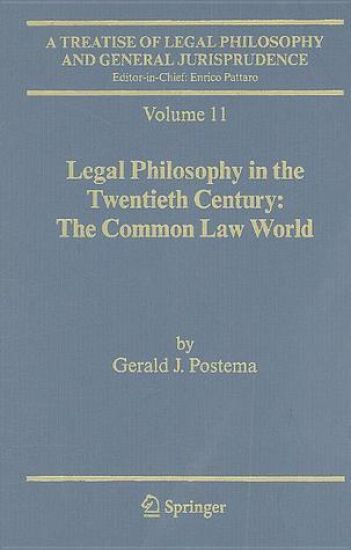
A Treatise of Legal Philosophy and General Jurisprudence
Volume 11, the sixth of the historical volumes of A Treatise of Legal Philosophy and General Jurisprudence, offers a fresh, philosophically engaged, critical interpretation of the main currents of jurisprudential thought in the English-speaking world of the 20th century. It tells the tale of two lectures and their legacies: Oliver Wendell Holmes, Jr.’s “The Path of Law” (1897) and H.L.A. Hart’s Holmes Lecture, “Positivism and the Separation of Law and Morals” (1958). Holmes’s radical challenge to late 19th century legal science gave birth to a rich variety of competing approaches to understanding law and legal reasoning from realism to economic jurisprudence to legal pragmatism, from recovery of key elements of common law jurisprudence and rule of law doctrine in the work of Llewellyn, Fuller and Hayek to root-and-branch attacks on the ideology of law by the Critical Legal Studies and Feminist movements. Hart, simultaneously building upon and transforming the undations of Austinian analytic jurisprudence laid in the early 20th century, introduced rigorous philosophical method to English-speaking jurisprudence and offered a reinterpretation of legal positivism which set the agenda for analytic legal philosophy to the end of the century and beyond. A wide-ranging debate over the role of moral principles in legal reasoning, sparked by Dworkin’s fundamental challenge to Hart’s theory, generated competing interpretations of and fundamental challenges to core doctrines of Hart’s positivism, including the nature and role of conventions at the foundations of law and the methodology of philosophical jurisprudence.
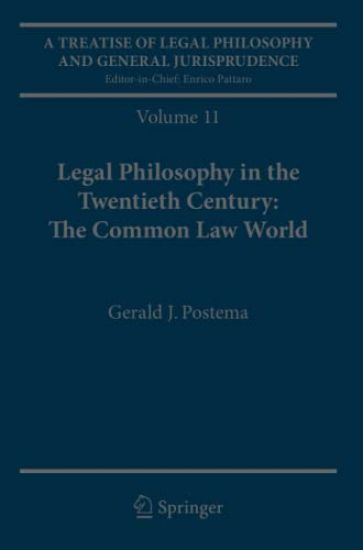
A Treatise of Legal Philosophy and General Jurisprudence
Volume 11, the sixth of the historical volumes of A Treatise of Legal Philosophy and General Jurisprudence, offers a fresh, philosophically engaged, critical interpretation of the main currents of jurisprudential thought in the English-speaking world of the 20th century. It tells the tale of two lectures and their legacies: Oliver Wendell Holmes, Jr.’s “The Path of Law” (1897) and H.L.A. Hart’s Holmes Lecture, “Positivism and the Separation of Law and Morals” (1958). Holmes’s radical challenge to late 19th century legal science gave birth to a rich variety of competing approaches to understanding law and legal reasoning from realism to economic jurisprudence to legal pragmatism, from recovery of key elements of common law jurisprudence and rule of law doctrine in the work of Llewellyn, Fuller and Hayek to root-and-branch attacks on the ideology of law by the Critical Legal Studies and Feminist movements. Hart, simultaneously building upon and transforming the undations of Austinian analytic jurisprudence laid in the early 20th century, introduced rigorous philosophical method to English-speaking jurisprudence and offered a reinterpretation of legal positivism which set the agenda for analytic legal philosophy to the end of the century and beyond. A wide-ranging debate over the role of moral principles in legal reasoning, sparked by Dworkin’s fundamental challenge to Hart’s theory, generated competing interpretations of and fundamental challenges to core doctrines of Hart’s positivism, including the nature and role of conventions at the foundations of law and the methodology of philosophical jurisprudence.