Kirjojen hintavertailu. Mukana 11 717 486 kirjaa ja 12 kauppaa.

Kirjahaku

Etsi kirjoja tekijän nimen, kirjan nimen tai ISBN:n perusteella.

8 kirjaa tekijältä Gerald L. Bruns

Hermeneutics Ancient and Modern

Hermeneutics Ancient and Modern

Gerald L. Bruns

Yale University Press
1995
pokkari
In this wide-ranging meditation on the nature and purpose of hermeneutics, Gerald L. Bruns argues that hermeneutics is not merely a contemporary theory but an extended family of questions about understanding and interpretation that have multiple and conflicting histories going back to before the beginning of writing.What does it mean to understand a riddle, an action, a concept, a law, an alien culture, or oneself? Bruns expands our sense of the horizons of hermeneutics by situating its basic questions against a background of different cultural traditions and philosophical topics. He discusses, for example, the interpretation of oracles, the silencing of the muses and the writing of history, the quarrel between philosophy and poetry, the canonization of sacred texts, the nature of allegorical exegesis, rabbinical midrash, the mystical exegesis of the Qur'an, the rise of literalism and the individual interpreter, and the nature of Romantic hermeneutics. Dealing with thinkers ranging from Socrates to Luther to Wordsworth to Ricoeur, Bruns also ponders several basic dilemmas about the nature of hermeneutical experience, the meaning of tradition, the hermeneutical function of narrative, and the conflict between truth and freedom in philosophy and literature. His eloquent book demonstrates the continuing power of hermeneutical thinking to open up questions about the world and our place in it.
Maurice Blanchot:

Maurice Blanchot:

Gerald L. Bruns

Johns Hopkins University Press
2005
nidottu
As a novelist, essayist, critic, and theorist, Maurice Blanchot has earned tributes from authors as diverse as Jacques Derrida, Giles Deleuze, and Emmanuel Levinas. But their praise has told us little about what Blanchot's work actually says and why it has been so influential. In the first comprehensive study of this important French writer to appear in English, Gerald Bruns ties Blanchot's writings to each other and to the works of his contemporaries, including the poet Paul Celan. Blanchot belongs to the generation of French intellectuals who came of age during the 1930s, survived the Occupation, and flourished during the quarter century or so after World War II. He was one of the first French intellectuals to take a systematic interest in questions of language and meaning. His focus in the mid-1930s on extreme situations-death, madness, imprisonment, exile, revolution, catastrophe-anticipated the later interest of the existentialists. Like Nietzsche, Wittgenstein, and Adorno, Blanchot was a self-conscious writer of fragments, and he has given us one the most developed investigations that we have on the fragment as a kind of writing. In a series of close readings, Bruns addresses the philosophical and political questions that have surrounded Blanchot and his writings for decades. He describes what is creative in Blanchot's readings of Heidegger's controversial works and examines Blanchot's conception of poetry as an inquiry into the limits of philosophy, rationality, and power.
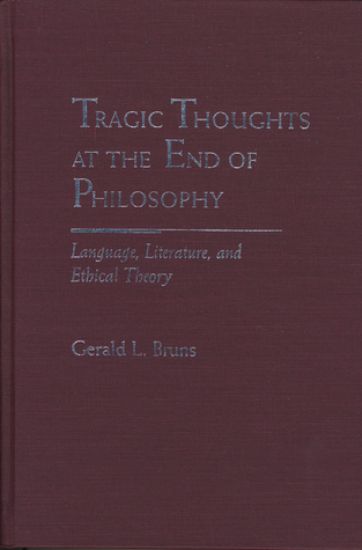
Tragic Thoughts at the End of Philosophy

Tragic Thoughts at the End of Philosophy

Gerald L. Bruns

Northwestern University Press
1999
sidottu
Bruns, perhaps one of most insightful of contemporary literary theorists, investigates the recent phenomenon of philosophers taking an interest in literature and literary theory. Beginning with the premise that philosophy and literature are internal to one another's histories, starting with Plato's ""Republic"", Bruns examines diverse thinkers and topics such as Stanley Cavell on Shakespeare, Donald Davidson on James Joyce and Richard Rorty on the Poetizing of culture. The book offers a view of what happens when philosophers begin looking at the world from the ground level - that is, as inhabitants, rather than as disengaged observers.
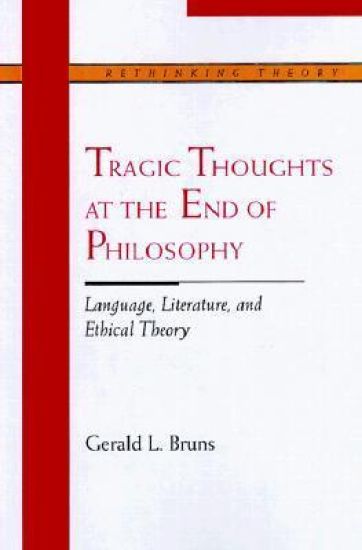
Tragic Thoughts at the End of Philosophy

Tragic Thoughts at the End of Philosophy

Gerald L. Bruns

Northwestern University Press
1999
nidottu
Bruns, perhaps one of most insightful of contemporary literary theorists, investigates the recent phenomenon of philosophers taking an interest in literature and literary theory. Beginning with the premise that philosophy and literature are internal to one another's histories, starting with Plato's ""Republic"", Bruns examines diverse thinkers and topics such as Stanley Cavell on Shakespeare, Donald Davidson on James Joyce and Richard Rorty on the Poetizing of culture. The book offers a view of what happens when philosophers begin looking at the world from the ground level - that is, as inhabitants, rather than as disengaged observers.
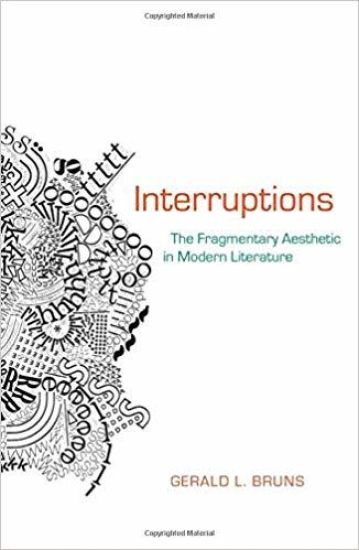
Interruptions

Interruptions

Gerald L. Bruns

The University of Alabama Press
2018
nidottu
A history of fragmentary—or interrupted—writing in avant-garde poetry and prose by a renowned literary critic. In Interruptions: The Fragmentary Aesthetic in Modern Literature, Gerald L. Bruns explores the effects of parataxis, or fragmentary writing as a device in modern literature. Bruns focuses on texts that refuse to follow the traditional logic of sequential narrative. He explores numerous examples of self-interrupting composition, starting with Friedrich Schlegel's inaugural theory and practice of the fragment as an assertion of the autonomy of words, and their freedom from rule-governed hierarchies. Bruns opens the book with a short history of the fragment as a distinctive feature of literary modernism in works from Gertrude Stein to Paul Celan to present-day authors. The study progresses to the later work of Maurice Blanchot and Samuel Beckett, and argues, controversially, that Blanchot's writings on the fragment during the 1950s and early 1960s helped to inspire Beckett’s turn toward paratactic prose. The study also extends to works of poetry, examining the radically paratactic arrangements of two contemporary British poets, J. H. Prynne and John Wilkinson, focusing chiefly on their most recent, and arguably most abstruse, works. Bruns also offers a close study of the poetry and poetics of Charles Bernstein. Interruptions concludes with two chapters about James Joyce. First, Bruns tackles the language of Finnegans Wake, namely the break-up of words themselves, its reassembly into puns, neologisms, nonsense, and even random strings of letters. Second, Bruns highlights the experience of mirrors in Joyce’s fiction, particularly in Dubliners, Portrait of the Artist as a Young Man, and Ulysses, where mirrored reflections invariably serve as interruptions, discontinuities, or metaphorical displacements and proliferations of self-identity.
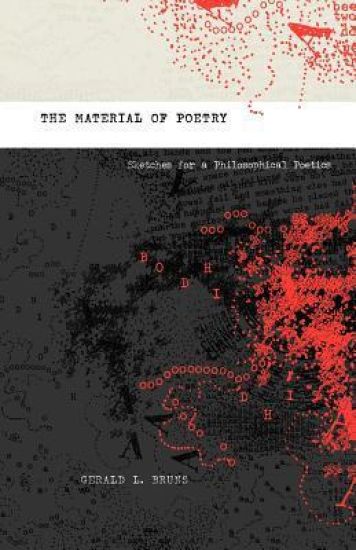
The Material of Poetry

The Material of Poetry

Gerald L. Bruns

University of Georgia Press
2012
pokkari
Poetry is philosophically interesting, writes Gerald L. Bruns, "when it is innovative not just in its practices, but, before everything else, in its poetics (that is, in its concepts or theories of itself)." In The Material of Poetry, Bruns considers the possibility that anything, under certain conditions, may be made to count as a poem. By spelling out such enabling conditions he gives us an engaging overview of some of the kinds of contemporary poetry that challenge our notions of what language is: sound poetry, visual or concrete poetry, and "found" poetry.Poetry's sense and meaning can hide in the spaces in which it is written and read, says Bruns, and so he urges us to become anthropologists, to go afield in poetry's social, historical, and cultural settings. From that perspective, Bruns draws on works by such varied poets as Gertrude Stein, Ezra Pound, Steve McCaffery, and Francis Ponge to argue for three seemingly competing points. First, poetry is made of language but is not a use of it. That is, poetry is made of words but not of what we use words to produce: concepts, narratives, expressions of feeling, and so on. Second, as the nine sound poems on the online audio recordings included with the book demonstrate, poetry is not necessarily made of words but is rooted in, and in fact already fully formed by, sounds the human body can produce. Finally, poetry belongs to the world alongside ordinary things; it cannot be confined to some aesthetic, neutral, or disengaged dimension of human culture.Poetry without frontiers, unmoored from expectations, and sometimes even written in imaginary languages: Bruns shows us why, for the sake of all poetry, we should embrace its anarchic, vitalizing ways.
On the Anarchy of Poetry and Philosophy

On the Anarchy of Poetry and Philosophy

Gerald L. Bruns

Fordham University Press
2007
sidottu
Marcel Duchamp once asked whether it is possible to make something that is not a work of art. This question returns over and over in modernist culture, where there are no longer any authoritative criteria for what can be identified (or excluded) as a work of art. As William Carlos Williams says, "A poem can be made of anything," even newspaper clippings. At this point, art turns into philosophy, all art is now conceptual art, and the manifesto becomes the distinctive genre of modernism. This book takes seriously this transformation of art into philosophy, focusing upon the systematic interest that so many European philosophers take in modernism. Among the philosophers Gerald Bruns discusses are Theodor W. Adorno, Maurice Blanchot, Arthur Danto, Stanley Cavell, Hans-Georg Gadamer, Michel Foucault, Gilles Deleuze and Felix Guattari, Jacques Derrida, Jean-François Lyotard, Jean-Luc Nancy, Philippe Lacoue-Labarthe, and Emmanuel Levinas. As Bruns demonstrates, the difficulty of much modern and contemporary poetry can be summarized in the idea that a poem is made of words, not of any of the things that we use words to produce: meanings, concepts, propositions, narratives, or expressions of feeling. Many modernist poets have argued that in poetry language is no longer a form of mediation but a reality to be explored and experienced in its own right. But what sort of experience, philosophically, might this be? The problem of the materiality or hermetic character of poetic language inevitably leads to questions of how philosophy itself is to be written and what sort of community defines the work of art—or, for that matter, the work of philosophy. In this provocative study, Bruns answers that the culture of modernism is a kind of anarchist community, where the work of art is apt to be as much an event or experience—or, indeed, an alternative form of life—as a formal object. In modern writing, philosophy and poetry fold into one another. In this book, Bruns helps us to see how.
On the Anarchy of Poetry and Philosophy

On the Anarchy of Poetry and Philosophy

Gerald L. Bruns

Fordham University Press
2007
pokkari
Marcel Duchamp once asked whether it is possible to make something that is not a work of art. This question returns over and over in modernist culture, where there are no longer any authoritative criteria for what can be identified (or excluded) as a work of art. As William Carlos Williams says, "A poem can be made of anything," even newspaper clippings. At this point, art turns into philosophy, all art is now conceptual art, and the manifesto becomes the distinctive genre of modernism. This book takes seriously this transformation of art into philosophy, focusing upon the systematic interest that so many European philosophers take in modernism. Among the philosophers Gerald Bruns discusses are Theodor W. Adorno, Maurice Blanchot, Arthur Danto, Stanley Cavell, Hans-Georg Gadamer, Michel Foucault, Gilles Deleuze and Felix Guattari, Jacques Derrida, Jean-François Lyotard, Jean-Luc Nancy, Philippe Lacoue-Labarthe, and Emmanuel Levinas. As Bruns demonstrates, the difficulty of much modern and contemporary poetry can be summarized in the idea that a poem is made of words, not of any of the things that we use words to produce: meanings, concepts, propositions, narratives, or expressions of feeling. Many modernist poets have argued that in poetry language is no longer a form of mediation but a reality to be explored and experienced in its own right. But what sort of experience, philosophically, might this be? The problem of the materiality or hermetic character of poetic language inevitably leads to questions of how philosophy itself is to be written and what sort of community defines the work of art—or, for that matter, the work of philosophy. In this provocative study, Bruns answers that the culture of modernism is a kind of anarchist community, where the work of art is apt to be as much an event or experience—or, indeed, an alternative form of life—as a formal object. In modern writing, philosophy and poetry fold into one another. In this book, Bruns helps us to see how.