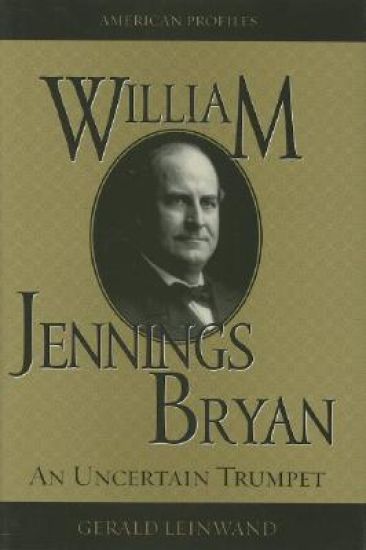
At the time of his death in 1925, William Jennings Bryan was, as Henry Steele Commager wrote, "the most representative American of his time." To understand Bryan is to understand the United States on the cusp of modernity as regionalism declined, national political and economic institutions expanded, and the urban way of life began to eclipse the rural. Bryan's time, as today, was one of profound transition and tumult in the United States. The late nineteenth century and early twentieth century saw significant changes in economic, social, and political life which were to result in the modern nation we now recognize. At such a time Americans looked for moral leadership and yet there was no consensus about right and wrong in private or public life. In this uncertain era, Bryan stood forth as a political, moral, and economic reformer and sounded his trumpet for the values of the common man and woman as he so uncertainly understood them. As Gerald Leinwand skillfully shows, the true Bryan is not the caricature we have substituted for the man—the quixotic presidential candidate or the rural bumpkin who tried to match wits with Clarence Darrow on the matter of whether humans were descended from apes. In this important new study of Bryan's life, we find a reformer and politician of compelling power who stood at the center of American political life for thirty years. A Christian fundamentalist and a populist, Bryan was a lively mixture of Protestant revivalism and Jacksonian democracy—rural in upbringing, western in sentiment, and often a disappointed outsider to the political establishment. Best known for his fiery monetary policy crusade against the gold standard, Bryan also favored women's suffrage, direct election of U.S. Senators, and government regulation of railroads. He was a populist whose death left the socialist Eugene V. Debbs unmoved and a conservative whose name was anathema to early twentieth century plutocrats. At the time of his death, no man in public life had more devoted followers and none had more political enemies than William Jennings Bryan. How could a man who was wrong so many times, and who voiced such disharmonious opinions, dominate American life for nearly three decades? In this engaging narrative, Leinwand takes a fresh look at William Jennings Bryan, his character, and his mental, spiritual, and intellectual development. The variety of views about Bryan and the uncertainty of Bryan's own accomplishments as a politician are, as Leinwand demonstrates, reflected in the larger tumult that was American society of the era. Leinwand also includes, in an epilogue, a discussion that has engaged the attention of scholars as to whether the Wizard of Oz was in effect an allegory for Bryan's failure in his campaign for silver.