
Kirjojen hintavertailu. Mukana 11 505 934 kirjaa ja 12 kauppaa.

Kirjahaku

Etsi kirjoja tekijän nimen, kirjan nimen tai ISBN:n perusteella.

3 kirjaa tekijältä Gerard de Vries

Bruno Latour

Bruno Latour

Gerard de Vries

Polity Press
2016
sidottu
Bruno Latour is among the most important figures in contemporary philosophy and social science. His ethnographic studies have revolutionized our understanding of areas as diverse as science, law, politics and religion. To facilitate a more realistic understanding of the world, Latour has introduced a radically fresh philosophical terminology and a new approach to social science, ‘Actor-Network Theory’. In seminal works such as Laboratory Life, We Have Never Been Modern and An Inquiry into Modes of Existence, Latour has outlined an alternative to the foundational categories of ‘modern’ western thought Ð particularly its distinction between society and nature Ð that has major consequences for our understanding of the ecological crisis and of the role of science in democratic societies. Latour’s ‘empirical philosophy’ has evolved considerably over the past four decades. In this lucid and compelling book, Gerard de Vries provides one of the first overviews of Latour’s work. He guides readers through Latour’s main publications, from his early ethnographies to his more recent philosophical works, showing with considerable skill how Latour’s ideas have developed. This book will be of great value to students and scholars attempting to come to terms with the immense challenge posed by Latour’s thought. It will be of interest to those studying philosophy, anthropology, sociology, science and technology studies, and almost all other branches of the social sciences and humanities.
Bruno Latour

Bruno Latour

Gerard de Vries

Polity Press
2016
nidottu
Bruno Latour is among the most important figures in contemporary philosophy and social science. His ethnographic studies have revolutionized our understanding of areas as diverse as science, law, politics and religion. To facilitate a more realistic understanding of the world, Latour has introduced a radically fresh philosophical terminology and a new approach to social science, ‘Actor-Network Theory’. In seminal works such as Laboratory Life, We Have Never Been Modern and An Inquiry into Modes of Existence, Latour has outlined an alternative to the foundational categories of ‘modern’ western thought Ð particularly its distinction between society and nature Ð that has major consequences for our understanding of the ecological crisis and of the role of science in democratic societies. Latour’s ‘empirical philosophy’ has evolved considerably over the past four decades. In this lucid and compelling book, Gerard de Vries provides one of the first overviews of Latour’s work. He guides readers through Latour’s main publications, from his early ethnographies to his more recent philosophical works, showing with considerable skill how Latour’s ideas have developed. This book will be of great value to students and scholars attempting to come to terms with the immense challenge posed by Latour’s thought. It will be of interest to those studying philosophy, anthropology, sociology, science and technology studies, and almost all other branches of the social sciences and humanities.
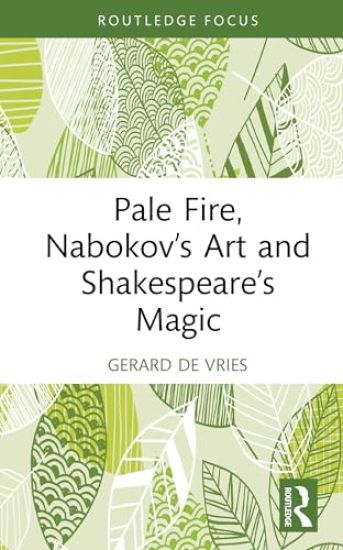
Pale Fire, Nabokov’s Art and Shakespeare’s Magic
This manuscript examines Vladimir Nabokov's Pale Fire, widely regarded as his most challenging and critically acclaimed work. While Lolita remains Nabokov's best-known novel, Pale Fire has generated the most sustained scholarly attention and interpretive debate among literary critics. Existing scholarship on Shakespeare's influence in Pale Fire has remained narrowly focused on Timon of Athens, the source of the novel's title. This study provides the first comprehensive analysis of all fifty-one Shakespearean references throughout the text, examining the complete range of plays to which Nabokov alludes. Through systematic investigation of these intertextual connections, this work demonstrates that Nabokov's deployment of Shakespearean imagery functions as a crucial interpretive key to the novel's central concerns. The analysis reveals how Shakespeare's presence illuminates three fundamental themes in Pale Fire: the novel's autobiographical dimensions, the protagonist's quest for immortality, and the tragedy of Hazel Shade, the work's tragic heroine. By tracing these Shakespearean threads throughout Nabokov's intricate narrative structure, this study offers new insights into the novel's complex thematic architecture and demonstrates how literary allusion operates as both aesthetic strategy and meaning-making device in one of twentieth-century literature's most enigmatic masterworks.