Kirjojen hintavertailu. Mukana 11 244 527 kirjaa ja 12 kauppaa.

Kirjahaku

Etsi kirjoja tekijän nimen, kirjan nimen tai ISBN:n perusteella.

12 kirjaa tekijältä Gerd Baumann

Mathematica for Theoretical Physics

Mathematica for Theoretical Physics

Gerd Baumann

Springer-Verlag New York Inc.
2005
sidottu
Mathematica for Theoretical Physics: Classical Mechanics and Nonlinear DynamicsThis second edition of Baumann's Mathematica® in Theoretical Physics shows readers how to solve physical problems and deal with their underlying theoretical concepts while using Mathematica® to derive numeric and symbolic solutions. Each example and calculation can be evaluated by the reader, and the reader can change the example calculations and adopt the given code to related or similar problems. The second edition has been completely revised and expanded into two volumes: The first volume covers classical mechanics and nonlinear dynamics. Both topics are the basis of a regular mechanics course. The second volume covers electrodynamics, quantum mechanics, relativity, and fractals and fractional calculus. New examples have been added and the representation has been reworked to provide a more interactive problem-solving presentation. This book can be used as a textbook or as a reference work, by students and researchers alike. A brief glossary of terms and functions is contained in the appendices.The examples given in the text can also be interactively used and changed for the reader’s purposes.The Author, Gerd Baumann, is affiliated with the Mathematical Physics Division of the University of Ulm, Germany, where he is professor. He is the author of Symmetry Analysis of Differential Equations with Mathematica®. Dr. Baumann has given numerous invited talks at universities and industry alike. He regularly hosts seminars and lectures on symbolic computing at the University of Ulm and at TECHNISCHE UNIVERSITÄT MÜNCHEN (TUM), Munich.
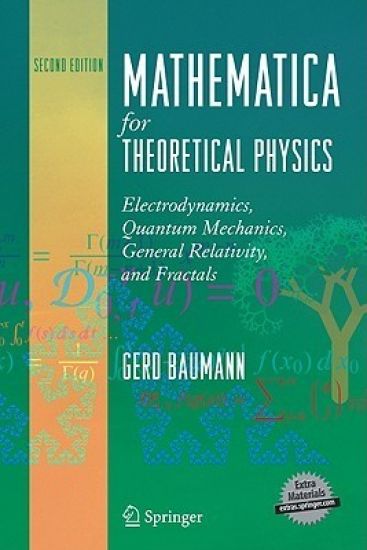
Mathematica for Theoretical Physics

Mathematica for Theoretical Physics

Gerd Baumann

Springer-Verlag New York Inc.
2005
sidottu
As physicists, mathematicians or engineers, we are all involved with mathematical calculations in our everyday work. Most of the laborious, complicated, and time-consuming calculations have to be done over and over again if we want to check the validity of our assumptions and derive new phenomena from changing models. Even in the age of computers, we often use paper and pencil to do our calculations. However, computer programs like Mathematica have revolutionized our working methods. Mathematica not only supports popular numerical calculations but also enables us to do exact analytical calculations by computer. Once we know the analytical representations of physical phenomena, we are able to use Mathematica to create graphical representations of these relations. Days of calculations by hand have shrunk to minutes by using Mathematica. Results can be verified within a few seconds, a task that took hours if not days in the past. The present text uses Mathematica as a tool to discuss andto solve examples from physics. The intention of this book is to demonstrate the usefulness of Mathematica in everyday applications. We will not give a complete description of its syntax but demonstrate by examples the use of its language. In particular, we show how this modern tool is used to solve classical problems. viii Preface This second edition of Mathematica in Theoretical Physics seeks to prevent the objectives and emphasis of the previous edition.
The Multicultural Riddle

The Multicultural Riddle

Gerd Baumann

Routledge
1999
sidottu
Multicultural Riddle is a comprehensive exploration of all the issues that shape our search for a multicultural society. The book examines how we can establish a state of justice and equality between and among three groups: those who believe in a unified national culture, those who trace their culture to their ethnic identity, and those who view their religion as their culture. To solve the multicultural riddle, one must rethink national identity, ethnicity and the role of religion in the modern world.
The Multicultural Riddle

The Multicultural Riddle

Gerd Baumann

Routledge
1999
nidottu
Multicultural Riddle is a comprehensive exploration of all the issues that shape our search for a multicultural society. The book examines how we can establish a state of justice and equality between and among three groups: those who believe in a unified national culture, those who trace their culture to their ethnic identity, and those who view their religion as their culture. To solve the multicultural riddle, one must rethink national identity, ethnicity and the role of religion in the modern world.
Contesting Culture: Discourses of Identity in Multi-Ethnic London
This innovative study presents an account of the interaction of people from different ethnic backgrounds who live in Southall, the most densely populated, multi-ethnic ghetto in the London area. Breaking with the tradition of studying a single ethnic community, Gerhard Baumann treats Southall as a social field, in which various immigrant groups come to terms with one another and with the dominant, if distant, host culture. The people of Southall affirm ethnic distinctiveness in some contexts, but they are also engaged in rethinking their identities and in debating the meaning of their cultural heritage. This book is at once a vivid ethnographic account of an aspect of contemporary British life, and a challenge to the conventional discourse of community studies.
Contesting Culture

Contesting Culture

Gerd Baumann

Cambridge University Press
1996
pokkari
This innovative study presents an account of the interaction of people from different ethnic backgrounds who live in Southall, the most densely populated, multi-ethnic ghetto in the London area. Breaking with the tradition of studying a single ethnic community, Gerhard Baumann treats Southall as a social field, in which various immigrant groups come to terms with one another and with the dominant, if distant, host culture. The people of Southall affirm ethnic distinctiveness in some contexts, but they are also engaged in rethinking their identities and in debating the meaning of their cultural heritage. This book is at once a vivid ethnographic account of an aspect of contemporary British life, and a challenge to the conventional discourse of community studies.
Symmetry Analysis of Differential Equations with Mathematica®

Symmetry Analysis of Differential Equations with Mathematica®

Gerd Baumann

Springer-Verlag New York Inc.
2014
nidottu
The purpose of this book is to provide the reader with a comprehensive introduction to the applications of symmetry analysis to ordinary and partial differential equations. The theoretical background of physics is illustrated by modem methods of computer algebra. The presentation of the material in the book is based on Mathematica 3.0 note­ books. The entire printed version of this book is available on the accompanying CD. The text is presented in such a way that the reader can interact with the calculations and experiment with the models and methods. Also contained on the CD is a package called MathLie-in honor of Sophus Lie---carrying out the calculations automatically. The application of symmetry analysis to problems from physics, mathematics, and en­ gineering is demonstrated by many examples. The study of symmetries of differential equations is an old subject. Thanks to Sophus Lie we today have available to us important information on the behavior of differential equations. Symmetries can be used to find exact solutions. Symmetries can be applied to verify and to develop numerical schemes. They can provide conservation laws for differential equations. The theory presented here is based on Lie, containing improve­ ments and generalizations made by later mathematicians who rediscovered and used Lie's work. The presentation of Lie's theory in connection with Mathematica is novel and vitalizes an old theory. The extensive symbolic calculations necessary under Lie's theory are supported by MathLie, a package written in Mathematica.
Mathematica for Theoretical Physics

Mathematica for Theoretical Physics

Gerd Baumann

Springer-Verlag New York Inc.
2014
nidottu
Mathematica for Theoretical Physics: Classical Mechanics and Nonlinear DynamicsThis second edition of Baumann's Mathematica® in Theoretical Physics shows readers how to solve physical problems and deal with their underlying theoretical concepts while using Mathematica® to derive numeric and symbolic solutions. Each example and calculation can be evaluated by the reader, and the reader can change the example calculations and adopt the given code to related or similar problems. The second edition has been completely revised and expanded into two volumes: The first volume covers classical mechanics and nonlinear dynamics. Both topics are the basis of a regular mechanics course. The second volume covers electrodynamics, quantum mechanics, relativity, and fractals and fractional calculus. New examples have been added and the representation has been reworked to provide a more interactive problem-solving presentation. This book can be used as a textbook or as a reference work, by students and researchers alike. A brief glossary of terms and functions is contained in the appendices.The examples given in the text can also be interactively used and changed for the reader’s purposes.The Author, Gerd Baumann, is affiliated with the Mathematical Physics Division of the University of Ulm, Germany, where he is professor. He is the author of Symmetry Analysis of Differential Equations with Mathematica®. Dr. Baumann has given numerous invited talks at universities and industry alike. He regularly hosts seminars and lectures on symbolic computing at the University of Ulm and at TECHNISCHE UNIVERSITÄT MÜNCHEN (TUM), Munich.
Mathematics for Engineers II

Mathematics for Engineers II

Gerd Baumann

De Gruyter Oldenbourg
2009
sidottu
"Mathematics for Engineers II" gehört zu einer vierbändigen Reihe und gibt eine Einführung in die Mathematik für Undergraduates, die ein Bachelor-Studium im Bereich Ingenieurwissenschaften aufgenommen haben. In Band II wird der klassische Calculus fort- und in die Grundlagen der Linearen Algebra eingeführt. Die Reihe unterscheidet sich von traditionellen Texten dadurch, dass sie interaktiv ist und mit Hilfe des Computer-Algebra-Systems Mathematica die Berechnungen darstellt. Jedem Buch liegt eine CD bei, die die Rechenprogramme und den vollständigen Text in Mathemetica enthält. Den Studierenden eröffnet sich so die Möglichkeit, interaktiv die Vorlesungsmaterialien nachzuvollziehen und die Fragestellungen des Texts sowie der Beispiele mit Unterstützung von Mathematica zu lösen. Die vormalig beiliegende CD ist nun online bei Band IV unter Zusatzmaterial als kostenfreier Download verfügbar.
Mathematics for Engineers III

Mathematics for Engineers III

Gerd Baumann

De Gruyter Oldenbourg
2011
sidottu
This book is part of a four-volume textbook on Engineering Mathematics for undergraduates. Volume III treats vector calculus and differential equations of higher order. The text uses Mathematica as a tool to discuss and to solve examples from mathematics. The basic use of this language is demonstrated by examples.
Mathematics for Engineers IV

Mathematics for Engineers IV

Gerd Baumann

De Gruyter Oldenbourg
2009
sidottu
"Mathematics for Engineers I" gehört zu einer vierbändigen Reihe und gibt eine Einführung in die Mathematik für Undergraduates, die ein Bachelor-Studium im Bereich Ingenieurwissenschaften aufgenommen haben. Band IV ergänzt den Calculus und die Lineare Algebra durch grundlegende numerische Verfahren und deren Anwendung auf praktische Fragestellungen. Die Reihe unterscheidet sich von traditionellen Texten dadurch, dass sie interaktiv ist und mit Hilfe des Computer-Algebra-Systems Mathematica die Berechnungen darstellt. Jedem Buch liegt eine CD bei, die die Rechenprogramme und den vollständigen Text in Mathemetica enthält. Den Studierenden eröffnet sich so die Möglichkeit, interaktiv die Vorlesungsmaterialien nachzuvollziehen und die Fragestellungen des Texts sowie der Beispiele mit Unterstützung von Mathematica zu lösen.