Kirjojen hintavertailu. Mukana 12 016 292 kirjaa ja 12 kauppaa.

Kirjahaku

Etsi kirjoja tekijän nimen, kirjan nimen tai ISBN:n perusteella.

6 kirjaa tekijältä Gerd Heuschmann

Tug of War: Classical Versus Modern Dressage: Why Classical Training Works and How Incorrect Modern Riding Negatively Affects Horses' Health
German rider and equine veterinarian Dr. Gerd Heuschmann is well-known in dressage circles-admired for his plain speaking regarding what he deems the incorrect and damaging training methods commonly employed by riders and trainers involved in competition today. Here, he presents an intelligent and thought-provoking exploration of both classical and "modern" training methods, including "hyperflexion" (also known as Rollkur), against a practical backdrop of the horse's basic anatomy and physiology.In a detailed yet comprehensible fashion, Dr. Heuschmann describes parts of the horse's body that need to be correctly developed by the dressage rider. He then examines how they function both individually and within an anatomical system, and how various schooling techniques affect these parts for the good, or for the bad. Using vivid color illustrations of the horse's skeletal system, ligaments, and musculature, in addition to comparative photos depicting "correct" versus "incorrect" movement-and most importantly, photos of damaging schooling methods-Dr. Heuschmann convincingly argues that the horse's body tells us whether our riding is truly gymnasticizing and "building the horse up," or simply wearing it down and tearing it apart. He then outlines his ideal "physiological education" of the horse.Training should mirror the mental and physical development of the horse, fulfilling "classical" requirements-such as regularity of the three basic gaits, suppleness, and acceptance of the bit-rather than disregarding time-tested values for quick fixes that could lead to the degradation of the horse's well-being. Dr. Heuschmann's assertion that the true objectives of dressage schooling must never be eclipsed by simple "mechanical perfection" is certain to inspire riders at all levels to examine their riding, their riding goals, and the techniques they employ while pursuing them.
Balancing ACT: The Horse in Sport--An Irreconcilable Conflict?
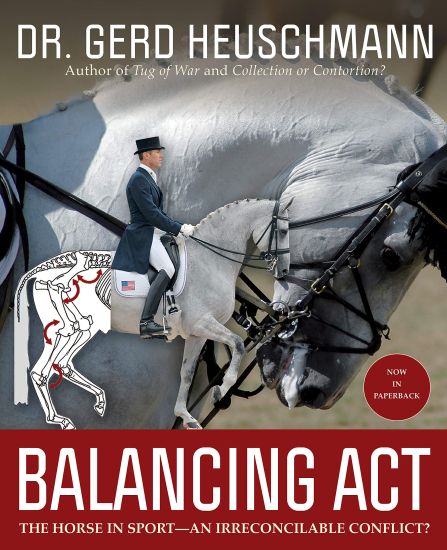
A wake-up-call of a follow-up from the bestselling author of Tug of War: Classical versus "Modern" Dressage. In no uncertain terms, this book asks what it means to be a responsible rider, and whether, in today's society, it is indeed possible for equestrians in any horse sport to put the good of the horse first and foremost, and above ambition and fame. With vibrantly clear illustrations of the horse's anatomy and how it is impacted by various riding techniques, Balancing Act presents proof that, although some steps have been taken to prevent the use of forceful and cruel techniques, many sport horses still perform in pain and discomfort. With detailed, practical information on horse physiology and multiple examples of poor riding in pictures so that the reader can avoid similar pitfalls, Dr. Heuschmann gives all of us reasons to examine ourselves and those around us through the lens of the horse's welfare. As a veterinarian with thorough knowledge of the working equine's body, Dr. Heuschmann ultimately intends through his expos to show how bad horse-training methods can be eradicated in favor of far more humane ones. Readers will also find five chapters full of researched and proven recommendations for retraining horses with behavioral or biomechanical issues related to poor training techniques, including: The tense horse. The rein-lame horse. The horse with gait deviations. The hyperflexed horse. The unbalanced horse that is off the aids.
Balancing Act

Balancing Act

Gerd Heuschmann

J.A.Allen Co Ltd
2021
nidottu
In no uncertain terms, this book asks what it means to be a responsible rider, and whether, in today's society, it is indeed possible for equestrians in any horse sport to put the good of the horse first and foremost, and above ambition and fame. With vibrantly clear illustrations of the horse's anatomy and how it is impacted by various riding techniques, Balancing Act presents proof that, although some steps have been taken to prevent the use of forceful and cruel techniques, many sport horses still perform in pain and discomfort. With fabulous art to help show the anatomy of the horse and multiple examples of poor riding in pictures so that the reader can avoid similar pitfalls, Dr. Heuschmann gives all of us reasons to examine ourselves and those around us through the lens of the horse's welfare. Readers will also find five chapters full of researched and proven recommendations for retraining horses with behavioural or biomechanical issues related to poor training techniques, including: the tense horse; the rein-lame horse; the horse with gait deviations; the hyperflexed horse; and the unbalanced horse that is completely off the aids. In paperback for the first time with new observations from the author, Balancing Act is for every conscientious horse person intent on riding and training with the good of the horse in mind.