Kirjojen hintavertailu. Mukana 12 358 928 kirjaa ja 12 kauppaa.

Kirjahaku

Etsi kirjoja tekijän nimen, kirjan nimen tai ISBN:n perusteella.

3 kirjaa tekijältä Gert Rosenthal

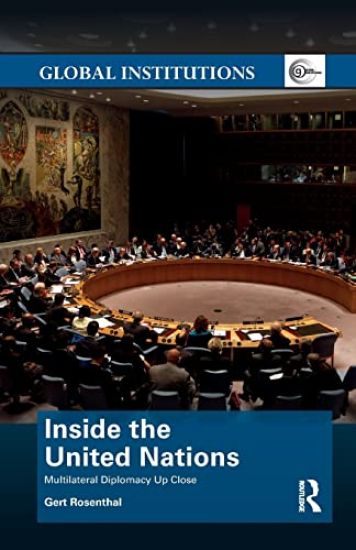
Inside the United Nations

Inside the United Nations

Gert Rosenthal

Routledge
2019
nidottu
Inside the United Nations illustrates some of the parameters surrounding consensus-building at the United Nations, seeking to provide new insights beyond what is already known. The author spent twelve years as P.R of Guatemala at the UN, offering him privileged observatories in all three of the main inter-governmental organs: the General Assembly, the Economic and Social Council, and the Security Council.In this book Rosenthal focuses on six case studies that offer the breadth and scope of what the UN does, and illustrate some of the main elements of the dynamics of consensus-building, providing concrete examples of the ingredients that shape decision-making in a multilateral setting. The chapters:cover the origin, preparation, and outcome of two successful international conferences: the 2000 Millennium Summit and the 2002 International Conference on Financing for Development;look at the 2000 negotiation on the scale of assessments to finance the UN’s budget in the General Assembly’s fifth committee (2000-2001);focus on the relevance of the Economic and Social Council;consider the internal politics involved in vying for elected posts in intergovernmental bodies by focusing on the campaign to be elected to the Security Council between Guatemala and Venezuela in 2006;reflect on the peculiarities of decision-making in the Security Council.Providing an insider’s view on the UN and exploring different facets of multilateral diplomacy at the UN, this book will be of great use and interest to scholars of international relations as well as the diplomatic community.
Inside the United Nations

Inside the United Nations

Gert Rosenthal

Routledge
2017
sidottu
Inside the United Nations illustrates some of the parameters surrounding consensus-building at the United Nations, seeking to provide new insights beyond what is already known. The author spent twelve years as P.R of Guatemala at the UN, offering him privileged observatories in all three of the main inter-governmental organs: the General Assembly, the Economic and Social Council, and the Security Council.In this book Rosenthal focuses on six case studies that offer the breadth and scope of what the UN does, and illustrate some of the main elements of the dynamics of consensus-building, providing concrete examples of the ingredients that shape decision-making in a multilateral setting. The chapters:cover the origin, preparation, and outcome of two successful international conferences: the 2000 Millennium Summit and the 2002 International Conference on Financing for Development;look at the 2000 negotiation on the scale of assessments to finance the UN’s budget in the General Assembly’s fifth committee (2000-2001);focus on the relevance of the Economic and Social Council;consider the internal politics involved in vying for elected posts in intergovernmental bodies by focusing on the campaign to be elected to the Security Council between Guatemala and Venezuela in 2006;reflect on the peculiarities of decision-making in the Security Council.Providing an insider’s view on the UN and exploring different facets of multilateral diplomacy at the UN, this book will be of great use and interest to scholars of international relations as well as the diplomatic community.

Soberanía y no intervención

Soberanía y no intervención

Gert Rosenthal; Francisco Villagrán de León

FG Editores
2021
pokkari
La intervenci n en los asuntos internos de los Estados ha existido hist ricamente con diferentes manifestaciones (militar, econ mica, pol tica, as como directa o encubierta). Desde la paz de Westfalia y el surgimiento del Estado naci n se reconoci que esos actos no deber an ser permitidos. La idea de formular la no intervenci n como regla de conducta en las relaciones entre Estados comenz a tomar forma en el siglo XVII.Con las injerencias frecuentes de Estados Unidos en Am rica Latina surgi la iniciativa de establecer la no intervenci n como norma jur dica. Su formulaci n inicial se dio en el derecho internacional americano y posteriormente se incorpor en las Cartas de la ONU y la OEA. Pero el criterio de que cualquier acci n internacional en asuntos internos era inadmisible comenz a cambiar en la d cada de 1970 cuando los derechos humanos fueron reconocidos como un asunto leg timo de preocupaci n internacional y su protecci n y vigencia dejaron de ser algo exclusivo de la jurisdicci n interna. Eso produjo una reinterpretaci n de la no intervenci n y su alcance. Con base en ese criterio, comenz despu s un proceso de ampliar el involucramiento internacional al mbito de la democracia representativa, lo que tambi n ha tenido su propio desarrollo normativo y forma parte del derecho internacional contempor neo. Como resultado, la acci n multilateral en asuntos internos se ha ido extendiendo y eso ha reducido m s el campo de la no intervenci n. En las ltimas d cadas se han abierto nuevos espacios de cooperaci n internacional con instituciones de los Estados y el apoyo externo se ha extendido a aquellas relacionadas con la administraci n de justicia. Esto refleja la evoluci n que han tenido el alcance y la interpretaci n de la no intervenci n.Pr logo. Gert RosenthalPrefacioCap tulo 1. Consideraciones generales1. Soberan a y no intervenci n / 2. El principio de no intervenci n en el derecho internacional / 3. Reinterpretaci n de la no intervenci n y delimitaci n de su alcanceCap tulo 2. Inserci n normativa de la no intervenci n en el derecho internacional1. Creaci n de las Naciones Unidas / 2. Creaci n de la Organizaci n de los Estados Americanos / 3. Desarrollo posterior del principio de no intervenci n en la onu y en la oeaCap tulo 3. La protecci n de los derechos humanos y la no intervenci n1. Los derechos humanos en el sistema de las Naciones Unidas / 2. Los derechos humanos en el sistema interamericano / 3. Los derechos humanos en el sistema europeoCap tulo 4. La democracia, el Estado de derecho y la no intervenci n1. Las Naciones Unidas y la democracia / 2. La oea y la democracia / 3. La cooperaci n internacional para fortalecer el Estado de derecho / 4. El final de la tercera ola democr tica y el futuro del apoyo a la democraciaConclusiones