
Kirjojen hintavertailu. Mukana 11 699 587 kirjaa ja 12 kauppaa.

Kirjahaku

Etsi kirjoja tekijän nimen, kirjan nimen tai ISBN:n perusteella.

5 kirjaa tekijältä Gert Schubring

Conflicts Between Generalization, Rigor, and Intuition

Conflicts Between Generalization, Rigor, and Intuition

Gert Schubring

Springer-Verlag New York Inc.
2005
sidottu
This volume is, as may be readily apparent, the fruit of many years’ labor in archives and libraries, unearthing rare books, researching Nachlässe, and above all, systematic comparative analysis of fecund sources. The work not only demanded much time in preparation, but was also interrupted by other duties, such as time spent as a guest professor at universities abroad, which of course provided welcome opportunities to present and discuss the work, and in particular, the organizing of the 1994 International Graßmann Conference and the subsequent editing of its proceedings. If it is not possible to be precise about the amount of time spent on this work, it is possible to be precise about the date of its inception. In 1984, during research in the archive of the École polytechnique, my attention was drawn to the way in which the massive rupture that took place in 1811—precipitating the change back to the synthetic method and replacing the limit method by the method of the quantités infiniment petites—significantly altered the teaching of analysis at this first modern institution of higher education, an institution originally founded as a citadel of the analytic method.

Conflicts Between Generalization, Rigor, and Intuition

Conflicts Between Generalization, Rigor, and Intuition

Gert Schubring

Springer-Verlag New York Inc.
2010
nidottu
This volume is, as may be readily apparent, the fruit of many years’ labor in archives and libraries, unearthing rare books, researching Nachlässe, and above all, systematic comparative analysis of fecund sources. The work not only demanded much time in preparation, but was also interrupted by other duties, such as time spent as a guest professor at universities abroad, which of course provided welcome opportunities to present and discuss the work, and in particular, the organizing of the 1994 International Graßmann Conference and the subsequent editing of its proceedings. If it is not possible to be precise about the amount of time spent on this work, it is possible to be precise about the date of its inception. In 1984, during research in the archive of the École polytechnique, my attention was drawn to the way in which the massive rupture that took place in 1811—precipitating the change back to the synthetic method and replacing the limit method by the method of the quantités infiniment petites—significantly altered the teaching of analysis at this first modern institution of higher education, an institution originally founded as a citadel of the analytic method.
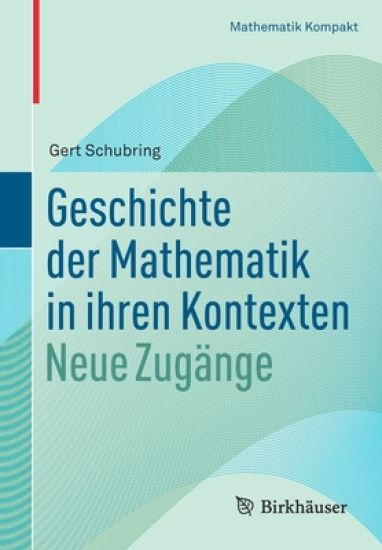
Geschichte der Mathematik in ihren Kontexten

Geschichte der Mathematik in ihren Kontexten

Gert Schubring

Springer Nature Switzerland AG
2021
nidottu
Dieses Buch ist konzipiert für angehende und praktizierende Mathematiklehrer; es richtet sich aber auch generell an Studierende der Mathematik. Ebenso wird es einem an Mathematik interessierten Leser neue Zugänge zur Mathematik eröffnen.Kenntnisse in Geschichte der Mathematik werden stets wichtiger als Bestandteil der Mathematiklehrer-Ausbildung: zur Vertiefung des Begriffs-Verständnisses und aufgrund der in der Mathematik-Didaktik international stets stärker empfohlenen Einbeziehung der Mathematik-Geschichte in den Mathematikunterricht – um durch die Vorzüge einer „genetischen“ Methodik die Begriffsentwicklung bei den Schülern effektiver gestalten zu können. Das Buch will zur Ausbildung von „Metawissen“ beitragen – von Wissen über das Fachwissen. Anstatt der häufigen Reduktion der Mathematik-Geschichte in Lehrbüchern auf anekdotische Informationen oder der Beschränkung auf wenige, als ‚große‘ präsentierte Mathematiker und auf ideengeschichtliche Entwicklungen eröffnet das Buch, auf dem aktuellen Stand der historischen Forschung, neue Zugänge zum Verständnis der Begriffs-Entwicklungen durch deren Darstellung in ihren kulturellen und sozialen Kontexten. Zudem leitet das Buch dazu an, traditionelle historische Berichte aufgrund neuerer Methodologien kritisch zu hinterfragen.Den meisten Kapiteln sind Aufgaben hinzugefügt, teils zur Vertiefung der Themen des Kapitels, teils als Anregung zur eigenen Praxis, um sie etwa selbst im Unterricht einzusetzen.
Analysing Historical Mathematics Textbooks

Analysing Historical Mathematics Textbooks

Gert Schubring

Springer International Publishing AG
2023
sidottu
This book is about the creation and production of textbooks for learning and teaching mathematics. It covers a period from Antiquity to Modern Times. The analysis begins by assessing principal cultures with a practice of mathematics. The tension between the role of the teacher and his oral mode, on the one hand, and the use of a written (printed) text, in their respective relation with the student, is one of the dimensions of the comparative analysis, conceived of as the ‘textbook triangle’. The changes in this tension with the introduction of the printing press are discussed. The book presents various national case studies (France, Germany, Italy) as well as analyses of the internationalisation of textbooks via transmission processes. As this topic has not been sufficiently explored in the literature, it will be very well received by scholars of mathematics education, mathematics teacher educators and anyone with an interest in the field.
Analysing Historical Mathematics Textbooks

Analysing Historical Mathematics Textbooks

Gert Schubring

Springer International Publishing AG
2024
nidottu
This book is about the creation and production of textbooks for learning and teaching mathematics. It covers a period from Antiquity to Modern Times. The analysis begins by assessing principal cultures with a practice of mathematics. The tension between the role of the teacher and his oral mode, on the one hand, and the use of a written (printed) text, in their respective relation with the student, is one of the dimensions of the comparative analysis, conceived of as the ‘textbook triangle’. The changes in this tension with the introduction of the printing press are discussed. The book presents various national case studies (France, Germany, Italy) as well as analyses of the internationalisation of textbooks via transmission processes. As this topic has not been sufficiently explored in the literature, it will be very well received by scholars of mathematics education, mathematics teacher educators and anyone with an interest in the field.