Kirjojen hintavertailu. Mukana 11 627 469 kirjaa ja 12 kauppaa.

Kirjahaku

Etsi kirjoja tekijän nimen, kirjan nimen tai ISBN:n perusteella.

7 kirjaa tekijältä Gillian Brown

Domestic Individualism

Domestic Individualism

Gillian Brown

University of California Press
1992
pokkari
Gillian Brown's book probes the key relationship between domestic ideology and formulations of the self in nineteenth-century America. Arguing that domesticity institutes gender, class, and racial distinctions that govern masculine as well as feminine identity, Brown brilliantly alters, for literary critics, feminists, and cultural historians, the critical perspective from which nineteenth-century American literature and culture have been viewed. In this study of the domestic constitution of individualism, Brown traces how the values of interiority, order, privacy, and enclosure associated with the American home come to define selfhood in general. By analyzing writings by Stowe, Hawthorne, Melville, Fern, and Gilman, and by examining other contemporary cultural modes--abolitionism, consumerism, architecture, interior decorating, motherhood, mesmerism, hysteria, and agoraphobia--she reconfigures the parameters of both domesticity and the patterns of self it fashions. Unfolding a representational history of the domestic, Brown's work offers striking new readings of the literary texts as well as of the cultural contexts that they embody.

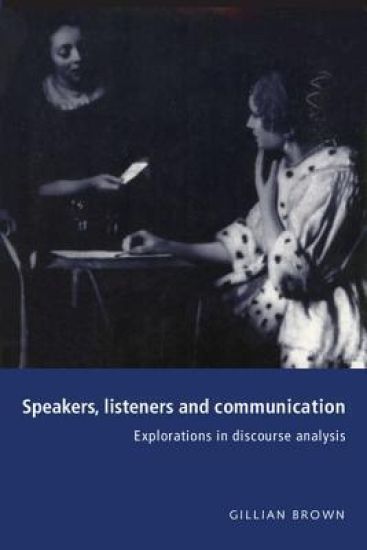
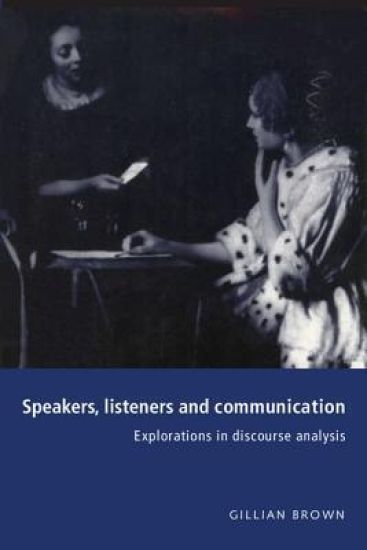
Speakers, Listeners, and Communication: Explorations in Discourse Analysis
Gillian Brown draws on a wide range of examples of discourse analysis to explore the ways in which speakers and listeners use language collaboratively to talk about what they can see in front of them and about a series of events. The focus of her attention is on the listener's role, as the listener tries to make sense of what the speaker says in a highly constrained context; and her cognitive/pragmatic approach to discourse analysis both complements and challenges current sociological/anthropological perspectives on the subject.
Speakers, Listeners and Communication

Speakers, Listeners and Communication

Gillian Brown

Cambridge University Press
1996
pokkari
In this book Gillian Brown draws on a wide range of examples of discourse analysis to explore the ways in which speakers and listeners use language collaboratively to talk about what they can see in front of them and about a series of events. She examines the conditions under which communication is successful, and the conditions under which it sometimes fails. The focus of her attention is upon the listener’s role, as the listener tries to make sense of what the speaker says in a highly constrained context; her cognitive/pragmatic approach to discourse analysis both complements and challenges the sociological/anthropological perspectives on the subject which currently predominate. Gillian Brown is co-author of the well-known textbook Discourse Analysis (Cambridge University Press, 1983).
The Consent of the Governed

The Consent of the Governed

Gillian Brown

Harvard University Press
2001
sidottu
What made the United States what it is began long before a shot was fired at a redcoat in Lexington, Massachusetts in 1775. It began quietly in homes and schoolrooms across the colonies in the reading lessons women gave to children. Just as the Protestant revolt originated in a practice of individual reading of the Bible, so the theories of reading developed by John Locke were the means by which a revolutionary attitude toward authority was disseminated throughout the British colonies in North America that would come to form in the United States. Gillian Brown takes us back to the basics to understand why Americans value the right to individual self-determination above all other values. It all begins with children.Locke crucially linked consent with childhood, and it is his formulation of the child's natural right to consent that eighteenth-century Americans learned as they learned to read through Lockean-style pedagogies and textbooks. Tracing the Lockean legacy through the New England Primer and popular readers, fables, and fairy tales, Brown demonstrates how Locke's emphasis on the liberty--and difficulty--of individual judgment became a received notion in the American colonies.After the revolution, American consent discourse features a different prototype of individuality; instead of wronged children, images of seduced or misguided women predominate postrevolutionary culture. The plights of these women display the difficulties of consent that Locke from the start realized. Individuals continually confront standards and prejudices at odds with their own experiences and judgments. Thus, the Lockean legacy to the United States is the reminder of the continual work to be done to endow every individual with consent and to make consent matter.What emerged in America was a new and different attitude toward authority in which authority does not belong to the elders but to the upcoming generations and groups. To effect this dramatic a change in the values of humankind took a grassroots revolution. That's what this book is about.
Listening to Spoken English

Listening to Spoken English

Gillian Brown

Routledge
2016
sidottu
For those who are familiar with the first edition, it will be convenient to have some indication of where the main changes lie. Chapter one has been largely rewritten to give an outline of current approaches to a model of comprehension of spoken language. Chapter two has a new initial section but otherwise remains as it was. Chapter three incorporates a new section on "pause" and how this interacts with rhythm, and rather more on the function of stress. Chapter four has an extended initial section but otherwise remains largely as it was. Chapter five on intonation contains several sections which have been rewritten to varying extents. Chapter six of the first edition has disappeared: in 1977, very little work had been published on "fillers" and it seemed worthwhile incorporating a chapter that sat rather oddly with the phonetic/phonological interests of the rest of the book. Not that there is a great industry of descriptions of the forms and functions of these and similar phenomena there seems no reason to retain this early but admittedly primitive account. The chapter on "paralinguistic vocal features", now chapter six, has some rewriting in the early part but considerable rewriting in the last sections. The final chapter on "teaching listening comprehension" has grown greatly in length. It still incorporates some material from the original chapter but most of it is completely rewritten.