Kirjojen hintavertailu. Mukana 12 016 292 kirjaa ja 12 kauppaa.

Kirjahaku

Etsi kirjoja tekijän nimen, kirjan nimen tai ISBN:n perusteella.

5 kirjaa tekijältä Giovanni Cerulli

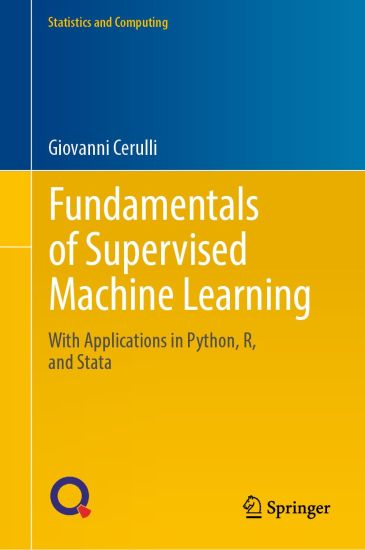
Fundamentals of Supervised Machine Learning

Fundamentals of Supervised Machine Learning

Giovanni Cerulli

Springer International Publishing AG
2023
sidottu
This book presents the fundamental theoretical notions of supervised machine learning along with a wide range of applications using Python, R, and Stata. It provides a balance between theory and applications and fosters an understanding and awareness of the availability of machine learning methods over different software platforms.After introducing the machine learning basics, the focus turns to a broad spectrum of topics: model selection and regularization, discriminant analysis, nearest neighbors, support vector machines, tree modeling, artificial neural networks, deep learning, and sentiment analysis. Each chapter is self-contained and comprises an initial theoretical part, where the basics of the methodologies are explained, followed by an applicative part, where the methods are applied to real-world datasets. Numerous examples are included and, for ease of reproducibility, the Python, R, and Stata codes used in the text, along with the related datasets, are available online.The intended audience is PhD students, researchers and practitioners from various disciplines, including economics and other social sciences, medicine and epidemiology, who have a good understanding of basic statistics and a working knowledge of statistical software, and who want to apply machine learning methods in their work.
Econometric Evaluation of Socio-Economic Programs

Econometric Evaluation of Socio-Economic Programs

Giovanni Cerulli

Springer-Verlag Berlin and Heidelberg GmbH Co. K
2016
nidottu
This book provides advanced theoretical and applied tools for the implementation of modern micro-econometric techniques in evidence-based program evaluation for the social sciences. The author presents a comprehensive toolbox for designing rigorous and effective ex-post program evaluation using the statistical software package Stata. For each method, a statistical presentation is developed, followed by a practical estimation of the treatment effects. By using both real and simulated data, readers will become familiar with evaluation techniques, such as regression-adjustment, matching, difference-in-differences, instrumental-variables and regression-discontinuity-design and are given practical guidelines for selecting and applying suitable methods for specific policy contexts.
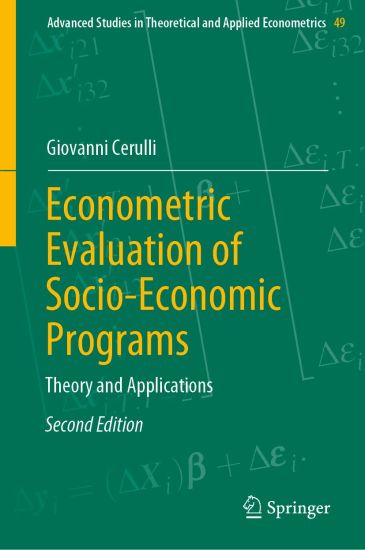
Econometric Evaluation of Socio-Economic Programs

Econometric Evaluation of Socio-Economic Programs

Giovanni Cerulli

Springer-Verlag Berlin and Heidelberg GmbH Co. KG
2022
sidottu
This book provides advanced theoretical and applied tools for the implementation of modern micro-econometric techniques in evidence-based program evaluation for the social sciences. The author presents a comprehensive toolbox for designing rigorous and effective ex-post program evaluation using the statistical software package Stata. For each method, a statistical presentation is developed, followed by a practical estimation of the treatment effects. By using both real and simulated data, readers will become familiar with evaluation techniques, such as regression-adjustment, matching, difference-in-differences, instrumental-variables, regression-discontinuity-design, and synthetic control method, and are given practical guidelines for selecting and applying suitable methods for specific policy contexts.The second revised and extended edition features two new chapters on some recent development of difference-in-differences. Specifically, chapter 5 introduces advanceddifference-in-differences methods when many times are available and treatment can be either time-varying or fixed at a specific time. Chapter 6 introduces the synthetic control method, a treatment effect estimation approach suitable when only one unit is treated. Both chapters present applications using the software Stata.
Econometric Evaluation of Socio-Economic Programs

Econometric Evaluation of Socio-Economic Programs

Giovanni Cerulli

Springer-Verlag Berlin and Heidelberg GmbH Co. KG
2023
nidottu
This book provides advanced theoretical and applied tools for the implementation of modern micro-econometric techniques in evidence-based program evaluation for the social sciences. The author presents a comprehensive toolbox for designing rigorous and effective ex-post program evaluation using the statistical software package Stata. For each method, a statistical presentation is developed, followed by a practical estimation of the treatment effects. By using both real and simulated data, readers will become familiar with evaluation techniques, such as regression-adjustment, matching, difference-in-differences, instrumental-variables, regression-discontinuity-design, and synthetic control method, and are given practical guidelines for selecting and applying suitable methods for specific policy contexts.The second revised and extended edition features two new chapters on some recent development of difference-in-differences. Specifically, chapter 5 introduces advanceddifference-in-differences methods when many times are available and treatment can be either time-varying or fixed at a specific time. Chapter 6 introduces the synthetic control method, a treatment effect estimation approach suitable when only one unit is treated. Both chapters present applications using the software Stata.
Fundamentals of Supervised Machine Learning

Fundamentals of Supervised Machine Learning

Giovanni Cerulli

Springer International Publishing AG
2024
nidottu
This book presents the fundamental theoretical notions of supervised machine learning along with a wide range of applications using Python, R, and Stata. It provides a balance between theory and applications and fosters an understanding and awareness of the availability of machine learning methods over different software platforms. After introducing the machine learning basics, the focus turns to a broad spectrum of topics: model selection and regularization, discriminant analysis, nearest neighbors, support vector machines, tree modeling, artificial neural networks, deep learning, and sentiment analysis. Each chapter is self-contained and comprises an initial theoretical part, where the basics of the methodologies are explained, followed by an applicative part, where the methods are applied to real-world datasets. Numerous examples are included and, for ease of reproducibility, the Python, R, and Stata codes used in the text, along with the related datasets, are available online. The intended audience is PhD students, researchers and practitioners from various disciplines, including economics and other social sciences, medicine and epidemiology, who have a good understanding of basic statistics and a working knowledge of statistical software, and who want to apply machine learning methods in their work.