Kirjojen hintavertailu. Mukana 12 390 323 kirjaa ja 12 kauppaa.

Kirjahaku

Etsi kirjoja tekijän nimen, kirjan nimen tai ISBN:n perusteella.

7 kirjaa tekijältä Glenn C. Altschuler, Stuart M. Blumin

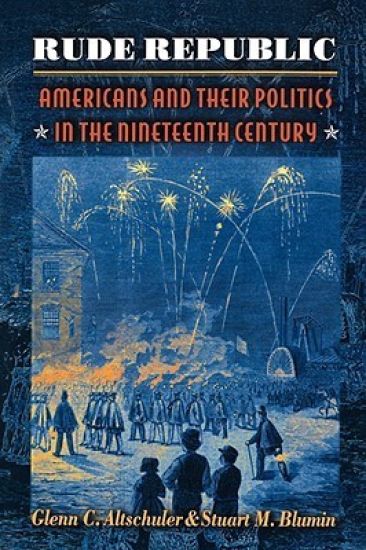
Rude Republic

Rude Republic

Glenn C. Altschuler; Stuart M. Blumin

Princeton University Press
2001
pokkari
What did politics and public affairs mean to those generations of Americans who first experienced democratic self-rule? Taking their cue from vibrant political campaigns and very high voter turnouts, historians have depicted the nineteenth century as an era of intense and widespread political enthusiasm. But rarely have these historians examined popular political engagement directly, or within the broader contexts of day-to-day life. In this bold and in-depth look at Americans and their politics, Glenn Altschuler and Stuart Blumin argue for a more complex understanding of the "space" occupied by politics in nineteenth-century American society and culture. Mining such sources as diaries, letters, autobiographies, novels, cartoons, contested-election voter testimony to state legislative committees, and the partisan newspapers of representative American communities ranging from Massachusetts and Georgia to Texas and California, the authors explore a wide range of political actions and attitudes. They consider the enthusiastic commitment celebrated by historians together with various forms of skepticism, conflicted engagement, detachment, and hostility that rarely have been recognized as part of the American political landscape. Rude Republic sets the political parties and their noisy and attractive campaign spectacles, as well as the massive turnout of voters on election day, within the communal social structure and calendar, the local human landscape of farms, roads, and county towns, and the organizational capacities of emerging nineteenth-century institutions. Political action and engagement are set, too, within the tide of events: the construction of the mass-based party system, the gathering crisis over slavery and disunion, and the gradual expansion of government (and of cities) in the post-Civil War era. By placing the question of popular engagement within these broader social, cultural, and historical contexts, the authors bring new understanding to the complex trajectory of American democracy.
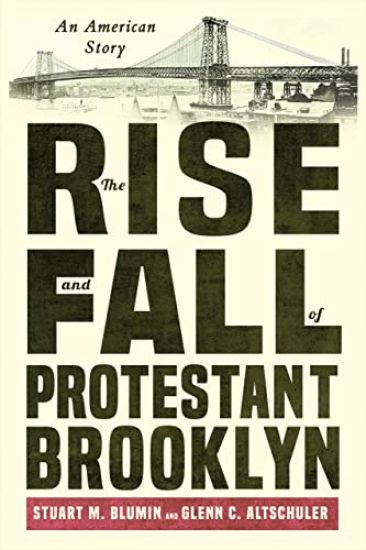
The Rise and Fall of Protestant Brooklyn

The Rise and Fall of Protestant Brooklyn

Stuart M. Blumin; Glenn C. Altschuler

CORNELL UNIVERSITY PRESS
2022
sidottu
Winner of the Herbert H. Lehman Prize from the New York Academy of History. In The Rise and Fall of Protestant Brooklyn, Stuart M. Blumin and Glenn C. Altschuler detail how nineteenth-century Brooklyn was dominated by Puritan New England Protestants and how their control unraveled with the arrival of diverse groups in the twentieth century. Before becoming a hub of urban diversity, Brooklyn was a charming "town across the river" from Manhattan, known for its churches and suburban life. This changed with the city's growth, new secular institutions, and Coney Island's attractions, which clashed with post-Puritan values. Despite these changes, Yankee-Protestant dominance continued until the influx of Southern and Eastern European immigrants. The Rise and Fall of Protestant Brooklyn explores how these new residents built a vibrant ethnic mosaic, laying the foundation for cultural pluralism and embedding it in the American Creed.
The Rise and Fall of Protestant Brooklyn

The Rise and Fall of Protestant Brooklyn

Stuart M. Blumin; Glenn C. Altschuler

CORNELL UNIVERSITY PRESS
2025
pokkari
Winner of the Herbert H. Lehman Prize from the New York Academy of History. In The Rise and Fall of Protestant Brooklyn, Stuart M. Blumin and Glenn C. Altschuler detail how nineteenth-century Brooklyn was dominated by Puritan New England Protestants and how their control unraveled with the arrival of diverse groups in the twentieth century. Before becoming a hub of urban diversity, Brooklyn was a charming "town across the river" from Manhattan, known for its churches and suburban life. This changed with the city's growth, new secular institutions, and Coney Island's attractions, which clashed with post-Puritan values. Despite these changes, Yankee-Protestant dominance continued until the influx of Southern and Eastern European immigrants. The Rise and Fall of Protestant Brooklyn explores how these new residents built a vibrant ethnic mosaic, laying the foundation for cultural pluralism and embedding it in the American Creed.
The 100 Most Notable Cornellians

The 100 Most Notable Cornellians

Glenn C. Altschuler; Isaac Kramnick; R. Laurence Moore

Cornell University Press
2003
sidottu
"Cornell is unique among American research universities and in the Ivy League.... It aspires to the ideals of Ezra Cornell, who founded an institution 'where any one person could find instruction in any study.'... Cornell has played a distinctive role in democratizing higher education, while helping to shape the American university's post-Civil War commitment to useful service to American society and to the world. The undergraduate experience has been the heart of life on East Hill, 'far above Cayuga's Waters.' Its undergraduates have lived the ideals carved into the Eddy Street gate: 'So enter that daily thou mayest become more learned and thoughtful. So depart that daily thou mayest become more useful to thy country and to mankind.' It is our privilege and honor to single out and, in most cases, pay tribute to Cornell's most distinguished sons and daughters."—from the Preface Graduates of Cornell University have achieved remarkable success in all areas from literature and photography to economics and agriculture, from finance and chemistry to athletics and the stage. They have held positions of leadership in boardrooms and classrooms, blazed new paths in medicine and journalism, acted on lofty ideals and strong ambition. Cornellians are regulars in Stockholm, on the bestseller lists, and in high office. Faced with all that excellence, the authors of this book sifted through encyclopedias, archives, and alumni records and engaged in conversations and debates to arrive at a final group of one hundred notable men and women who completed an undergraduate degree program at Cornell. These alumni are representative in their distinction (and, in a few cases, for their notoriety). Each Cornellian is profiled in a witty and erudite essay, each accompanied—with one telling exception—by a portrait. In immortalizing a selection of notable Cornellians from a bit more than the first hundred years of the university, the authors arrive at a portrait of Cornell itself, "a world-class institution with an egalitarian soul" where undergraduates are guided to exceed their own goals and change the world, too.
Cornell

Cornell

Glenn C. Altschuler; Isaac Kramnick

Cornell University Press
2014
sidottu
In their history of Cornell since 1940, Glenn C. Altschuler and Isaac Kramnick examine the institution in the context of the emergence of the modern research university. The book examines Cornell during the Cold War, the civil rights movement, Vietnam, antiapartheid protests, the ups and downs of varsity athletics, the women's movement, the opening of relations with China, and the creation of Cornell NYC Tech. It relates profound, fascinating, and little-known incidents involving the faculty, administration, and student life, connecting them to the "Cornell idea" of freedom and responsibility. The authors had access to all existing papers of the presidents of Cornell, which deeply informs their respectful but unvarnished portrait of the university. Institutions, like individuals, develop narratives about themselves. Cornell constructed its sense of self, of how it was special and different, on the eve of World War II, when America defended democracy from fascist dictatorship. Cornell's fifth president, Edmund Ezra Day, and Carl Becker, its preeminent historian, discerned what they called a Cornell "soul," a Cornell "character," a Cornell "personality," a Cornell "tradition"—and they called it "freedom." "The Cornell idea" was tested and contested in Cornell's second seventy-five years. Cornellians used the ideals of freedom and responsibility as weapons for change—and justifications for retaining the status quo; to protect academic freedom—and to rein in radical professors; to end in loco parentis and parietal rules, to preempt panty raids, pornography, and pot parties, and to reintroduce regulations to protect and promote the physical and emotional well-being of students; to add nanofabrication, entrepreneurship, and genomics to the curriculum—and to require language courses, freshmen writing, and physical education. In the name of freedom (and responsibility), black students occupied Willard Straight Hall, the anti–Vietnam War SDS took over the Engineering Library, proponents of divestment from South Africa built campus shantytowns, and Latinos seized Day Hall. In the name of responsibility (and freedom), the university reclaimed them. The history of Cornell since World War II, Altschuler and Kramnick believe, is in large part a set of variations on the narrative of freedom and its partner, responsibility, the obligation to others and to one's self to do what is right and useful, with a principled commitment to the Cornell community—and to the world outside the Eddy Street gate.
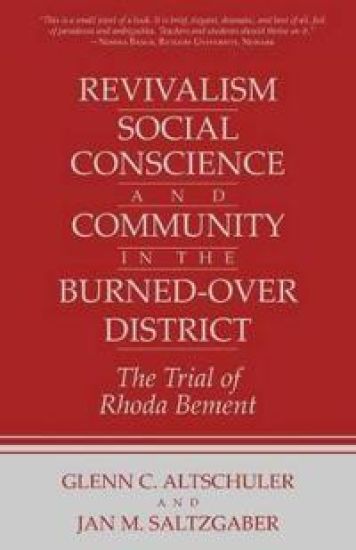
Revivalism, Social Conscience, and Community in the Burned-Over District

Revivalism, Social Conscience, and Community in the Burned-Over District

Glenn C. Altschuler; Jan M. Saltzgaber

Cornell University Press
1983
pokkari
In 1843 in Seneca Falls, New York, Rhonda Bement was brought before a disciplinary trial at her church, the First Presbyterian Church, charged with "unchristian and unladylike" behavior. Her transgression was to challenge the authority and integrity of her minister because he had refused to read to the congregation her announcement about abolitionist lectures taking place in the village, and she was eventually excommunicated. The transcript of her trial is the centerpiece of Revivalism, Social Conscience, and Community in the Burned-Over District, which presents through the testimonies of the witnesses the tensions between organized religion and the reform movements of abolitionism, temperance, and women's rights that were sweeping the country in this period. The book is divided into three parts. Jan M. Saltzgaber sets the stage in an introductory essay that examines the religious and social ramifications of the Second Great Awakening in the "burned-over" region of New York, analyzing in detail the changing social and economic environment of Seneca Falls and delineating connections between these changes and the currents of revival and reform in the 1830s and 1840s. The fully-annotated text of the trial is then presented in its entirety. In the epilogue, Glenn C. Altschuler uses the trial and evidence from other local churches to reassess the divisive effects of revivalism, stressing local conditions and church practices that acted as centripetal forces that impressed conservatives, moderates, and even "ultraists" with the importance of church unity.
Ten Great American Trials

Ten Great American Trials

Faust F. Rossi; Glenn C. Altschuler

American Bar Association
2017
pokkari
Ten Great American Trials provides chapter-length accounts of some of the most highly publicizedand fascinatingcourt cases of the twentieth century. Embedded in each of our narratives is an analysis of the use by prosecutors and defense attorneys of trial advocacy techniques (involving discovery, pre-trial motions, jury selection, direct testimony, cross-examination, the introduction of forensic exhibits, and summations) to craft compelling stories about what happened. We also assess the impact of cultural, social, and political values on the proceedings and the outcomes. We selected the cases, several of which have been dubbed "the crime of the century," because they are dramatic, suspenseful, emotional, intellectually powerful, and have become part of American culture.