Kirjojen hintavertailu. Mukana 11 717 486 kirjaa ja 12 kauppaa.

Kirjahaku

Etsi kirjoja tekijän nimen, kirjan nimen tai ISBN:n perusteella.

3 kirjaa tekijältä Gordon H. Orians

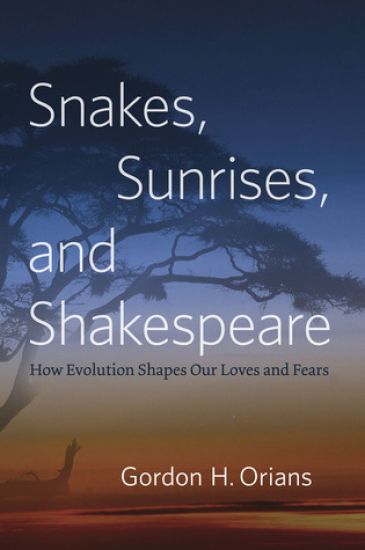
Snakes, Sunrises, and Shakespeare

Snakes, Sunrises, and Shakespeare

Gordon H. Orians

University of Chicago Press
2014
sidottu
Our breath catches and we jump in fear at the sight of a snake. We pause and marvel at the sublime beauty of a sunrise. These reactions are no accident; in fact, many of our human responses to nature are steeped in our deep evolutionary past - we fear snakes because of the danger of venom or constriction, and we welcome the assurances of the sunrise as the predatory dangers of the dark night disappear. Many of our aesthetic preferences - from the kinds of gardens we build to the foods we enjoy and the entertainment we seek - are the lingering result of natural selection. In this ambitious and unusual work, evolutionary biologist Gordon H. Orians explores the role of evolution in human responses to the environment, beginning with why we have emotions and ending with evolutionary approaches to aesthetics. Orians reveals how our emotional lives today are shaped by decisions our ancestors made centuries ago on African savannas. During this time our likes and dislikes became wired in our brains, as the appropriate responses to the environment meant the difference between survival or death. His rich analysis explains why we mimic the tropical savannas of our ancestors in our parks and gardens, why we are simultaneously attracted to danger and approach it cautiously, and how paying close attention to nature's sounds has resulted in us being an unusually musical species. We also learn why we have developed discriminating palates for wine, why we have strong reactions to some odors, and why we enjoy classifying almost everything. By applying biological perspectives ranging from Darwin to current neuroscience to analyses of our aesthetic preferences for landscapes, sounds, smells, plants, and animals, Snakes, Sunrises, and Shakespeare transforms how we view our experience of the natural world and how we relate to each other.
Snakes, Sunrises, and Shakespeare

Snakes, Sunrises, and Shakespeare

Gordon H. Orians

University of Chicago Press
2015
nidottu
In this ambitious and unusual work, evolutionary biologist Gordon H Orians explores the role of evolution in human responses to the environment, beginning with why we have emotions and ending with evolutionary approaches to aesthetics. Orians reveals how our emotional lives today are shaped by decisions our ancestors made centuries ago on African savannas as they selected places to live, sought food and safety, and socialized in small hunter-gatherer groups. During this time our likes and dislikes became wired in our brains, as the appropriate responses to the environment meant the difference between survival or death. His rich analysis explains why we mimic the tropical savannas of our ancestors in our parks and gardens, why we are simultaneously attracted to danger and approach it cautiously, and how paying close attention to nature's sounds has resulted in us being an unusually musical species. We also learn why we have developed discriminating palates for wine, and why we have strong reactions to some odors, and why we enjoy classifying almost everything.
Some Adaptations of Marsh-Nesting Blackbirds

Some Adaptations of Marsh-Nesting Blackbirds

Gordon H. Orians

Princeton University Press
1980
pokkari
The variety of social systems among the New World blackbirds (Family Icteridae) and the structural simplicity of their foraging environment provide excellent opportunities for testing theorics about the adaptive significance of their behavior. Here Gordon Orians presents the results of his many years of research on how blackbirds utilize their marsh environments during the breeding season. These results stem from information he gathered on three species during ten breeding seasons in the Pacific Northwest, on Red-winged blackbirds during two breeding seasons in Costa Rica, and on three species during one breeding season in Argentina. The author uses models derived from Darwin's theory of natural selection to predict the behavior and morphology of individuals as well as the statistical properties of their populations. First he tests models that predict habitat selection, foraging behavior, territoriality, and mate selection. Then he considers some population patterns, especially range of use of environmental resources and overlap among species, that may result from those individual attributes. Professor Orianns concludes with an overview of the structure of bird communities in marshes of the world and the relation of these patterns to overall source availability in these simple but productive habitats.