Kirjahaku
Etsi kirjoja tekijän nimen, kirjan nimen tai ISBN:n perusteella.
8 kirjaa tekijältä Graham S Ogden

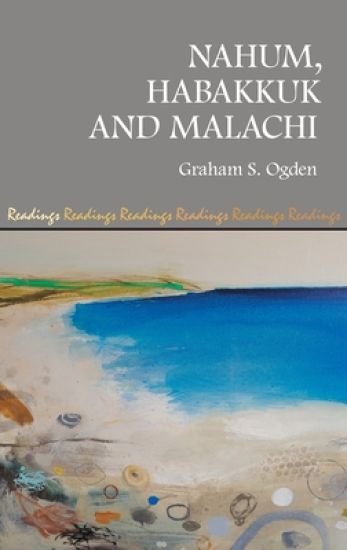
Nahum, ironically named 'the compassionate one', Habakkuk who laments God's failure to answer his questions about justice and violence, and the eponymous Malachi are the three characters whose record is the focus of this reading. The commentary offers a close reading of the Hebrew text of each book along with its rhetorical features. The three books are read from within their several ancient contexts, literary, cultural and theological.Only Habakkuk is specifically identified as a 'prophet', while Nahum's and Malachi's editors studiously avoid the term, raising a question about why these three books have been honoured with a place in the Scroll of the Twelve rather than somewhere else. Each book is titled a Massa' by its editor, identifying them as examples of an emerging literary trope that combines both prophetic and wisdom elements in a didactic purpose. Nahum is identified not as a prophet but as a Visionary. He saw the dire situation of his people and expressed his longing for God's intervention. The God of whom he spoke was one 'jealous, and avenging', one he longed would act against the overwhelming power of the Assyrians that threatened his people.Habakkuk, though identified as a prophet, shows no evidence of any prophetic activity. He laments the failure of justice and consequent violence as witnessed (1.2-4). The Lament-form used has been torn in two by the editor for the purpose of inserting a Dialogue with God (1.5-2.20), a Dialogue that fails completely to answer Habakkuk's 'Why' questions in 1.1-2. The concluding portion of the Lament (3.2-19) witnesses to Habakkuk's continued trust in his God despite the divine failure to resolve his questions.The eponymous 'Malachi' is identified as a Messenger, never as a prophet, as the book reports six different and independent messages covering issues that arose during an extended period in early postexilic Judaean life. Using a frame of six Question-Response forms that feature rhetorical questions, his audiences deny the validity of each negative charge against them.
Nahum, ironically named 'the compassionate one', Habakkuk who laments God's failure to answer his questions about justice and violence, and the eponymous Malachi are the three characters whose record is the focus of this reading. The commentary offers a close reading of the Hebrew text of each book along with its rhetorical features. The three books are read from within their several ancient contexts, literary, cultural and theological.Only Habakkuk is specifically identified as a 'prophet', while Nahum's and Malachi's editors studiously avoid the term, raising a question about why these three books have been honoured with a place in the Scroll of the Twelve rather than somewhere else. Each book is titled a Massa' by its editor, identifying them as examples of an emerging literary trope that combines both prophetic and wisdom elements in a didactic purpose. Nahum is identified not as a prophet but as a Visionary. He saw the dire situation of his people and expressed his longing for God's intervention. The God of whom he spoke was one 'jealous, and avenging', one he longed would act against the overwhelming power of the Assyrians that threatened his people.Habakkuk, though identified as a prophet, shows no evidence of any prophetic activity. He laments the failure of justice and consequent violence as witnessed (1.2-4). The Lament-form used has been torn in two by the editor for the purpose of inserting a Dialogue with God (1.5-2.20), a Dialogue that fails completely to answer Habakkuk's 'Why' questions in 1.1-2. The concluding portion of the Lament (3.2-19) witnesses to Habakkuk's continued trust in his God despite the divine failure to resolve his questions.The eponymous 'Malachi' is identified as a Messenger, never as a prophet, as the book reports six different and independent messages covering issues that arose during an extended period in early postexilic Judaean life. Using a frame of six Question-Response forms that feature rhetorical questions, his audiences deny the validity of each negative charge against them.
Amos denied being a prophet, for he was a Visionary, one who 'saw' and assessed what was happening around him. Micah condemned all prophets as corrupt liars, ensuring that he should not be mistaken for one. He too was a Visionary who 'saw' the state of affairs in that same eighth century BCE Israelite society. The fact that neither of these men is identified in the text as a prophet is vitally important, for it indicates how one must read their edited works. The traditional view that these men spoke what Yahweh their God revealed to them is not applicable; both spoke about what they themselves 'saw' in the social and religious context within Israel at the time.Both books, Amos and Micah, are reports of their insights now set within new frames. Amos is structured about discrete blocks of material with shared forms, such as the opening series of numerical x, x+1 forms (1.3-2.16), the calls to 'Hear this word...' (3.1-5.17), 'Woe...' forms(5.18-6.7) and his five visions (7.1-9.6). It is a planned re-arrangement of Amos' words (1.1) as recalled. Micah's editor similarly has selected a number of discrete and generalized speeches attributed to Micah, setting them within a chiastic structure with 4.11-13 as the central unit; it spells out his conviction that Yahweh is 'master of the whole earth'. Indeed, Micah's very name asks the question 'Who is like Yah(weh)' and 4.11-13 is his response, closing in 7.18-20 with another rhetorical question 'Who is a God like you' Micah sees his God as incomparable The commentary depends on the text's literary and rhetorical evidence to give expression to Amos' and Micah's deep personal concerns within the historical and cultural setting of their time.