
Kirjojen hintavertailu. Mukana 12 363 588 kirjaa ja 12 kauppaa.

Kirjahaku

Etsi kirjoja tekijän nimen, kirjan nimen tai ISBN:n perusteella.

3 kirjaa tekijältä Greg Eghigian

After the Flying Saucers Came

After the Flying Saucers Came

Greg Eghigian

OXFORD UNIVERSITY PRESS INC
2024
sidottu
Roswell, 1947. Washington, DC, 1952. Quarouble, 1954. New Hampshire, 1961. Pascagoula, 1973. Petrozavodsk, 1977. Copley Woods, 1983. Explore how sightings of UFOs and aliens seized the world's attention and discover what the fascination with flying saucers and extraterrestrial visitors says about our changing views on science, technology, and the paranormal. In the summer of 1947, a private pilot flying over the state of Washington saw what he described as several pie pan-shaped aircraft traveling in formation at remarkably high speed. Within days, journalists began referring to the objects as "flying saucers." Over the course of that summer, Americans reported seeing them in the skies overhead. News quickly spread, and within a few years, flying saucers were being spotted across the world. The question on everyone's mind was, what were they? Some new super weapon in the Cold War? Strange weather patterns? Optical illusions? Or perhaps it was all a case of mass hysteria? Some, however, concluded they could only be one thing: spacecrafts built and piloted by extraterrestrials. The age of the unidentified flying object, the UFO, had arrived. Greg Eghigian tells the story of the world's fascination with UFOs and the prospect that they were the work of visitors from outer space. While accounts of great wonders in the sky date back to antiquity, reports of UFOs took place against the unique backdrop of the Cold War and space age, giving rise to disputed government inquiries, breathtaking news stories, and single-minded sleuths. After the Flying Saucers Came traces how a seemingly isolated incident sparked an international drama involving shady figures, questionable evidence, suspicions of conspiracy, hoaxes, new religions, scandals, unsettling alien encounters, debunkers, and celebrities. It examines how descriptions, theories, and debates about unidentified flying objects and alien abduction changed over time and how they appeared in the United States, Europe, Latin America, Asia, and Russia. And it explores the impact UFOs have had on our understanding of space, science, technology, and ourselves up through the present day. Replete with stories of the people who have made up the ufology community, the military and defense units that investigate them, the scientists and psychologists who have researched these unexplained encounters, and the many novels, movies, TV shows, and websites that have explored these phenomena, After the Flying Saucers Came speaks to believers and skeptics alike.
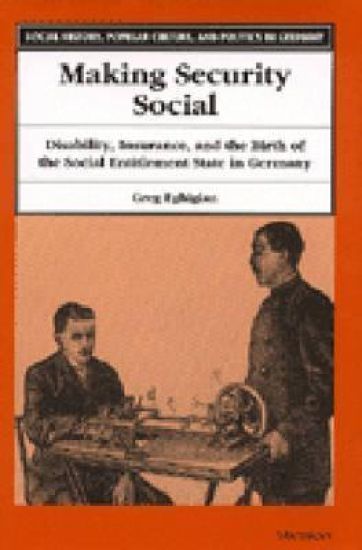
Making Security Social

Making Security Social

Greg Eghigian

The University of Michigan Press
2000
sidottu
While welfare has been subject to pronounced criticism throughout the twentieth century, social insurance has consistently enjoyed the overwhelming support of European policy makers and citizens. This volume argues that the emergence of social insurance represents a paradigmatic shift in modern understandings of health, work, political participation, and government. By institutionalizing compensation, social insurance transformed it into a right that the employed population quickly came to assume.Theoretically informed and based on intensive archival research on disability insurance records, most of which have never been used by historians, the book considers how social science and political philosophy combined to give shape to the idea of a "social" insurance in the nineteenth century; the process by which social insurance gave birth to modern notions of "disability" and "rehabilitation"; and the early-twentieth-century development of political action groups for the disabled.Most earlier histories of German social insurance have been legislative histories that stressed the system's coercive features and functions. Making Security Social, by contrast, emphasizes the administrative practices of everyday life, the experience of consumers, and the ability of workers not only to resist, but to transform, social insurance bureaucracy and political debate. It thus demonstrates that social insurance was pivotal in establishing a general attitude of demand, claim, and entitlement as the primary link between the modern state and those it governed.In addition to historians of Germany, Making Security Social will attract researchers across disciplines who are concerned with public policy, disability studies, and public health.Greg Eghigian is Associate Professor of History, Penn State University.
The Corrigible and the Incorrigible

The Corrigible and the Incorrigible

Greg Eghigian

The University of Michigan Press
2015
sidottu
The Corrigible and the Incorrigible explores the surprising history of efforts aimed at rehabilitating convicts in 20th-century Germany, efforts founded not out of an unbridled optimism about the capacity of people to change, but arising from a chronic anxiety about the potential threats posed by others. Since the 1970s, criminal justice systems on both sides of the Atlantic have increasingly emphasized security, surveillance, and atonement, an approach that contrasts with earlier efforts aimed at scientifically understanding, therapeutically correcting, and socially reintegrating convicts. And while a distinction is often drawn between American and European ways of punishment, the contrast reinforces the longstanding impression that modern punishment has played out as a choice between punitive retribution and correctional rehabilitation. Focusing on developments in Nazi, East, and West Germany, The Corrigible and the Incorrigible shows that rehabilitation was considered an extension of, rather than a counterweight to, the hardline emphasis on punishment and security by providing the means to divide those incarcerated into those capable of reform and the irredeemable.