Kirjojen hintavertailu. Mukana 11 241 044 kirjaa ja 12 kauppaa.

Kirjahaku

Etsi kirjoja tekijän nimen, kirjan nimen tai ISBN:n perusteella.

23 kirjaa tekijältä Gregory

The Encyclical Letter [On the Authority of the Church] of Pope Gregory Xvi. Bearing Date August 16Th [Really 15Th] 1832, Tr., With Notes
This is a translated edition of the Encyclical Letter of Pope Gregory XVI, originally issued on August 15, 1832. Addressed to all patriarchs, primates, archbishops, and bishops of the Catholic Church, the encyclical, titled "On the Authority of the Church," reflects the Pope's views on various contemporary issues and challenges facing the Church. This historical document provides insight into the religious and political climate of the 19th century and showcases the Pope's stance on matters of faith, governance, and social order. It remains a valuable resource for scholars and anyone interested in the history of the Catholic Church and papal pronouncements. This work has been selected by scholars as being culturally important, and is part of the knowledge base of civilization as we know it. This work was reproduced from the original artifact, and remains as true to the original work as possible. Therefore, you will see the original copyright references, library stamps (as most of these works have been housed in our most important libraries around the world), and other notations in the work. This work is in the public domain in the United States of America, and possibly other nations. Within the United States, you may freely copy and distribute this work, as no entity (individual or corporate) has a copyright on the body of the work. As a reproduction of a historical artifact, this work may contain missing or blurred pages, poor pictures, errant marks, etc. Scholars believe, and we concur, that this work is important enough to be preserved, reproduced, and made generally available to the public. We appreciate your support of the preservation process, and thank you for being an important part of keeping this knowledge alive and relevant.
The Encyclical Letter [On the Authority of the Church] of Pope Gregory Xvi. Bearing Date August 16Th [Really 15Th] 1832, Tr., With Notes
This is a translated edition of the Encyclical Letter of Pope Gregory XVI, originally issued on August 15, 1832. Addressed to all patriarchs, primates, archbishops, and bishops of the Catholic Church, the encyclical, titled "On the Authority of the Church," reflects the Pope's views on various contemporary issues and challenges facing the Church. This historical document provides insight into the religious and political climate of the 19th century and showcases the Pope's stance on matters of faith, governance, and social order. It remains a valuable resource for scholars and anyone interested in the history of the Catholic Church and papal pronouncements. This work has been selected by scholars as being culturally important, and is part of the knowledge base of civilization as we know it. This work was reproduced from the original artifact, and remains as true to the original work as possible. Therefore, you will see the original copyright references, library stamps (as most of these works have been housed in our most important libraries around the world), and other notations in the work. This work is in the public domain in the United States of America, and possibly other nations. Within the United States, you may freely copy and distribute this work, as no entity (individual or corporate) has a copyright on the body of the work. As a reproduction of a historical artifact, this work may contain missing or blurred pages, poor pictures, errant marks, etc. Scholars believe, and we concur, that this work is important enough to be preserved, reproduced, and made generally available to the public. We appreciate your support of the preservation process, and thank you for being an important part of keeping this knowledge alive and relevant.
Catechetical Oration

Catechetical Oration

Gregory

Cambridge University Press
2009
pokkari
First published in 1903, this book is an edition by James Herbert Srawley of the Oratio Catechetica by Gregory of Nyssa. Collating the texts of numerous manuscripts - many of which had not been used to produce an edition before - Srawley's edition was designed to assist students in placing Gregory's treatise in its proper historical setting. The text is given in Greek, with extensive notes in English clarifying particular words and phrases and contextualizing the work. In addition to the notes, Srawley also offers an English introduction to the work, discussing its character, date, authenticity, and literary history, and placing it in the context of Gregory's wider teaching.
Ascetical Works

Ascetical Works

Gregory

The Catholic University of America Press
2000
sidottu
In the Christian world of the fourth century, the family of St. Gregory of Nyssa was distinguished for its leadership in civic and religious affairs in the region of the Roman Empire known as Pontus. Cardinal Newman, in an essay on the trials of St. Basil, refers to the family circle which produced these two eminent Fathers as 'a sort of nursery of bishops and saints.' From St. Gregory's life of his sister, St. Macrina, a work included in this volume, we learn of the fortitude of the three preceding generations. On her death-bed, St. Macrina, recalling details of their family history, speaks of a great-grandfather martyred and all his property confiscated, and grandparents deprived of their possessions at the time of the Dioceltian persecutions. Their father, Basil of Caesarea, a successful rhetorician, outstanding for his judgment and well known for the dignity of his life, died leaving to his wife, Emmelia, the care of four sons and five daughters. St. Gregory praises his mother for her virtue and for her eagerness to have her children educated in Holy Scripture. After managing their estate and arranging for the future of her children, she was persuaded by St. Macrina to retire from the world and to enter a life common with her maids as sisters and equals. This community of women would have been a counterpart of the monastery founded nearby by St. Basil on the banks of the Iris River. In a moving scene, St. Gregory tells of his mother's death at a rich old age in the arms of her oldest and youngest children, Macrina and Peter. Blessing all of her children, she prays in particular for the sanctification of these two who were, indeed, later canonized as saints. Newman notes the strong influence of the women in the family, and in one of his letters, St. Basil gives credit to his mother and his grandmother, the elder Macrina, for his clear and steadfast idea of God.
Three Poems

Three Poems

Gregory

The Catholic University of America Press
2001
nidottu
Gregory of Nazianzus was born into an aristocratic Christian family in Cappadocia during the reign of the emperor Constantine. He received a superb education in Athens and entered into the monastic life with his classmate and friend Basil (who would become known as "Basil the Great"). After reluctantly submitting to ordination to the priesthood in 362, he subsequently became the Bishop of Sasima. Upon the accession of Theodosius I to the imperial throne in 379 and the convening of the Council of Constantinople in 381, Gregory was summoned to the eastern imperial capital to serve as bishop of that city and as presider over the council. The unfortunate incidents that occurred in Constantinople at that time impelled Gregory to retire to his boyhood home and to devote himself to writing. The autobiographical poems in this volume relate the events of his life through his own unique perspective.
Dialogues

Dialogues

Gregory

The Catholic University of America Press
2002
nidottu
Rich in captivating narratives, the four books of Dialogues of Gregory the Great (Pope, 590-604) present hagiographical accounts of the lives of Italian saints whose holiness remained intact during tumultuous times. Of these, the most famous is the monastic founder Benedict, whose life story occupies all of Book Two. These stories, along with Book Four's mixture of expository and narrative assurances of the immortality of the soul, must have been encouraging to its contemporary Italian readers, especially since Gregory wrote these books at a time when Italy had been ravaged by barbarian invasions, floods, plagues, and famines.
Funeral Orations

Funeral Orations

Gregory

The Catholic University of America Press
2004
nidottu
The volume presents the most generally admired ancient Christian funeral orations-four from the Greek (those of St. Gregory Nazianzen), four from the Latin (those of St. Ambrose of Milan). From the Bishop of Nazianzen, we have words spoken in honor of three kinsmen, his father, a brother, and a sister, and of the great St. Basil, Bishop of Caesarea. Two of the orations from the lips of St. Ambrose are likewise for a kinsman, his brother Satyrus, while the other two are for wearers of the purple, the youthful Valentinian II and the emporor Theodosius.
The Pauline Privilege

The Pauline Privilege

Gregory

The Catholic University of America Press
2014
sidottu
CUA Press is proud to announce the CUA Studies in Canon Law. In conjunction with the School of Canon Law of the Catholic University of America, we are making available, both digitally and in print, more than 400 canon law dissertations from the 1920s to 1960s, many of which have long been unavailable.These volumes are rich in historical content, yet remain relevant to canon lawyers today. Topics covered include such issues as abortion, excommunication, and infertility. Several studies are devoted to marriage and the annulment process; the acquiring and disposal of church property, including the union of parishes; the role and function of priests, vicars general, bishops, and cardinals; and juridical procedures within the church.For those who seek to understand current ecclesial practices in light of established canon law, these books will be an invaluable resource.
Moral Reflections on the Book of Job, Volume 1
Gregory the Great was pope from 590 to 604, a time of great turmoil in Italy and in the western Roman Empire generally because of the barbarian invasions. Gregory’s experience as prefect of the city of Rome and as apocrisarius of Pope Pelagius fitted him admirably for the new challenges of the papacy. The Moral Reflections on the Book of Job were first given to the monks who accompanied Gregory to the embassy in Constantinople. This first volume of the work contains books 1–5, accompanied by an introduction by Mark DelCogliano.
On the Song of Songs

On the Song of Songs

Gregory

Liturgical Press
2012
pokkari
Gregory the Great (+604) was a master of the art of exegesis. His interpretations are theologically profound, methodologically fascinating, and historically influential. Nowhere is this more clearly seen than in his exegesis of the Song of Songs. Gregory’s interpretation of this popular Old Testament book not only owes much to Christian exegetes who preceded him, such as Origen, but also profoundly influenced later Western Latin exegetes, such as Bernard of Clairvaux.This volume includes all that Gregory had to say on the Song of Songs: his Exposition on the Song of Songs, the florilegia compiled by Paterius (Gregory’s secretary) and the Venerable Bede, and, finally, William of Saint Thierry’s Excerpts from the Books of Blessed Gregory on the Song of Songs. It is now the key resource for reading and studying Gregory’s interpretation of the Song of Songs.
Moral Reflections on the Book of Job, Volume 4
Gregory the Great was pope from 590 to 604, a time of great turmoil in Italy and in the western Roman Empire generally because of the barbarian invasions. Gregory’s experience as prefect of the city of Rome and as apocrisarius of Pope Pelagius fitted him admirably for the new challenges of the papacy. The Moral Reflections on the Book of Job were first given to the monks who accompanied Gregory to the embassy in Constantinople.This fourth volume, containing books 17 through 22, provides commentary on twelve chapters of Job, from 24:21 through 31:40.
Moral Reflections on the Book of Job, Volume 5
Gregory the Great was pope from 590 to 604, a time of great turmoil in Italy and in the western Roman Empire generally because of the barbarian invasions. Gregory’s experience as prefect of the city of Rome and as apocrisarius of Pope Pelagius fitted him admirably for the new challenges of the papacy. The Moral Reflections on the Book of Job were first given to the monks who accompanied Gregory to the embassy in Constantinople. This fifth volume, containing books 23 through 27, provides commentary on six chapters of Job, from 32:1 through 37:24. The present volume covers the chapters of Job devoted to Elihu, the young man who derides the three friends who couldn’t find an answer to Job. For the most part Gregory confines himself, with a few exceptions, to the allegorical moral exegesis, making Elihu a symbol of the arrogant person (sometimes the heretic, and sometimes the unworthy member of the church), and Job a type either of the church herself or of the holy preachers of sound doctrine.
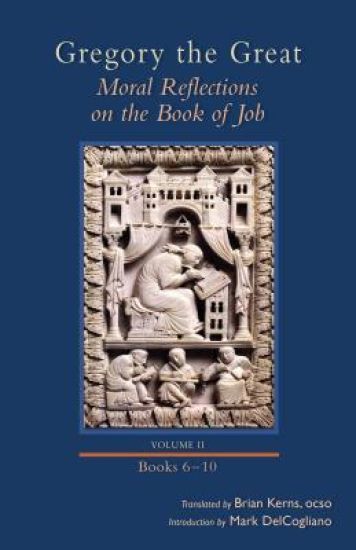
Moral Reflections on the Book of Job, Volume 2
Gregory the Great was pope from 590 to 604, a time of great turmoil in Italy and in the western Roman Empire generally because of the barbarian invasions. Gregory’s experience as prefect of the city of Rome and as apocrisarius of Pope Pelagius fitted him admirably for the new challenges of the papacy. The Moral Reflections on the Book of Job were first given to the monks who accompanied Gregory to the embassy in Constantinople. This second volume, containing books 6–10, provides commentary on Job 5:3–12:5. Here, Gregory sets forth “a mystical interpretation” of these chapters, showing the way that Scripture foretells Christ’s incarnation and that Job himself manifests Jesus’ passion.
Moral Reflections on the Book of Job, Volume 3
Gregory the Great was pope from 590 to 604, a time of great turmoil in Italy and in the western Roman Empire generally because of the barbarian invasions. Gregory’s experience as prefect of the city of Rome and as apocrisarius of Pope Pelagius fitted him admirably for the new challenges of the papacy. The Moral Reflections on the Book of Job were first given to the monks who accompanied Gregory to the embassy in Constantinople. This third volume, containing books 11 through 16, provides commentary on six chapters of Job, from 12:6 through 24:20. Whereas volume 1 concentrated largely on the moral reading of the first four chapters of Job and volume 2 on the mystical interpretation of the next seven, volume 3 offers a rapid overview of nearly thirteen chapters in their original oral format, including a brief comment at the beginning of each of the six books to explain its contents.
Forty Gospel Homilies

Forty Gospel Homilies

Gregory

Liturgical Press
1990
pokkari
It is often forgotten, in the centuries after scholastic systems and Reformation polemic came to dominate the study of theology; just how intimate was the familiarity the Church Fathers and monastic authors had of Scripture. It formed their prayer, their lives, and their teaching. The author of a book on Pastoral Care, Gregory the Great (†604) reveals himself in these forty sermons on the gospel as both pastor and preacher. He pays careful attention to the historical details of Scripture, seeks out its moral application to daily Christian life, and through it reflects on the hidden reality of God. For the Christian, study of Scripture entails a personal engagement with mystery, and openness to transformation. This is not a form of escapism but an attempt to achieve a mystical, intuitive, experiential perception of the divine while one is still held bound by earthly and bodily ties. Everything Gregory thought or spoke or wrote leads to this goal. This is why he remains an effective guide for those who seek a religion that gives meaning to their lives.
Exploring welfare debates

Exploring welfare debates

Gregory

Policy Press
2018
sidottu
This wide-ranging guide to key concepts and debates in welfare uses an innovative, question-based narrative to highlight the importance of theory to understanding social policy. It unpacks common questions and assumptions about the purpose, value and focus of welfare systems and provides students with a comprehensive vocabulary and toolkit for analysing policy examples and developing social science arguments.