Kirjojen hintavertailu. Mukana 11 244 527 kirjaa ja 12 kauppaa.

Kirjahaku

Etsi kirjoja tekijän nimen, kirjan nimen tai ISBN:n perusteella.

13 kirjaa tekijältä Gregory Baum

The Theology of Tariq Ramadan: A Catholic Perspective

The Theology of Tariq Ramadan: A Catholic Perspective

Gregory Baum

UNIVERSITY OF NOTRE DAME PRESS
2022
sidottu
Tariq Ramadan has emerged as one of the most influential Muslim theologians in the world today. In this important book, Gregory Baum presents for the first time an introduction to several key aspects of Ramadan's theological enterprise. Baum examines Ramadan's work historically within an interfaith perspective, drawing several parallels between Islamic and Catholic encounters with modernity. His comparison of the debates in the two traditions suggests that reform and renewal are compatible with the substance of both Catholic and Muslim traditions. After a brief account of the evolution of Catholic theology up to the Second Vatican Council, Baum introduces Ramadan's published work and theological orientation, examining both within the historical development of Islam. He outlines Ramadan's theology of God, humanity, and the universe and discusses Ramadan's interpretation of sharia, the divinely revealed Islamic way of life. The book then addresses what fidelity to Islam means for Western Muslims and contrasts Ramadan's theology with the theological liberalism advocated by some Muslim authors. Throughout, Baum makes helpful connections between Islam and Vatican II Catholicism. Both belief systems are steeped in ancient traditions, rely on a sacred book, and find themselves confronting a modern context. Reformist Islam shares much with Catholic social thought in showing a regard for the poor and marginalized. Baum concludes by examining points of difference between Muslim and Catholic theology that support further conversation. This readable introduction to Ramadan's work is accessible to non-Muslim students, teachers, clergy, and general readers interested in Islam and interfaith dialogue.
Karl Polanyi on Ethics and Economics

Karl Polanyi on Ethics and Economics

Gregory Baum

McGill-Queen's University Press
1996
sidottu
Exploring Polanyi's lesser-known works as well as The Great Transformation, Baum provides a more complete and nuanced understanding of Polanyi's thought. He examines Polanyi's interpretation of modern economic and social history, clarifies the ethical presuppositions present in Polanyi's work, and addresses how Polanyi's understanding of the relation between ethics and economics touches on many issues relevant to the contemporary debate about the world's economic future. Baum argues that we should look to Polanyi's understanding of modern capitalism to reinstate the social discourse and, in political practice, the principles of reciprocity and solidarity. He points to examples, both in Canada and abroad, of attempts to formulate alternative models of economic development and to create new forms of institutional and cultural intervention. Karl Polanyi on Ethics and Economics provides fascinating insights into Polanyi's work and today's central social and political issues. It will be of great interest to sociologists, economists, political scientists, and philosophers.
Karl Polanyi on Ethics and Economics

Karl Polanyi on Ethics and Economics

Gregory Baum

McGill-Queen's University Press
1996
nidottu
Exploring Polanyi's lesser-known works as well as The Great Transformation, Baum provides a more complete and nuanced understanding of Polanyi's thought. He examines Polanyi's interpretation of modern economic and social history, clarifies the ethical presuppositions present in Polanyi's work, and addresses how Polanyi's understanding of the relation between ethics and economics touches on many issues relevant to the contemporary debate about the world's economic future. Baum argues that we should look to Polanyi's understanding of modern capitalism to reinstate the social discourse and, in political practice, the principles of reciprocity and solidarity. He points to examples, both in Canada and abroad, of attempts to formulate alternative models of economic development and to create new forms of institutional and cultural intervention. Karl Polanyi on Ethics and Economics provides fascinating insights into Polanyi's work and today's central social and political issues. It will be of great interest to sociologists, economists, political scientists, and philosophers.
Nationalism, Religion, and Ethics

Nationalism, Religion, and Ethics

Gregory Baum

McGill-Queen's University Press
2001
sidottu
In beautifully simple language, Gregory Baum discusses the writings of four men whose nationalism was shaped by their religion and their time: Martin Buber's speeches on Zionism before the creation of Israel; Mahatma Gandhi's influential incitement to peaceful resistance against British imperialism; Paul Tillich's book on socialism and nationalism which was banned by the Nazis; and Jacques Grand'Maison's defence of Quebecois nationalism in the wake of the province's Quiet Revolution. Baum also examines nationalism in a world dominated by transnational corporations and economic globalization: for example, how does Scottish nationalism fit within the European Union, and how can the Church of Scotland contribute to this secular movement? Finally, Baum turns to Quebec and its tension between ethnic and civil nationalism. As a province with a homogenous and distinctive culture that is different from that of the country surrounding it, how can Quebec guarantee its own survival in an ethically acceptable way? This quiet masterpiece of clear thinking and humane reasoning illuminates the uses and misdirections of one of the most powerful forces in politics and society.
Nationalism, Religion, and Ethics

Nationalism, Religion, and Ethics

Gregory Baum

McGill-Queen's University Press
2001
nidottu
In beautifully simple language, Gregory Baum discusses the writings of four men whose nationalism was shaped by their religion and their time: Martin Buber's speeches on Zionism before the creation of Israel; Mahatma Gandhi's influential incitement to peaceful resistance against British imperialism; Paul Tillich's book on socialism and nationalism which was banned by the Nazis; and Jacques Grand'Maison's defence of Quebecois nationalism in the wake of the province's Quiet Revolution. Baum also examines nationalism in a world dominated by transnational corporations and economic globalization: for example, how does Scottish nationalism fit within the European Union, and how can the Church of Scotland contribute to this secular movement? Finally, Baum turns to Quebec and its tension between ethnic and civil nationalism. As a province with a homogenous and distinctive culture that is different from that of the country surrounding it, how can Quebec guarantee its own survival in an ethically acceptable way? This quiet masterpiece of clear thinking and humane reasoning illuminates the uses and misdirections of one of the most powerful forces in politics and society.
Truth and Relevance

Truth and Relevance

Gregory Baum

McGill-Queen's University Press
2014
sidottu
After the Quiet Revolution, the Catholic church lost its stronghold in Quebec. Despite this decline, or perhaps because of it, contemporary Catholic thought in Quebec exhibits a bold creativity. In Truth and Relevance, Gregory Baum introduces, contextualizes, and interprets Catholic theological writing in Quebec since the 1960s, and presents this body of work for an anglophone readership. Baum shows how Catholic theologians, inspired by the Second Vatican Council (1962-65), uncovered the social meaning in the Christian message, allowing them to address many problems and concerns of contemporary society. With reliance on the Gospel, they supported Quebec's new self-understanding, embraced its nationalism under certain conditions, fostered social solidarity, criticized the unregulated market system, demanded gender equality, and called for respect of new religious and cultural pluralism. Leaving behind the Catholicism of Quebec's past, these theologians embraced the humanistic values of modern society, recognizing their affinity with the Gospel, while at the same time revealing the destructive potential of modernity, its individualism, utilitarianism, relativism, and its link to empire and capitalism. Weaving together theological and sociological reflections, Truth and Relevance is a fascinating account of modernity, secularism, and the evolution of the Catholic church in Quebec.
Truth and Relevance

Truth and Relevance

Gregory Baum

McGill-Queen's University Press
2015
nidottu
After the Quiet Revolution, the Catholic church lost its stronghold in Quebec. Despite this decline, or perhaps because of it, contemporary Catholic thought in Quebec exhibits a bold creativity. In Truth and Relevance, Gregory Baum introduces, contextualizes, and interprets Catholic theological writing in Quebec since the 1960s, and presents this body of work for an anglophone readership. Baum shows how Catholic theologians, inspired by the Second Vatican Council (1962-65), uncovered the social meaning in the Christian message, allowing them to address many problems and concerns of contemporary society. With reliance on the Gospel, they supported Quebec's new self-understanding, embraced its nationalism under certain conditions, fostered social solidarity, criticized the unregulated market system, demanded gender equality, and called for respect of new religious and cultural pluralism. Leaving behind the Catholicism of Quebec's past, these theologians embraced the humanistic values of modern society, recognizing their affinity with the Gospel, while at the same time revealing the destructive potential of modernity, its individualism, utilitarianism, relativism, and its link to empire and capitalism. Weaving together theological and sociological reflections, Truth and Relevance is a fascinating account of modernity, secularism, and the evolution of the Catholic church in Quebec.
Fernand Dumont

Fernand Dumont

Gregory Baum

McGill-Queen's University Press
2015
sidottu
Fernand Dumont (1927-1997) was a sociologist, philosopher, theologian, and poet. A prominent intellectual in Quebec, he is recognized for his research on the sociology of knowledge and the foundations of modern culture. Dumont's work conceives of culture in terms of both memory and distance, arguing that without culture, man would be immersed in the monotony of his present actions, never achieving the distance necessary to create a past or a future. In Fernand Dumont: A Sociologist Turns to Theology, Gregory Baum interprets Dumont's L'institution de la theologie, which studies the assumptions and commitments implicit in the rational reflection of Catholic thinkers on the meaning of their faith. Baum shows that while Dumont's book is preoccupied with the theoretical, its methodology is informed by the cognitive presuppositions of the social sciences, and its contents - dealing with the spiritual, personal, and social struggles that constitute daily life - are concrete. For Dumont religious truth is insufficient, and may have no impact on everyday life. What counts is relevance, insights that reply to urgent questions and unresolved conflicts. He offers an innovative interpretation of Catholicism that is faithful to the Gospel and relevant to the problems of modern life and the serious questions Quebecers are asking themselves. In Fernand Dumont: A Sociologist Turns to Theology, Baum elucidates Dumont's main ideas and connects the concerns of the Christian gospel with those of contemporary society.
The Oil Has Not Run Dry

The Oil Has Not Run Dry

Gregory Baum

McGill-Queen's University Press
2016
sidottu
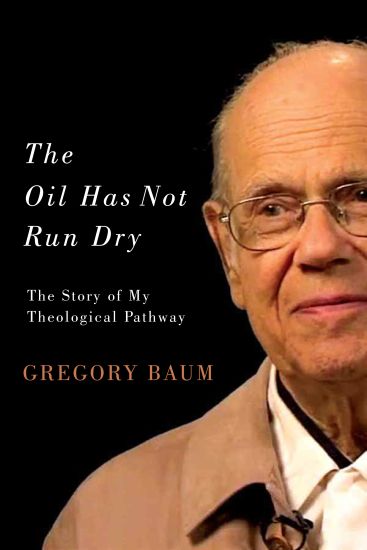
Born to a Jewish mother and Protestant father in 1923 Berlin, Gregory Baum has devoted his career to a humanistic approach to Catholicism. In The Oil Has Not Run Dry, Baum shares recollections about his lifelong commitment to theology, his atypical views, and his evolving understanding of the Catholic Church's message. Baum reflects on his groundbreaking work with the Second Vatican Council (1962-65) and how it helped to open the Church to a new understanding of outsiders - one that advocated cooperation with world religions in support of peace and justice and respected secular philosophies committed to truth and social solidarity. Later embracing Latin American liberation theology, he became a leading thinker of the Catholic Left in Canada, adopting radical positions that initially earned support from Canadian bishops in the 1970s. Diverging from official Catholic doctrines regarding women and sexual ethics, Baum eventually left the priesthood, but continued to teach theology and remained active in the Church. The Oil Has Not Run Dry also discusses the contrast between Catholicism in Quebec and English-speaking North America, and the ways in which Baum sees Quebec's culture as more marked by social solidarity. This significant difference has inspired his own writings which present the original development of Catholic thought in Quebec to an English-speaking readership.
The Oil Has Not Run Dry

The Oil Has Not Run Dry

Gregory Baum

McGill-Queen's University Press
2018
nidottu
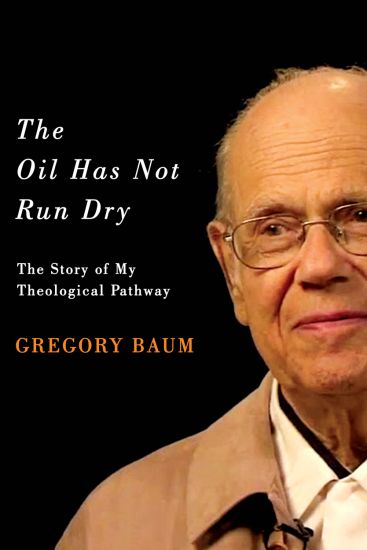
Born to a Jewish mother and Protestant father in 1923 Berlin, Gregory Baum devoted his career to a humanistic approach to Catholicism. In The Oil Has Not Run Dry, Baum shares recollections about his lifelong commitment to theology, his atypical views, and his evolving understanding of the Catholic Church’s message. Baum reflects on his groundbreaking work with the Second Vatican Council (1962-65) and how it helped to open the Church to a new understanding of outsiders - one that advocated cooperation with world religions in support of peace and justice and respected secular philosophies committed to truth and social solidarity. Later embracing Latin American liberation theology, he became a leading thinker of the Catholic Left in Canada, adopting radical positions that initially earned support from Canadian bishops in the 1970s. Diverging from official Catholic doctrines regarding women and sexual ethics, Baum eventually left the priesthood, but continued to teach theology and remained active in the Church. The Oil Has Not Run Dry also discusses the contrast between Catholicism in Quebec and English-speaking North America, and the ways in which Baum sees Quebec's culture as more marked by social solidarity. This significant difference has inspired his own writings, which present the original development of Catholic thought in Quebec to an English-speaking readership.
Compassion and Solidarity

Compassion and Solidarity

Gregory Baum

House of Anansi Press Ltd ,Canada
1992
pokkari
In the forthright style that has earned him a reputation for controversy, theologian Gregory Baum presents the Faith and Justice movement in the churches -- especially the Roman Catholic Church -- together with the considerable opposition to it. He discusses why many Christians are becoming activists, turning their faith into deeds by working for the liberation of the poor, not only in South America and the Third World but in Canada, as well. Baum argues for a new ecumenism, permitting a more representative opinion within the Church and, in a larger sense, for what he believes are the fundamentals of a "just society." He says that there is a new realization that God is on the side of the oppressed -- that Christians are here to help in the struggle for liberation.