Kirjojen hintavertailu. Mukana 11 627 362 kirjaa ja 12 kauppaa.

Kirjahaku

Etsi kirjoja tekijän nimen, kirjan nimen tai ISBN:n perusteella.

9 kirjaa tekijältä Gregory L. Naber

Spacetime and Singularities

Spacetime and Singularities

Gregory L. Naber

Cambridge University Press
1989
pokkari
This book is an elementary introduction to the geometrical methods and notions used in special and general relativity. Particular emphasis is placed on the ideas concerned with the structure of spacetime and those which play a role in the Penrose–Hawking singularity theorems. Indeed, the author’s prime purpose is to give a rigorous proof of the simplest of these theorems yet one which is representative of the whole. No previous exposure either to relativity theory or differential geometry is required to the reader, as necessary concepts are developed when needed, though in order to keep the presentation reasonably accessible, some restrictions are imposed on the types of space considered. Each chapter is liberally supplied with exercises and examples. The book will therefore be attractive to senior undergraduate and first year graduate students of mathematics and physics for independent study or courses preparatory to more advanced works.
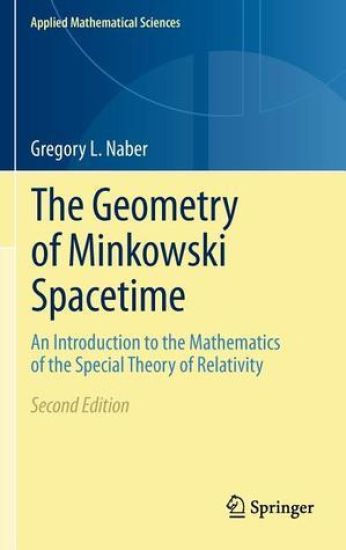
The Geometry of Minkowski Spacetime

The Geometry of Minkowski Spacetime

Gregory L. Naber

Springer-Verlag New York Inc.
2010
nidottu
This book offers a presentation of the special theory of relativity that is mathematically rigorous and yet spells out in considerable detail the physical significance of the mathematics. It treats, in addition to the usual menu of topics one is accustomed to finding in introductions to special relativity, a wide variety of results of more contemporary origin. These include Zeeman’s characterization of the causal automorphisms of Minkowski spacetime, the Penrose theorem on the apparent shape of a relativistically moving sphere, a detailed introduction to the theory of spinors, a Petrov-type classification of electromagnetic fields in both tensor and spinor form, a topology for Minkowski spacetime whose homeomorphism group is essentially the Lorentz group, and a careful discussion of Dirac’s famous Scissors Problem and its relation to the notion of a two-valued representation of the Lorentz group. This second edition includes a new chapter on the de Sitter universe which is intended to serve two purposes. The first is to provide a gentle prologue to the steps one must take to move beyond special relativity and adapt to the presence of gravitational fields that cannot be considered negligible. The second is to understand some of the basic features of a model of the empty universe that differs markedly from Minkowski spacetime, but may be recommended by recent astronomical observations suggesting that the expansion of our own universe is accelerating rather than slowing down. The treatment presumes only a knowledge of linear algebra in the first three chapters, a bit of real analysis in the fourth and, in two appendices, some elementary point-set topology. The first edition of the book received the 1993 CHOICE award for Outstanding Academic Title. Reviews of first edition: “… a valuable contribution to the pedagogical literature which will be enjoyed by all who delight in precise mathematics and physics.” (American Mathematical Society, 1993) “Where many physics texts explain physical phenomena by means of mathematical models, here a rigorous and detailed mathematical development is accompanied by precise physical interpretations.” (CHOICE, 1993) “… his talent in choosing the most significant results and ordering them within the book can’t be denied. The reading of the book is, really, a pleasure.” (Dutch Mathematical Society, 1993)
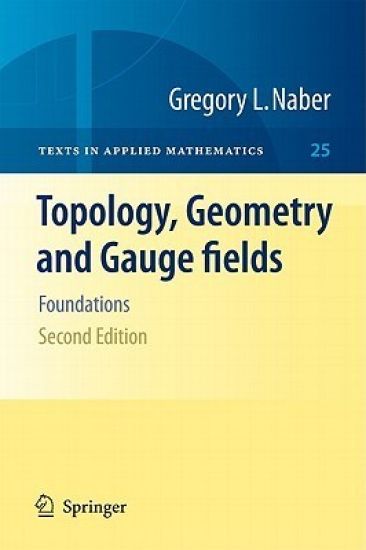
Topology, Geometry and Gauge fields

Topology, Geometry and Gauge fields

Gregory L. Naber

Springer-Verlag New York Inc.
2010
sidottu
This is a book on topology and geometry and, like any books on subjects as vast as these, it has a point-of-view that guided the selection of topics. Naber takes the view that the rekindled interest that mathematics and physics have shown in each other of late should be fostered and that this is best accomplished by allowing them to cohabit. The book weaves together rudimentary notions from the classical gauge theory of physics with the topological and geometrical concepts that became the mathematical models of these notions. We ask the reader to come to us with some vague notion of what an electromagnetic field might be, a willingness to accept a few of the more elementary pronouncements of quantum mechanics, a solid background in real analysis and linear algebra and some of the vocabulary of modern algebra. To such a reader we offer an excursion that begins with the definition of a topological space and finds its way eventually to the moduli space of anti-self-dual SU(2) connections on S4 with instanton number -1. Iwould go over both volumes thoroughly and make some minor changes in terminology and notation and correct any errors I find. In this new edition, a chapter on Singular Homology will be added as well as minor changes in notation and terminology throughout and some sections have been rewritten or omitted. Reviews of First Edition: “It is unusual to find a book so carefully tailored to the needs of this interdisciplinary area of mathematical physics...Naber combines a knowledge of his subject with an excellent informal writing style." (NZMS Newletter) "...this book should be very interesting for mathematicians and physicists (as well as other scientists) who are concerned with gauge theories." (Zentralblatt Fuer Mathematik)
The Geometry of Minkowski Spacetime

The Geometry of Minkowski Spacetime

Gregory L. Naber

Springer-Verlag New York Inc.
2011
sidottu
This book offers a presentation of the special theory of relativity that is mathematically rigorous and yet spells out in considerable detail the physical significance of the mathematics. It treats, in addition to the usual menu of topics one is accustomed to finding in introductions to special relativity, a wide variety of results of more contemporary origin. These include Zeeman’s characterization of the causal automorphisms of Minkowski spacetime, the Penrose theorem on the apparent shape of a relativistically moving sphere, a detailed introduction to the theory of spinors, a Petrov-type classification of electromagnetic fields in both tensor and spinor form, a topology for Minkowski spacetime whose homeomorphism group is essentially the Lorentz group, and a careful discussion of Dirac’s famous Scissors Problem and its relation to the notion of a two-valued representation of the Lorentz group. This second edition includes a new chapter on the de Sitter universe which is intended to serve two purposes. The first is to provide a gentle prologue to the steps one must take to move beyond special relativity and adapt to the presence of gravitational fields that cannot be considered negligible. The second is to understand some of the basic features of a model of the empty universe that differs markedly from Minkowski spacetime, but may be recommended by recent astronomical observations suggesting that the expansion of our own universe is accelerating rather than slowing down. The treatment presumes only a knowledge of linear algebra in the first three chapters, a bit of real analysis in the fourth and, in two appendices, some elementary point-set topology. The first edition of the book received the 1993 CHOICE award for Outstanding Academic Title. Reviews of first edition: “… a valuable contribution to the pedagogical literature which will be enjoyed by all who delight in precise mathematics andphysics.” (American Mathematical Society, 1993) “Where many physics texts explain physical phenomena by means of mathematical models, here a rigorous and detailed mathematical development is accompanied by precise physical interpretations.” (CHOICE, 1993) “… his talent in choosing the most significant results and ordering them within the book can’t be denied. The reading of the book is, really, a pleasure.” (Dutch Mathematical Society, 1993)
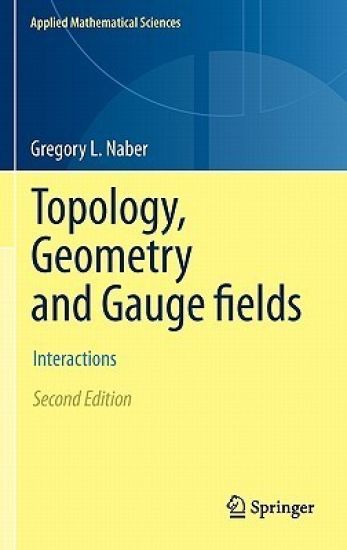
Topology, Geometry and Gauge fields

Topology, Geometry and Gauge fields

Gregory L. Naber

Springer-Verlag New York Inc.
2011
sidottu
A study of topology and geometry, beginning with a comprehensible account of the extraordinary and rather mysterious impact of mathematical physics, and especially gauge theory, on the study of the geometry and topology of manifolds. The focus of the book is the Yang-Mills-Higgs field and some considerable effort is expended to make clear its origin and significance in physics. Much of the mathematics developed here to study these fields is standard, but the treatment always keeps one eye on the physics and sacrifices generality in favor of clarity. This second edition has replaced a brief appendix in the first on the Seiberg-Witten equations with a much more detailed survey of Donaldson-Witten Theory and the Witten Conjecture regarding the relationship between Donaldson and Seiberg-Witten invariants.A large number of exercises are included to encourage active participation on the part of the reader.Review from first edition:"It is unusual to find a book so carefully tailored to the needs of this interdisciplinary area of mathematical physics...Naber combines a knowledge of his subject with an excellent informal writing style."SIAM REVIEW
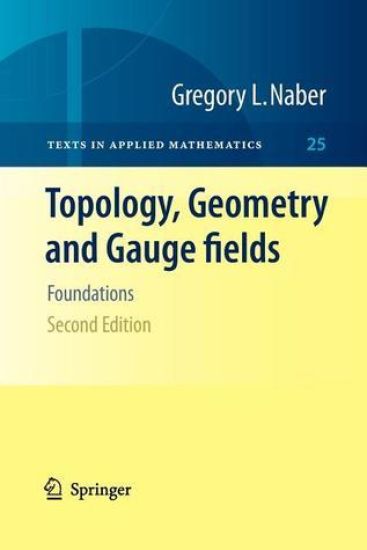
Topology, Geometry and Gauge fields

Topology, Geometry and Gauge fields

Gregory L. Naber

Springer-Verlag New York Inc.
2012
nidottu
This is a book on topology and geometry and, like any books on subjects as vast as these, it has a point-of-view that guided the selection of topics. Naber takes the view that the rekindled interest that mathematics and physics have shown in each other of late should be fostered and that this is best accomplished by allowing them to cohabit. The book weaves together rudimentary notions from the classical gauge theory of physics with the topological and geometrical concepts that became the mathematical models of these notions. We ask the reader to come to us with some vague notion of what an electromagnetic field might be, a willingness to accept a few of the more elementary pronouncements of quantum mechanics, a solid background in real analysis and linear algebra and some of the vocabulary of modern algebra. To such a reader we offer an excursion that begins with the definition of a topological space and finds its way eventually to the moduli space of anti-self-dual SU(2) connections on S4 with instanton number -1. Iwould go over both volumes thoroughly and make some minor changes in terminology and notation and correct any errors I find. In this new edition, a chapter on Singular Homology will be added as well as minor changes in notation and terminology throughout and some sections have been rewritten or omitted. Reviews of First Edition: “It is unusual to find a book so carefully tailored to the needs of this interdisciplinary area of mathematical physics...Naber combines a knowledge of his subject with an excellent informal writing style." (NZMS Newletter) "...this book should be very interesting for mathematicians and physicists (as well as other scientists) who are concerned with gauge theories." (Zentralblatt Fuer Mathematik)
Topology, Geometry and Gauge fields

Topology, Geometry and Gauge fields

Gregory L. Naber

Springer-Verlag New York Inc.
2013
nidottu
A study of topology and geometry, beginning with a comprehensible account of the extraordinary and rather mysterious impact of mathematical physics, and especially gauge theory, on the study of the geometry and topology of manifolds. The focus of the book is the Yang-Mills-Higgs field and some considerable effort is expended to make clear its origin and significance in physics. Much of the mathematics developed here to study these fields is standard, but the treatment always keeps one eye on the physics and sacrifices generality in favor of clarity. This second edition has replaced a brief appendix in the first on the Seiberg-Witten equations with a much more detailed survey of Donaldson-Witten Theory and the Witten Conjecture regarding the relationship between Donaldson and Seiberg-Witten invariants.A large number of exercises are included to encourage active participation on the part of the reader.Review from first edition:"It is unusual to find a book so carefully tailored to the needs of this interdisciplinary area of mathematical physics...Naber combines a knowledge of his subject with an excellent informal writing style."SIAM REVIEW
The Geometry of Minkowski Spacetime

The Geometry of Minkowski Spacetime

Gregory L. Naber

Springer-Verlag New York Inc.
2014
nidottu
This book offers a presentation of the special theory of relativity that is mathematically rigorous and yet spells out in considerable detail the physical significance of the mathematics. It treats, in addition to the usual menu of topics one is accustomed to finding in introductions to special relativity, a wide variety of results of more contemporary origin. These include Zeeman’s characterization of the causal automorphisms of Minkowski spacetime, the Penrose theorem on the apparent shape of a relativistically moving sphere, a detailed introduction to the theory of spinors, a Petrov-type classification of electromagnetic fields in both tensor and spinor form, a topology for Minkowski spacetime whose homeomorphism group is essentially the Lorentz group, and a careful discussion of Dirac’s famous Scissors Problem and its relation to the notion of a two-valued representation of the Lorentz group. This second edition includes a new chapter on the de Sitter universe which is intended to serve two purposes. The first is to provide a gentle prologue to the steps one must take to move beyond special relativity and adapt to the presence of gravitational fields that cannot be considered negligible. The second is to understand some of the basic features of a model of the empty universe that differs markedly from Minkowski spacetime, but may be recommended by recent astronomical observations suggesting that the expansion of our own universe is accelerating rather than slowing down. The treatment presumes only a knowledge of linear algebra in the first three chapters, a bit of real analysis in the fourth and, in two appendices, some elementary point-set topology. The first edition of the book received the 1993 CHOICE award for Outstanding Academic Title. Reviews of first edition: “… a valuable contribution to the pedagogical literature which will be enjoyed by all who delight in precise mathematics andphysics.” (American Mathematical Society, 1993) “Where many physics texts explain physical phenomena by means of mathematical models, here a rigorous and detailed mathematical development is accompanied by precise physical interpretations.” (CHOICE, 1993) “… his talent in choosing the most significant results and ordering them within the book can’t be denied. The reading of the book is, really, a pleasure.” (Dutch Mathematical Society, 1993)
Quantum Mechanics

Quantum Mechanics

Gregory L. Naber

De Gruyter
2021
isokokoinen pokkari
This work covers quantum mechanics by answering questions such as where did the Planck constant and Heisenberg algebra come from, what motivated Feynman to introduce his path integral and why does one distinguish two types of particles, the bosons and fermions. The author addresses all these topics with utter mathematical rigor. The high number of instructive Appendices and numerous Remark sections supply the necessary background knowledge.